
Sailing subjects gear to extreme conditions. Salt spray corrodes hardware. Heavy waves slam against fabric. Constant exposure to sun degrades inferior plastics.
If you source low-grade waterproof bags, seams split and glues fail. A single leak ruins electronics, damages your reputation, and leads to costly product returns.
At Weierken, we have manufactured heavy-duty waterproof gear since 2006. Over the past 20 years, our factories have supplied OEM and ODM solutions to more than 2,000 global brands.
Building high-performance private label sailing backpacks requires strict engineering standards. Here is a direct breakdown of the five technical specs your products need and how to source them efficiently.
1. Eco-Friendly TPU Double-Sided Lamination
Traditional dry bags rely on PVC coatings. PVC works for light outdoor recreation, but it cracks in cold weather, smells chemically, and contains harmful phthalates. European and North American consumers increasingly reject PVC products.
For professional sailing gear, thermoplastic polyurethane (TPU) double-sided lamination is the industry standard. TPU offers superior tear resistance, high flexibility, and excellent anti-UV properties.
Technical Fabric Requirements
Base Material: High-tenacity 840D or 600D Nylon or Polyester woven substrate.
Coating Method: Double-sided TPU lamination for zero water permeability.
Environmental Standards: Full compliance with EU REACH and RoHS regulations.
Weierken prioritizes sustainable design across all production lines. We source eco-friendly TPU compounds that meet global chemical safety standards. This allows your brand to enter premium markets without regulatory hurdles.
2. Seamless High-Frequency (RF) Welding
Standard sewing machines use needles. Every needle puncture creates a potential leak path in waterproof fabric. Taping over stitched seams works temporarily, but salt water and flexing eventually degrade the adhesive.
Professional private label sailing backpacks must use high-frequency radio frequency (RF) welding instead of traditional stitching.
How RF Welding Works
RF welding passes electromagnetic energy through the material. This energy excites the molecules within the TPU layers, melting them together under mechanical pressure.
The result is a single fused seam that is stronger than the surrounding fabric itself. It creates a 100% airtight barrier without a single needle hole.
Weierken operates an 80,000+ square meter manufacturing footprint with over 3,000 skilled workers. Our modern facilities house high-precision RF welding machinery capable of maintaining uniform seam pressure across high-volume production runs.
3. IPX8 Airtight Zippers and Roll-Top Systems
Water intrusion happens most often at closure points. Depending on your target retail price and user base, you must select the right closure architecture.
Closure Options for Sailing Gear
Roll-Top Closure: Uses a 3-roll system secured with side-release buckles. Simple, reliable, and cost-effective for general marine use.
IPX8 Pressure-Proof Zippers: Uses airtight TPU teeth and fully sealed stops. Keeps gear dry even during complete immersion in deep water.
Our experienced R&D engineering team evaluates your target bill of materials (BOM) cost and performance needs. We help you design hybrid layouts, such as an airtight main compartment paired with splash-proof exterior pockets.
4. Laboratory-Grade IPX7 and IPX8 Waterproof Testing
Marketing a bag as "waterproof" without third-party lab validation creates legal liability. Marine gear must meet recognized Ingress Protection (IP) standards.
Understanding Key Ratings
IPX7: Prevents water entry when submerged at 1 meter depth for 30 minutes.
IPX8: Prevents water entry under deeper continuous submersion specified by the manufacturer.
Quality control cannot rely on visual inspection alone. A tiny gap in a welded seam is invisible to the human eye.
Weierken enforces a strict internal Quality Control (QC) protocol. Before packing, our factory subjects inflated bag batches to pressure retention and underwater leak tests, ensuring zero-defect deliveries to your warehouse.
5. Marine-Grade Hardware and Smart Drainage Systems
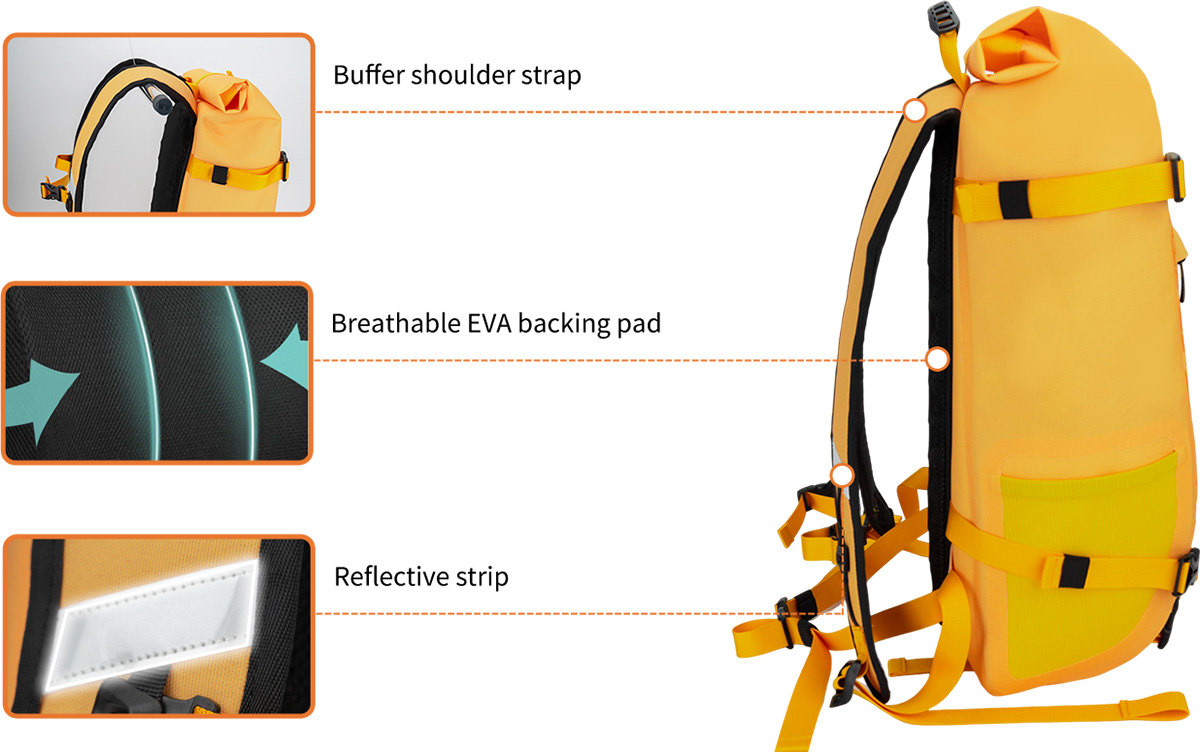
Saltwater destroys basic hardware. Cheap metal sliders rust within days, and low-grade plastic buckles turn brittle under direct sunlight.
A true sailing pack requires specialized components engineered for ocean environments.
Hardware & Feature Standards
Hardware Material: Marine-grade 316 stainless steel or reinforced acetal hardware from brands like Duraflex or ITW.
Smart Drainage: Exterior mesh storage zones with bottom-mounted drain grommets to isolate wet ropes and jackets from clean interior gear.
Design Style: Simple, functional, and timeless aesthetics that resist fast fashion trends.
Weierken integrates functional simplicity with marine-grade materials, balancing sleek aesthetic lines with industrial utility.
Why Global Brands Source Private Label Sailing Backpacks with Weierken
Designing a great bag spec is only half the battle. You also need a reliable supply chain partner to manufacture it at scale.
Here is why top outdoor and marine brands choose Weierken as their preferred OEM waterproof backpack manufacturer.
Dual-Base Manufacturing: China + Cambodia
Trade policies and tariffs directly impact your profit margins. US importers face high Section 301 tariffs on Chinese bag imports.
Weierken operates three self-owned factories across China and Cambodia. Our Cambodia bag factory offers strategic tariff relief for North American clients, helping you reduce duty costs significantly.
Meanwhile, our China manufacturing facilities handle complex technical builds and leverage complete local raw material supply chains. This dual-base setup gives your brand supply chain resilience, flexible capacity, and cost protection.
Fast R&D Turnaround
Speed to market matters. Our in-house research and development team transforms your design sketches or tech packs into physical prototypes in as few as 7 days.
Complete OEM and ODM Customization
We turn your concept into market-ready inventory with end-to-end customization services:
Custom logo placement via high-frequency embossing, screen printing, or rubber badge placement.
Custom Pantone color matching for TPU fabrics, webbing, and zippers.
Tailored retail packaging, hangtags, and eco-friendly polybags.
Build Your Next Marine Line with Confidence
Launching successful private label sailing backpacks requires the right technical specs: eco-friendly TPU fabrics, seamless RF welding, airtight closures, verified IPX testing, and salt-resistant hardware.
It also requires a manufacturing partner who understands ocean-going standards and supply chain management.
Weierken brings 20 years of factory expertise, sustainable manufacturing practices, and tariff-optimized production to your business.
Ready to launch your waterproof sailing bag line? Contact our engineering team today to request a technical consultation, CAD review, and free product quote.
Frequently Asked Questions (FAQ)
1. What is the minimum order quantity (MOQ) for private label sailing backpacks?
Our typical MOQ starts at 500 to 1,000 units per style or colorway, depending on custom fabric choices and material availability. Contact our sales team to discuss specific custom production runs.
2. How does manufacturing in Cambodia lower import tariffs for US buyers?
Goods fully produced in our Cambodia bag factory can enter the US market under different tariff classifications, helping buyers avoid the additional Section 301 tariffs applied to goods origin-labeled from China.
3. What is the difference between PVC and TPU for waterproof dry bags?
TPU is lighter, more flexible in cold weather, highly abrasion-resistant, and significantly more eco-friendly than PVC. TPU contains no toxic phthalates and meets strict global chemical regulations like REACH and RoHS.
4. Can Weierken customize bag sizes, features, and target price points?
Yes. As a full-service OEM/ODM manufacturer, we customize overall dimensions, pocket configurations, hardware selection, and strap designs. Our R&D team works directly with you to match your target BOM cost.
5. How do you test the waterproof capability of each production batch?
We perform rigorous quality control checks during manufacturing. We conduct 100% inflation retention tests on sealed chambers and perform IPX7/IPX8 submersion testing on production batch samples before packing.
6. What is the lead time for sampling and mass production?
Sample creation takes roughly 7 to 10 days after design approval. Mass production lead time is typically 35 to 45 days after sample sign-off and deposit receipt, depending on seasonal volume.