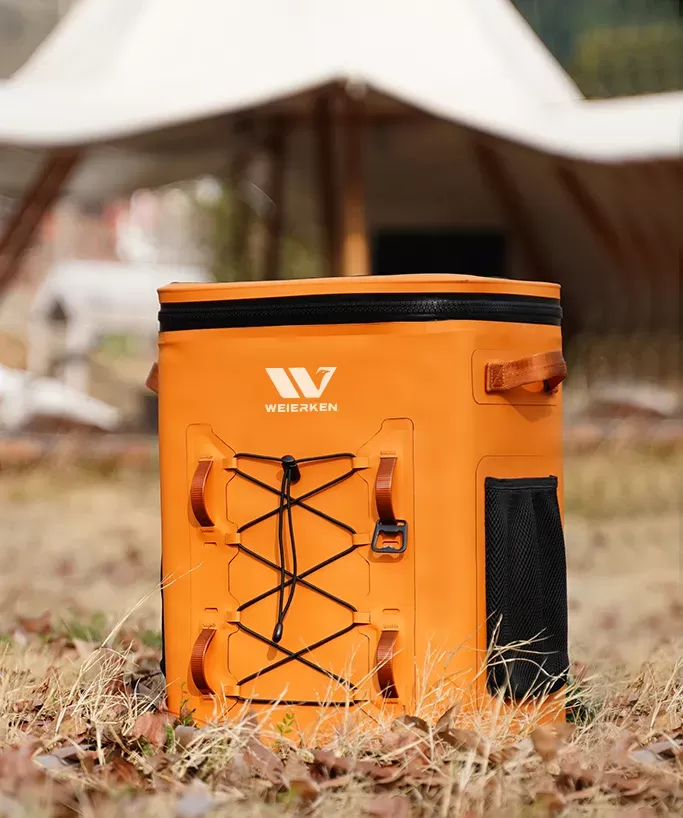

Fishing deck bags face the harshest working conditions in the marine luggage sector. Bolted or strapped to the bow of a center console, kayak, or stand-up paddleboard, they endure punishing saltwater spray, hours of blazing UV radiation, sharp hook punctures, and corrosive fish blood. Standard cut-and-sew bag makers cannot build products that survive this environment. Stitched seams rot, cheap zippers seize with salt crust, and water enters the main compartment, ruining thousands of dollars in tackle and marine electronics.
For outdoor and marine brands, sourcing a waterproof fishing deck bag supplier requires vetting capabilities beyond simple assembly. You need an engineering partner that understands marine materials, watertight welding, and international trade dynamics. With over two decades of technical manufacturing experience, Weierken highlights six non-negotiable OEM services your supply partner must deliver to protect your brand reputation and product margins.
1. Custom Hull-Fitting 3D Engineering & Rapid Prototyping
Deck spaces vary drastically across vessels. A kayak bow has a sharp, tapered profile; a flats skiff features an open flat deck; a pontoon boat demands wide, low-profile storage. A generic square bag creates drag, pools stagnant water, and slips under heavy wake.
A capable OEM boat deck bag manufacturer must offer in-house industrial design and rapid prototyping services. The engineering team should configure your bag with specialized marine-fit features:
Contoured Base Profiles: Tapered geometry matching standard kayak front hatches and boat bow angles.
Compression-Molded EVA Bases: Anti-slip bottoms with integrated drainage channels to prevent standing water contact.
Modular Anchor Systems: Reinforced D-ring matrices, quick-release cam buckles, and low-profile bungee routing systems that resist 50+ knot wind shear.
Speed to market matters. Top manufacturers run dedicated prototyping labs that translate your 3D CAD files or rough sketches into fully functional, water-tested prototypes in 12 to 30 days. This rapid turnaround allows your team to conduct real-world sea trials, make structural adjustments, and finalize production tooling before seasonal sales windows close.
2. Industrial High-Frequency (RF) Seam Welding Mastery
Traditional needle-and-thread stitching creates thousands of micro-perforations in the fabric. While basic waterproof tape can seal these holes temporarily, salt exposure, flexing, and temperature cycles degrade the adhesive. Within months, traditional bags leak along the bottom seams.
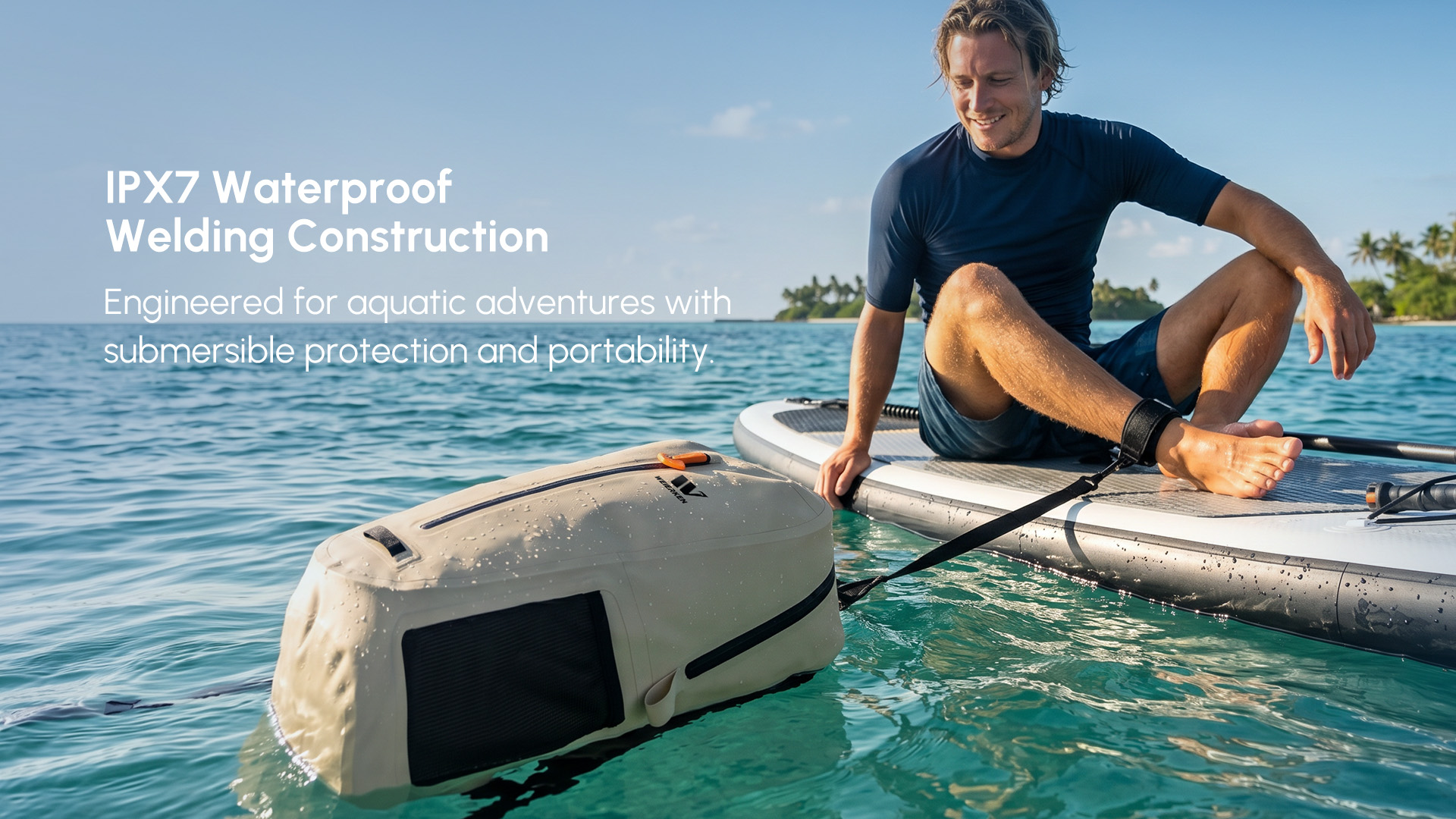
A true high-frequency welded deck bag factory eliminates needle stitching completely in critical water-barrier zones. Radio Frequency (RF) and High-Frequency (HF) welding use electromagnetic energy and targeted pressure to fuse thermoplastic-coated fabrics at the molecular level. The result is a monolithic joint that is as strong as—or stronger than—the raw material itself.
Your supplier should clearly distinguish between different waterproof ingress protection levels across the bag build:
IPX6 Stormproof Construction: Built with welded seams and heavy-duty splashproof roll-tops or splash-resistant water-guard zippers to deflect continuous heavy wave spray.
IPX7 Submersible Pockets: Built with pressure-welded waterproof zippers that prevent water ingress even when fully submerged during a kayak rollover or rough sea boarding.
Precision tooling is critical here. Inexperienced factories often burn the thermoplastic coating or leave micro-voids at 3D corner intersections. Verify that your partner operates automated multi-axis welding machines to maintain consistent pressure and temperature on complex curved deck bag panels.
3. Marine-Grade Material Science & Customization
The open ocean destroys cheap polymers. Salt crystals accelerate abrasion, while ultraviolet radiation breaks down plasticizers, turning inferior bags brittle and sticky. A specialized saltwater proof boat bag supplier must provide lab-certified marine materials tailored to your price point and performance tier.
Demanding fishing environments call for specific technical fabrics:
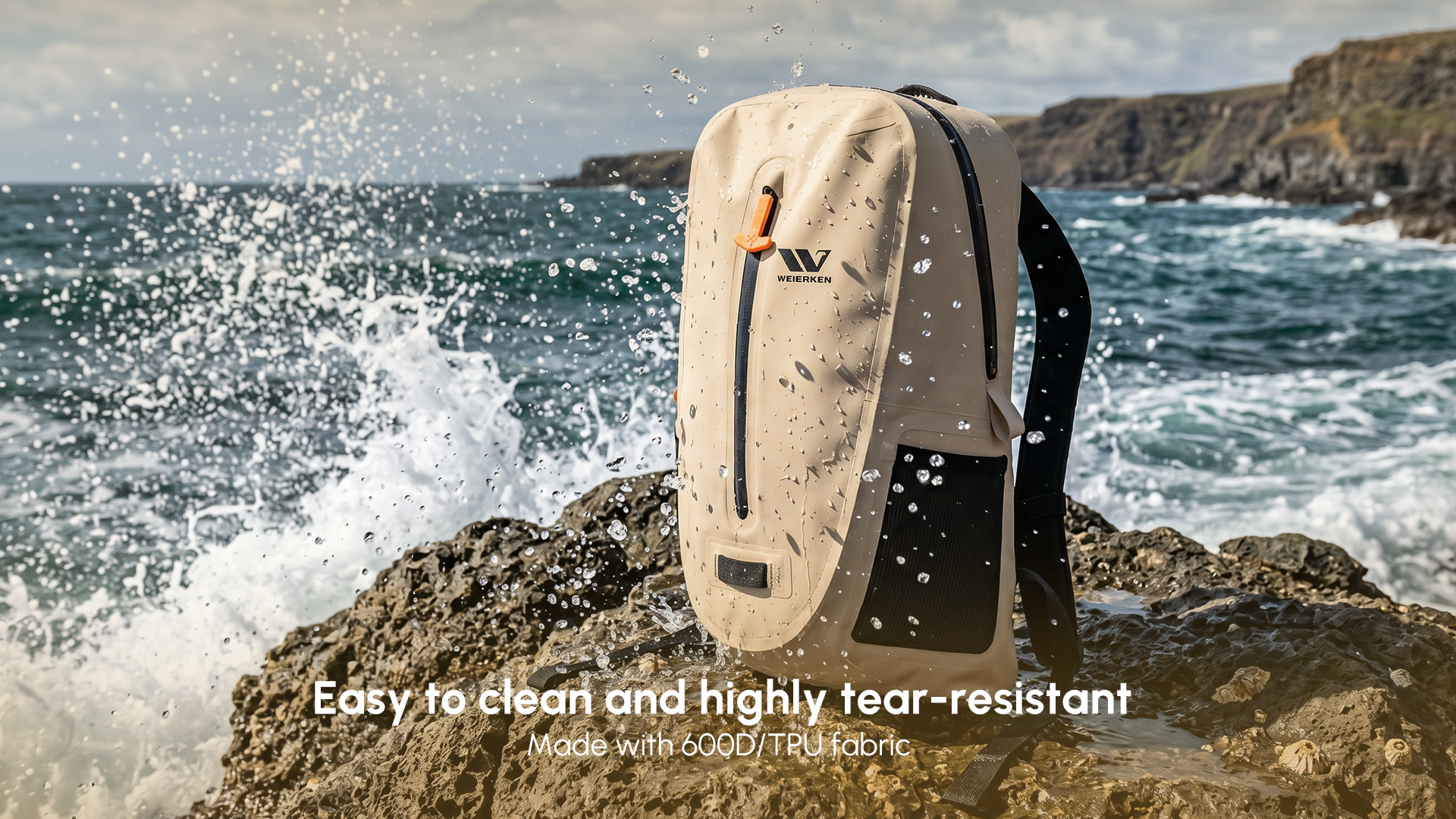
840D / 1000D TPU-Coated Nylon: The gold standard for premium marine gear. Double-sided Thermoplastic Polyurethane (TPU) provides extreme tear resistance, remains flexible in near-freezing water, and resists saltwater hydrolysis.
Heavy-Duty PVC Tarpaulin: An economical, highly durable option for commercial charter deck bags, offering excellent puncture resistance against fish spines and gaff hooks.
Anti-Microbial / Easy-Clean Liners: Internal fabric coatings that resist fish slime, blood stains, and mildew growth, allowing anglers to wash the bag out with a hose without damaging internal layers.
UV 50+ Stabilized Exterior Coatings: Proprietary compound treatments that prevent color fading and surface chalking under intense marine sunlight.
Environmental compliance is equally essential. Premium suppliers now offer Global Recycled Standard (GRS) certified rPET fabrics combined with non-toxic, PVC-free TPU laminations. Ensure your supplier provides complete test reports for EU REACH, RoHS, and California Proposition 65 to avoid import blockades.
4. 100% Watertight Quality Control with 99.5% First-Pass Yield
A single leaking deck bag can destroy a customer’s phone, car keys, or high-end tackle boxes. Anglers do not forgive waterproof failures, and high return rates will destroy your margins on e-commerce channels. Your manufacturing partner must enforce multi-stage, data-driven quality control protocols rather than spot-checking finished goods.
Look for an OEM partner that guarantees a 99.5% first-pass inspection yield backed by verifiable testing phases:
Raw Material Hydrostatic Head Testing: Verifying water column resistance (exceeding 10,000mm to 20,000mm) before fabric rolls reach the cutting tables.
Positive Pressure Decay Testing: Sealing finished airtight compartments, inflating them to target PSI, and monitoring pressure drop over time to detect microscopic seam leaks.
Hardware Salt Spray Testing: Exposing 316 stainless steel D-rings, anodized aluminum clips, and nylon buckle hardware to ASTM B117 salt fog chambers for 72 to 120 hours to guarantee zero corrosion.
Zipper Cycle & Tensile Stress Checks: Pull-testing welded grab handles and structural straps to 30+ kg loads to prevent blowout when lifting fully loaded bags off the boat.
At Weierken, quality control stations are integrated directly onto the assembly floor, ensuring that every custom marine waterproof gear bag undergoes physical leak validation before final packing.
5. Dual-Hub Manufacturing: China R&D + Cambodia Tariff Relief
Global supply chain volatility and regional tariffs create massive pricing pressure for outdoor brands. Importing specialized technical bags from China into North American or European markets can carry heavy customs duties (often 17.6% to over 25% under Section 301 tariffs). Relying on a single manufacturing location leaves your business vulnerable to trade policy changes and local disruptions.
Leading suppliers solve this problem through a synchronized dual-hub production model:
China Innovation Hub: Houses engineering, advanced mold development, complex RF welding prototyping, and rapid raw material sourcing.
Cambodia Mass Production Base: Handles large-scale cutting, high-frequency welding, and automated assembly. Cambodia benefits from favorable trade terms with many Western nations, helping you reduce landed import costs.
This dual-facility framework gives your brand supply chain agility. You get the fast prototyping and advanced technical tooling of China’s top engineers, combined with the significant tariff advantages and lower labor costs of a Southeast Asian production hub. Make sure your supplier maintains standardized quality systems and matching machinery across both facilities so that mass-production runs from Cambodia match the golden samples approved in China.
6. Turnkey DDP Delivery & Complete Factory Compliance
Sourcing overseas can drain internal resources if your team has to spend hours coordinating freight forwarders, clearing customs, and resolving port delays. A full-service waterproof fishing deck bag supplier acts as an extension of your logistics department by offering end-to-end Delivered Duty Paid (DDP) services.
A turnkey project management service should include:
Direct-to-Warehouse Logistics: Managing container booking, marine insurance, ocean transit, customs clearance, and inland trucking straight to your 3PL or distribution hub.
Dedicated Bilingual Project Managers: Direct communication with technical engineers who track production milestones and update digital schedules weekly.
International Social & Factory Audits: Verified certifications including BSCI, SEDEX (SMETA), and ISO 9001. These accreditations are mandatory if you plan to distribute your products through major retail channels such as Bass Pro Shops, REI, West Marine, or Decathlon.
When your supplier handles the complete chain from mold development to duty clearance, you free up your internal team to focus on product marketing, athlete endorsements, and expanding distribution channels.
Frequently Asked Questions (FAQ)
Q1: What is the main difference between an IPX6 and an IPX7 waterproof fishing deck bag?
An IPX6 deck bag is built to withstand high-pressure, heavy breaking waves and driving rain from any angle. It typically utilizes roll-top closures or heavy water-deflecting zip flaps. An IPX7 deck bag is fully submersible; it uses specialized airtight/watertight zippers and welded seams that prevent water entry even if the bag is pulled underwater up to 1 meter for 30 minutes, making it ideal for a waterproof kayak tackle deck pack.
Q2: Why is TPU preferred over traditional PVC for premium marine fishing bags?
While PVC is economical, TPU (Thermoplastic Polyurethane) offers superior abrasion resistance, better flex-crack resistance in cold weather, and higher UV stability. TPU does not contain liquid plasticizers, meaning it will not dry out, smell, or become brittle over years of sun and saltwater exposure. TPU can also be bonded to recycled nylon or polyester for eco-friendly product lines.
Q3: What is the standard Minimum Order Quantity (MOQ) for custom OEM deck bags?
Standard production MOQs for fully custom deck bags typically start around 500 to 1,000 units per colorway. This minimum is dictated by custom fabric dye lots and dedicated RF welding tooling setups. For established brands looking to split production between multiple SKUs, flexible suppliers can often negotiate tiered minimums across shared material platforms.
Q4: How does Weierken ensure that deck bag zippers do not seize up from dried saltwater?
We source heavy-gauge, self-lubricating polyacetal (POM) tooth zippers, marine-grade continuous water-repellent zippers, or fully airtight polymer zippers. None of these use corrodible metals in the track mechanism. In addition, pull tabs are constructed from molded TPU cords or 316 stainless steel components to ensure smooth operation even after heavy salt crystallization.
Q5: Can you manufacture custom deck bags using recycled ocean-bound plastics?
Yes. Weierken supports sustainable product initiatives by sourcing certified GRS (Global Recycled Standard) rPET nylon and polyester fabrics. These fabrics are woven from post-consumer recycled plastic bottles and coated with non-toxic TPU, allowing your brand to market high-performance marine gear with a significantly lower carbon footprint.
Q6: How long does the tooling and sampling process take for a new design?
From the moment you provide technical drawings or sample references, 3D CAD modeling and initial pattern layouts take roughly 3 to 7 days. Fabricating custom high-frequency welding copper molds takes about 7 to 10 days. A complete, factory-tested golden sample is typically delivered to your door within 12 to 30 days.
Partner with a Proven Waterproof Gear Manufacturer
Building a marine deck bag that withstands salt, sun, and rough seas requires advanced engineering, automated welding lines, and rigorous quality control. Settling for a generic cut-and-sew factory introduces serious risks of product failure, brand damage, and expensive customer returns.
Weierken delivers end-to-end OEM and ODM manufacturing solutions for leading outdoor and marine brands worldwide. From rapid 3D prototyping and specialized RF seam welding to high-capacity, tariff-advantaged production in our Cambodia facilities, we supply gear built for demanding environments.
Ready to develop your next generation of marine-grade deck bags? Contact the Weierken engineering team today to review your tech pack, request material swatches, and secure a detailed manufacturing quotation.