
Many factories claim their bags are waterproof. Yet, most of these products only resist light rain or quick splashes (IPX4 to IPX6 rating). If a bag leaks during a complete underwater submersion test, your brand faces massive return rates and damaged customer trust.
At Weierken, we frequently meet buyers who suffered product failures after sourcing from unverified trading firms. Finding a genuine IPX7 waterproof bag manufacturer requires looking far beyond attractive sales presentations and cheap pricing.
This checklist outlines seven essential criteria to evaluate prospective factories. Use these standards to filter out unqualified suppliers, protect your product quality, and secure reliable mass production.
1. High-Frequency Welding Technology and Machinery
Traditional needle stitching leaves thousands of tiny holes in fabric. Even when covered with seam-sealing tape, stitched seams often fail under continuous water pressure. True IPX7 performance requires high-frequency welding technology.
High-Frequency (RF) welding uses electromagnetic energy to melt thermoplastic materials at the molecular level. This process creates a seamless, airtight bond that is just as strong as the original fabric itself.
RF Welding Equipment: Verify if the factory owns dedicated high-frequency welding machines, hot-air seam sealers, and laser cutters.
Airtight Zipper Integration: Check whether the factory can weld airtight zippers smoothly without heat distortion or material puckering.
Roll-Top Sealing Systems: Ensure they master multi-fold roll-top designs reinforced with high-density TPU strips.
Ask prospective suppliers to send video footage of their high-frequency welding workshop. Pay close attention to how they handle complex corner joints where leaks usually occur.
2. Rigorous Air and Water Tightness Testing Protocols
Never rely solely on static PDF test reports. A professional IPX7 waterproof bag manufacturer conducts continuous testing directly on the factory floor, long before goods reach final packaging.
To pass IPX7 standards, a bag must remain completely dry inside when submerged under 1 meter of water for 30 minutes. Top-tier manufacturers run systematic tests at every production stage.
Inflation Pressure Testing: The factory inflates sealed bags with air to 2–3 PSI and monitors them for 24 hours to detect micro-leakage.
Hydrostatic Head Testing: Equipment measures fabric coating water resistance under extreme hydraulic pressure.
Submersion Tank Testing: Dedicated water tanks simulate immersion depths to verify actual waterproof bag sealing performance.
Inquire if the factory offers 100% full-inspection for airtight zip bags or if they only run random sample checks. For zero-defect requirements, full air-retention testing is mandatory.
3. Raw Material Selection and Environmental Compliance
Fabric quality dictates the durability and long-term waterproof integrity of your product. Cheap materials tear, crack, or delaminate after limited sun and water exposure.
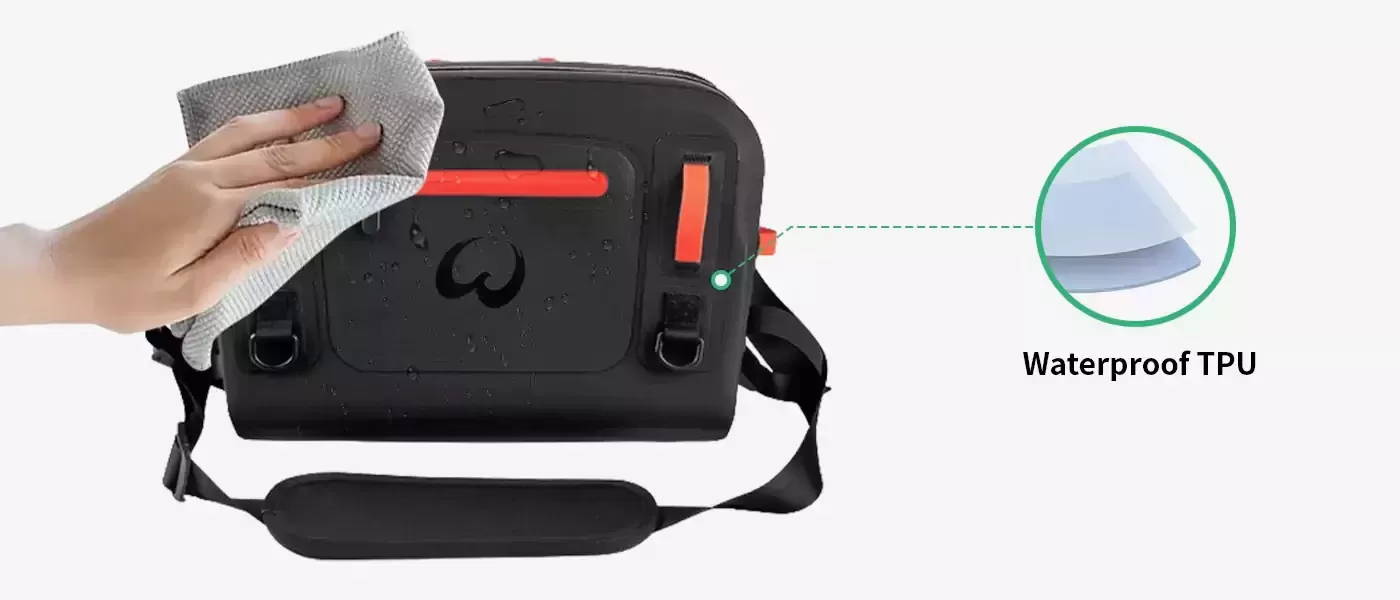
PVC (Polyvinyl Chloride) is affordable, but it hardens in cold weather and releases harmful phthalates. TPU (Thermoplastic Polyurethane) is the clear material choice for premium IPX7 dry bags.
Material Options: Look for factories that source TPU-laminated 420D/840D nylon, TPU polyester, or heavy-duty PVC tarpaulin.
Coating Adhesion: Ensure the TPU layer adheres tightly to the base fabric without peeling during repetitive folding.
Eco-Compliance: Confirm that fabrics comply with target market regulations like REACH (EU), RoHS, and California Proposition 65 (US).
Ask the factory for raw material swatch books and material safety data sheets (MSDS). Reliable suppliers maintain strong relationships with premium textile mills to ensure batch-to-batch color and thickness consistency.
4. OEM/ODM R&D and Rapid Prototyping Capabilities
Custom IPX7 bag manufacturing involves intricate mold development. A single alignment error on a welding die will cause seal leaks across an entire production batch.
Working with an experienced factory like Weierken simplifies product development. An expert engineering team helps convert your rough concept sketches or 2D tech packs into market-ready physical samples efficiently.
Structural Engineering Team: Check if the factory employs dedicated CAD designers and pattern engineers who understand RF tooling physics.
Custom Mold Development: Verify their capacity to design custom aluminum welding dies, zipper dock molds, and ergonomically molded handles.
Sampling Speed: Confirm standard prototype lead times. A capable manufacturer usually delivers paper patterns and functional samples in 5 to 10 days.
Review their past custom projects. Pay special attention to high-stress points, such as shoulder strap anchors and carry handle welds, to see how they reinforce critical structural areas.
5. Factory Certifications and Authentic Third-Party Audits
Certifications separate real manufacturing plants from unverified brokers. Sourcing managers must verify that the factory holds internationally recognized quality management and social compliance certificates.
Audits give you peace of mind that your products are made under fair working conditions and rigid quality management frameworks.
ISO 9001: Proves that the facility maintains a standardized, repeatable quality management system.
BSCI or Sedex (SMETA): Verifies ethical labor standards, safe factory working conditions, and environmental compliance.
Third-Party IPX7 Reports: Request test reports issued by independent laboratories such as SGS, TÜV, or Bureau Veritas (BV).
Always inspect the company name, factory address, and product photographs inside third-party test reports. Ensure the document belongs directly to the factory you plan to hire, rather than an unrelated subcontractor.
6. Strict Quality Control Systems and Defect Rate Control
Waterproof bags offer zero margin for error. A minor seam leak destroys the user's electronic devices inside, resulting in negative product reviews and potential warranty claims.
Partner with an IPX7 waterproof bag manufacturer that implements strict Acceptable Quality Limit (AQL) standards throughout the entire manufacturing process.
IQC (Incoming Quality Control): Inspects raw fabric rolls, zipper pullers, buckles, and webbing before production starts.
IPQC (In-Process Quality Control): Monitors high-frequency welding temperature, dwell time, and pressure settings hourly.
FQC (Final Quality Control): Performs final appearance checks, seam strength checks, and submersion tests on finished goods.
Ask the factory for their historical defect rate figures. A qualified manufacturer keeps mass production defect rates strictly below 0.5%.
7. Production Capacity, MOQ Flexibility, and Supply Chain Stability
Outdoor gear demands swing dramatically between peak and off-peak seasons. Deliveries delayed by weeks during peak spring sales can cripple your yearly profit margins.
Assess prospective suppliers' manufacturing capacity to confirm they can scale production smoothly when your order volume grows.
Monthly Output: Determine their monthly production volume (for example, 50,000 to 100,000 waterproof bags per month).
Minimum Order Quantity (MOQ): Ask about custom order MOQs for custom-dyed fabrics versus standard stock material colors.
Supply Chain Control: Check how well they manage raw material inventory to buffer against TPU resin price fluctuations and extended lead times.
A stable factory maintains inventory reserves of high-grade TPU fabrics and airtight zippers. This cushion keeps your pricing stable and protects your delivery schedules from global market volatility.
Choosing the right factory requires looking beyond the initial price quote. Focus on proven welding machinery, rigorous air-testing standards, material compliance, and strict quality control systems.
As a specialized IPX7 waterproof bag manufacturer, Weierken helps brands, Amazon sellers, and corporate buyers design, test, and mass-produce high-performance dry gear that survives extreme environments.
Protect your product line from costly leak defects and shipping delays today. Contact our technical team to discuss your project requirements, request a free sample, or get an accurate quotation within 24 hours.
Frequently Asked Questions (FAQ)
1. What is the difference between IPX6 and IPX7 waterproof bags?
IPX6 rated bags withstand powerful, high-pressure water jets from any angle but cannot survive complete underwater submersion. IPX7 rated bags can be fully submerged under 1 meter of water for up to 30 minutes without allowing any water ingress.
2. Why is TPU preferred over PVC for IPX7 waterproof bags?
TPU offers higher tensile strength, superior abrasion resistance, and excellent flexibility in sub-zero temperatures. Unlike PVC, TPU is non-toxic, eco-friendly, and free from hazardous plasticizers, making it the preferred material for premium outdoor brands.
3. How long does custom mold tooling take for an IPX7 dry bag?
Developing custom aluminum welding dies and injection molds for airtight zipper docks typically takes 15 to 25 days, depending on structural complexity. Once molds are ready, factories can produce functional pre-production samples within 5 to 7 days.
4. What is the typical MOQ when ordering from an IPX7 waterproof bag manufacturer?
Most OEM factories require a Minimum Order Quantity (MOQ) of 500 to 1,000 pieces per style for standard factory stock fabric colors. If your project requires custom fabric Pantone color dyeing, MOQs usually start at 1,500 to 2,000 pieces.
5. How can I verify if an IPX7 test report is genuine?
Request the official report number and clear laboratory contact details from the manufacturer. You can verify the report directly on the issuing agency's official website (such as SGS, TÜV, or BV) or email the lab directly to confirm report authenticity.