
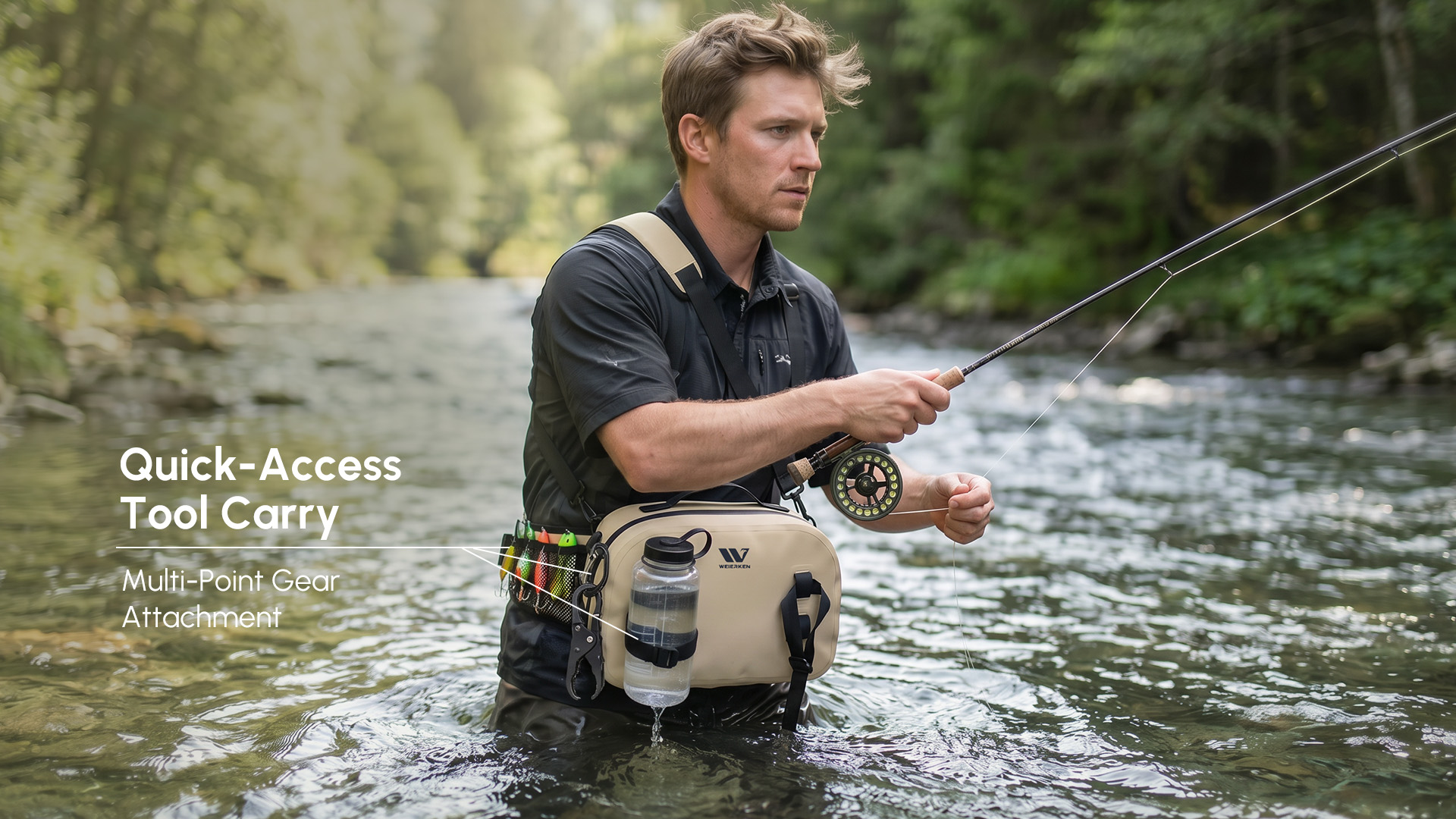
Fishing sling packs have quickly become a staple for both fly fishing and lure anglers. Anglers want mobility. They wade through rushing rivers, hike overgrown banks, and leap across rocky shores. A traditional backpack forces them to stop and take it off. A sling bag, however, glides smoothly from the back to the chest in a single motion.
Because of this booming demand, many brands source cheap, generic bags from open-mold catalogs. The result? A market flooded with lookalike products that drive a race to the bottom on price. If you want your brand to command healthy margins, functional differentiation is the way forward. At Weierken, we help outdoor brands engineer distinct gear that solves real problems on the water.
Here are eight essential functional features to integrate into your next collection of private label fishing sling bags to ensure high performance and strong repeat sales.
1. Ergonomic Swing-Around Access and Dual-Direction Zippers
A sling pack lives or dies by its transition speed. If an angler struggles to pull the pack forward, the design fails. The shoulder strap must follow an ergonomic contour that wraps the torso naturally without choking the neck.
Dual-direction zippers on the main compartment are mandatory. When an angler brings the pack to their chest while standing waist-deep in a river, they need precise control over the opening. A dual zipper lets them crack open just the top section. This stops expensive tackle boxes and fly cases from dumping into the current.
- Contoured, padded straps cut fatigue during all-day wading trips.
- Quick-release secondary stabilizer straps keep the bag firmly anchored during rough hikes.
- Oversized, glove-friendly zipper pulls ensure smooth access in freezing weather.
2. Molded EVA Drop-Down Workstation
Anglers often change lures while standing in swift currents. They have no flat ground to set gear down. A front pocket that folds out flat at a 90-degree angle instantly solves this issue.
By using a compression-molded EVA face on the front pocket, you create a rigid, protective shelf. Inside, include a detachable high-density slotted foam board. Anglers can press flies, jigs, and hooks directly into the foam while tying fresh leader knots.
This single feature transforms a basic storage bag into an active, hands-free work platform. It adds immediate perceived value on retail shelves.
3. Dedicated Tool Stations and Magnetic Landing Zones
Fishing requires constant access to pliers, line cutters, and forceps. If a fisherman has to dig through a zippered pocket every time they cut a line, frustration builds quickly.
Your custom pack should feature purpose-built exterior tool sleeves. A reinforced plier sheath with an adjustable hook-and-loop security tab keeps heavy tools secure. Pair this with a stainless steel D-ring or hypalon dock for lanyard attachment.
Consider integrating hidden rare-earth magnets behind the outer fabric layer. These magnetic points grab hemostats or scissors instantly. Anglers can temporarily drop their tools onto the bag without clipping them away, finish their knot, and grab them right back.
4. Strategic Water-Resistance and Coated Fabrics
Sling packs do not always need full submersible ratings, but they must withstand harsh, wet environments. Rain, river spray, and muddy shorelines destroy unprotected gear.
The base of the bag takes the most abuse. When anglers stop on a gravel bank, they drop the pack directly onto wet dirt and rocks. Reinforce the bottom panel with heavy-duty TPU-laminated fabric or waterproof 840D nylon. It wipes clean easily and prevents moisture from seeping upward.
For the main body, utilize tear-resistant 420D or 600D ripstop nylon backed with a PU coating and treated with a durable water repellent (DWR) finish. Combine this with reverse-coil or water-resistant zippers to handle downpours with ease.
5. Integrated Landing Net and Rod Holsters
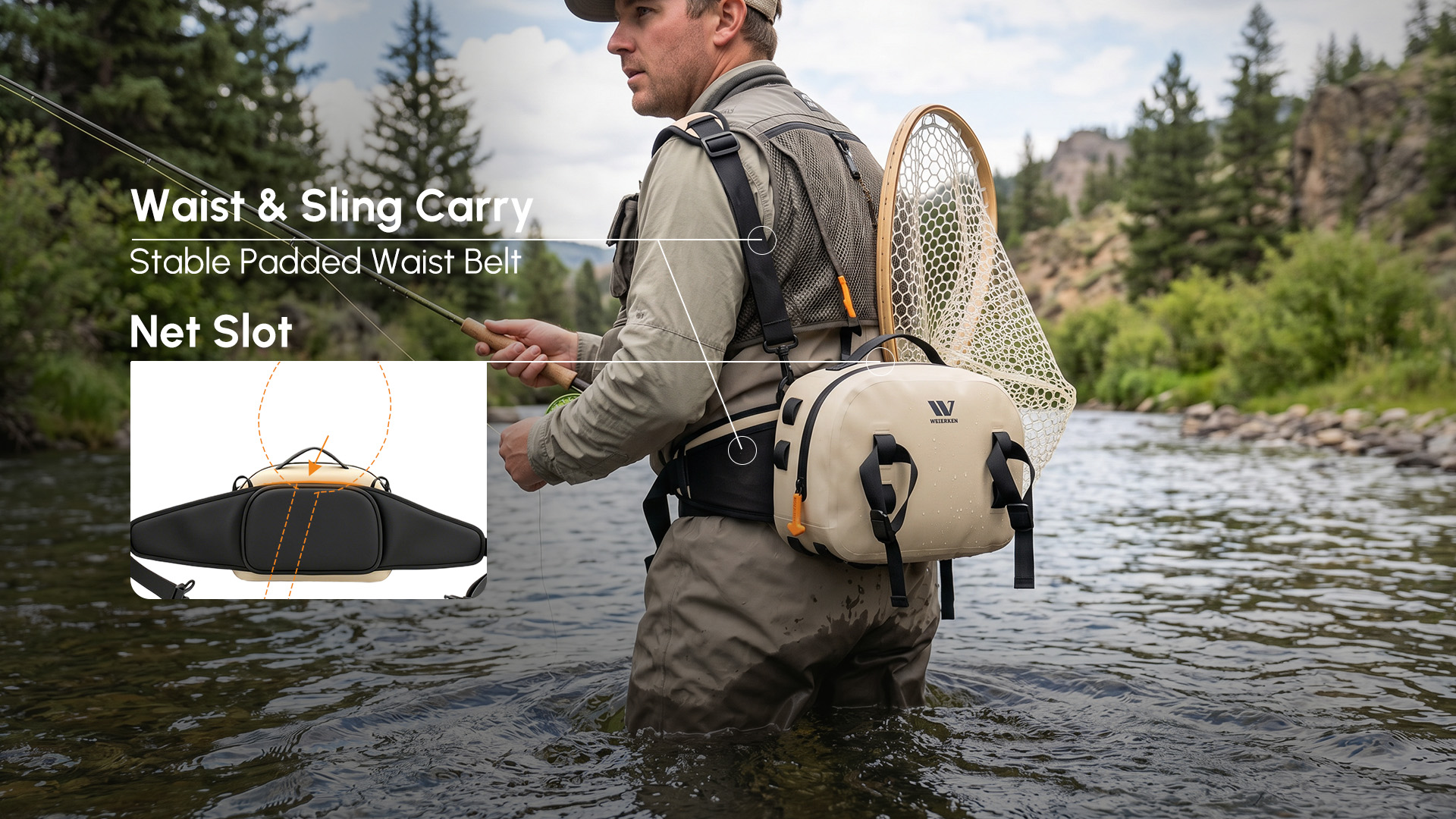
Carrying a long-handled landing net while bushwhacking to a hidden fishing spot is awkward. A well-designed net slot built directly into the back panel gives anglers an effortless carry solution.
A vertical pass-through sleeve allows the handle of the landing net to slide securely down between the back panel and the main compartment. The hoop stays upright behind the angler's head, out of the way of casts.
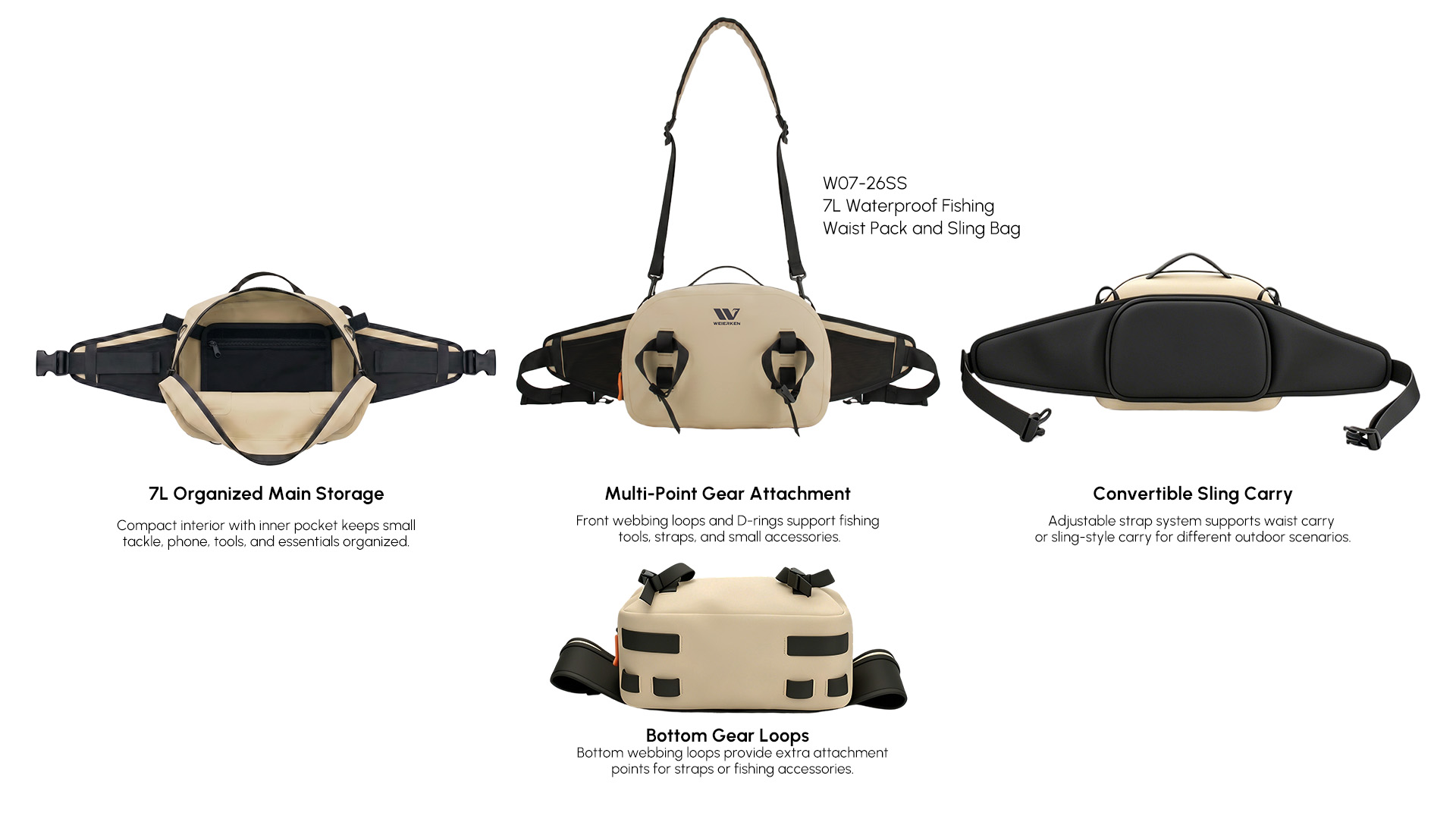
Add quick-cinch nylon webbing straps to the base or side of the pack. These let users strap down an extra four-piece travel rod tube or an insulated rain jacket during long treks.
6. Modular Interior Compatible with Industry Tackle Trays
Anglers are protective of their tackle organization. Most rely on industry-standard utility boxes, such as Plano 3600 or 3500 series trays. If a bag does not fit these sizes cleanly, anglers will not buy it.
Design the main compartment around these standard dimensions. Rather than leaving the inside as an empty cavern, install removable hook-and-loop dividers. This allows users to configure the compartment for their specific day:
- Stack two 3600-size tackle trays vertically.
- Separate one tray from a mirrorless camera system.
- Create dedicated slots for bulk soft-plastic bait bags.
Include transparent zippered interior pockets made from water-resistant TPU mesh. These provide quick visibility for leader spools, terminal tackle, and fishing licenses.
7. 3D Air-Mesh Breathable Back Panel
Carrying a sling pack across one shoulder for eight hours creates heat and pressure points. Poor airflow causes sweat buildup, leading to chafing and fatigue.
Build the rear panel with a multi-layer 3D air-mesh system. A central airflow channel allows breeze to move freely across the angler's back. Underneath the mesh, utilize dual-density EVA foam: a soft outer layer for body-contouring comfort, backed by a firm inner core to prevent hard tackle boxes from poking into the spine.
When working with experienced manufacturers like Weierken, you can custom-mold the back-panel foam with your brand’s logo or topographic patterns, blending performance with subtle branding.
8. Balanced Hydration Sleeve with Secure Cord-Lock
Anglers often lean forward over riverbanks or crouch down to land fish. Cheap side pockets allow water bottles to slip out and float downstream.
Position the water bottle pocket at the bottom or lower side of the pack to keep the center of gravity low. This placement prevents the pack from sagging or twisting while moving. Equip the pocket with a durable stretch mesh, an elastic drawcord, and a locking toggle that cinches tight around various bottle diameters.
Private Label Manufacturing: Turning Specs into Product
Designing high-performance private label fishing sling bags is only half the battle. Bringing the product to market requires smart manufacturing decisions.
Branding Options That Last
Fishing gear faces harsh sunlight, saltwater, and abrasion. Standard silk-screen printing peels off quickly. Instead, select high-durability branding methods:
- Molded 3D silicone badges stitched directly to high-wear zones.
- Corrosion-resistant matte-finished alloy emblems.
- Heat-pressed TPU logos with reflective accents for low-light safety.
Balancing Target MSRP with Feature Sets
Every strap, zipper, and pocket adds production cost. During the prototyping phase, determine your target retail price (MSRP) early. If your target is an entry-level technical pack, use durable DWR coatings and taped seams instead of fully waterproof zippers. For premium positioning, invest heavily in the molded EVA workstation and magnetic docking stations.
Fabric MOQs and Custom Colorways
Standard colors like black, olive drab, and slate gray are readily available from fabric mills at lower Minimum Order Quantities (MOQs). However, if your brand identity relies on proprietary camouflage patterns or custom Pantone shades, expect higher fabric minimums. Working with an experienced supply partner helps you navigate these order volumes efficiently.
Frequently Asked Questions (FAQ)
Q1: What fabric is best for private label fishing sling bags?
A1: High-density ripstop nylon (420D to 600D) with a PU backing and DWR coating offers the best balance of tear strength, weight, and water resistance. For heavy wear points like the bottom panel, TPU-coated nylon or heavy PVC tarp fabric is ideal for ground protection.
Q2: What is the typical MOQ for custom fishing sling packs?
A2: Minimum Order Quantities generally range between 500 and 1,000 units per colorway for fully customized cuts, hardware, and fabrics. Using stock fabric colors can sometimes reduce the required minimums for initial pilot runs.
Q3: Can these sling packs be adapted for left-handed anglers?
A3: Yes. You can design an ambidextrous sling pack by using symmetrical bag profiles and dual D-ring anchor points at the base. This allows users to clip the main shoulder strap to either the left or right side depending on their casting preference.
Q4: How do we test water resistance during development?
A4: Manufacturers run hydrostatic head tests to measure the waterproof rating of fabrics and coatings. Finished prototypes also undergo spray booth tests to ensure that zipper tracks, seams, and pocket flaps block hard rain and water splashes effectively.
Q5: Can our brand provide custom zipper pulls and hardware molds?
A5: Absolutely. You can customize plastic buckles, zipper pullers, and D-rings with embossed or debossed brand logos. Custom molds require a small tooling fee but deliver a distinct, professional finish that sets your gear apart from open-mold competitors.
Launch Your Custom Fishing Bag Line with Weierken
Standing out in the technical fishing market requires thoughtful design, functional durability, and disciplined manufacturing. A generic pack will not build long-term brand loyalty, but an expertly tailored sling bag will.
Weierken specializes in complete OEM and ODM manufacturing for technical outdoor and fishing bags. From initial sketches and material selection to rigorous prototyping and mass production, we bring your concepts to market.
Contact our product team today to request a quote or order your 2026 technical gear catalog. Let’s build something exceptional together.