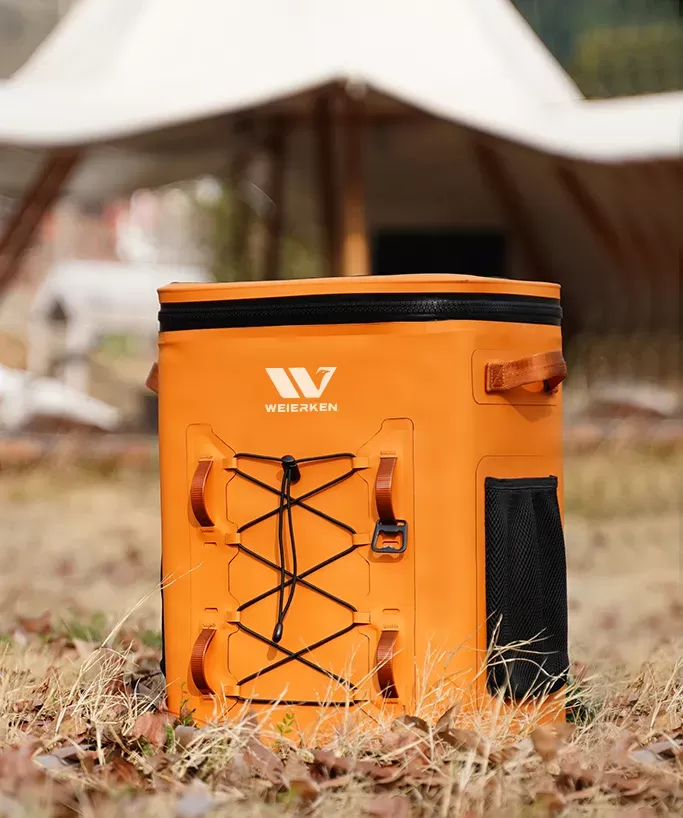

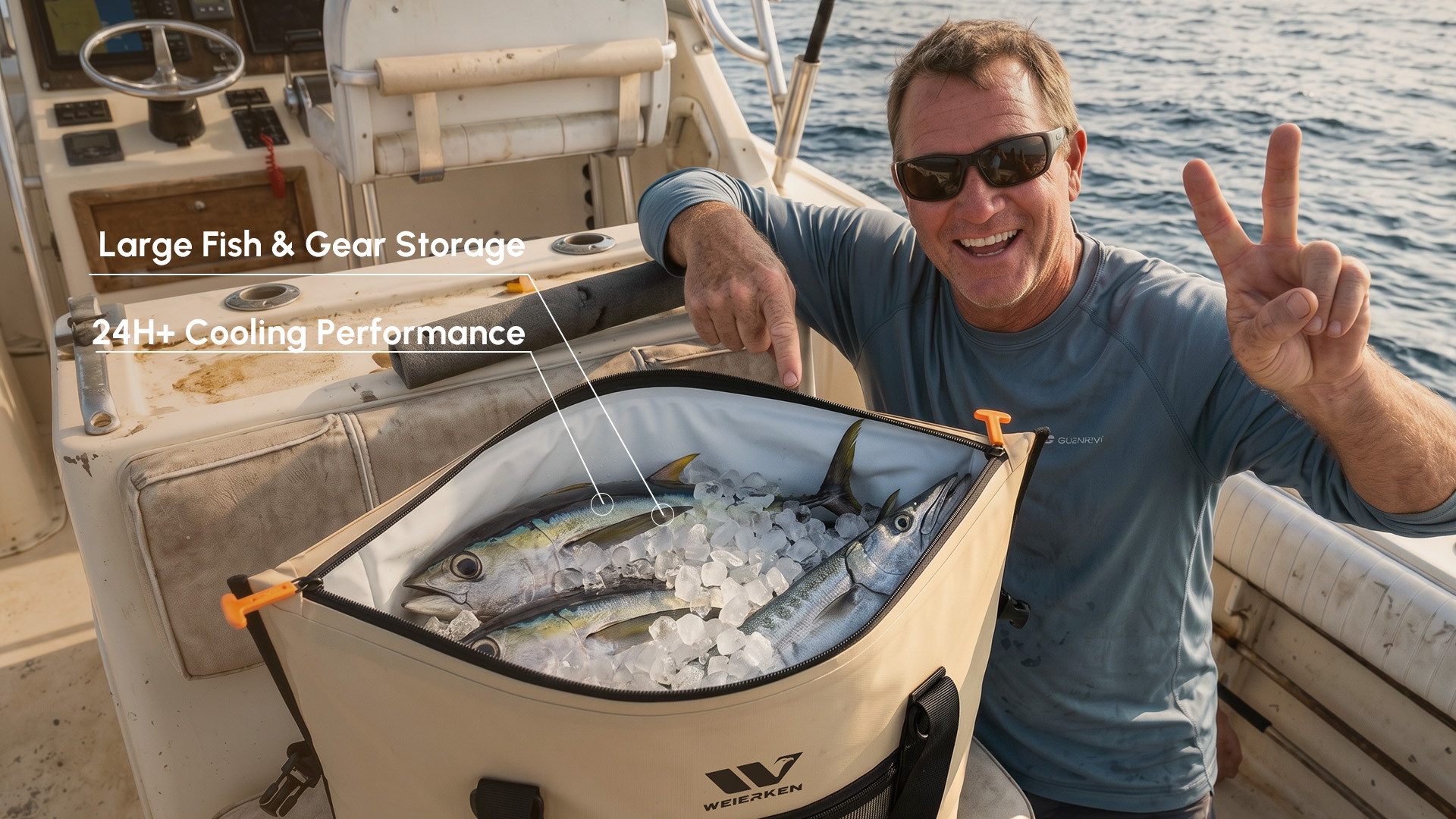
Offshore anglers, commercial fishermen, and tournament teams demand extreme thermal performance from their gear. When battling monster tuna, kingfish, or mahi-mahi miles from the shore, preserving the catch is paramount.
Traditional rigid coolers take up valuable deck space, add unnecessary hull weight, and scratch boat gelcoats. However, cheap soft cooler bags often fail within hours. They leak bloody ice slurry across the deck and let ambient heat spoil valuable meat.
For outdoor and fishing brands, building a reputable product line requires engineering kill bags that guarantee true 48-hour ice retention. Achieving this performance threshold requires precise material science, airtight assembly, and structural reinforcement. As a dedicated custom fish cooler bag OEM with 20 years of technical manufacturing experience, Weierken breaks down the five non-negotiable specifications required to deliver 48-hour thermal performance.
1. The Thermal Core: High-Density Closed-Cell Foam Architecture
The insulation layer serves as the primary barrier against conductive and radiant heat transfer. Low-end cooler bags frequently use open-cell polyurethane foam or cheap PE wool. These materials collapse under compression, absorb water, breed mildew, and lose their insulating R-value almost immediately.
To hit the 48-hour benchmark in 90°F (32°C) ambient temperatures, your OEM product must utilize closed-cell elastomeric foam.
Material Grade: High-density closed-cell NBR (Nitrile Butadiene Rubber) or cross-linked closed-cell PE/EVA foam blends.
Wall Thickness: A minimum thickness of 0.75 inches (19mm) for medium kill bags, and up to 1.0 inch (25.4mm) for offshore pelagic bags.
Structure: The closed micro-cell matrix traps inert gas inside independent bubbles, preventing moisture absorption even if fish spines puncture the outer wall.
Compression Resistance: High-density foam maintains its structural loft when stacked under heavy ice and 100-pound catches, preserving thermal efficiency under pressure.
A professional custom fish cooler bag OEM will adjust foam densities based on whether your brand targets compact kayak storage or heavy offshore tournament use.
2. Exterior Shell: Puncture-Resistant 840D/1000D TPU Composite
Marine environments punish gear. Salt spray, sharp gaff hooks, fish teeth, rough non-skid decks, and intense solar UV rays degrade low-grade fabrics in a single season.
Standard PVC can crack when exposed to cold temperatures and degrades under continuous UV exposure. For premium fish cooler bags, heavy-duty thermoplastic polyurethane (TPU) composite fabric is the industry standard.
Substrate Core: 840D to 1000D high-tenacity nylon or polyester woven scrim for maximum tear and tensile strength.
Double-Sided TPU Coating: Dual-layer TPU extrusion coating creates a hydrophobic, non-porous exterior that repels fish blood, engine grease, and saltwater.
UV & Cold-Crack Resistance: Marine-grade TPU resists UV degradation, preventing the material from yellowing, chalking, or cracking down to -30°F (-34°C).
Eco-Compliance: Premium TPU materials comply with REACH, RoHS, and Prop 65 standards, free of harmful plasticizers and heavy metals.
Using durable 840D/1000D TPU ensures that the thermal core remains hermetically sealed against external heat penetration and physical abrasion.
3. Construction Method: High-Frequency RF Welding and Airtight Zippers
Even the thickest insulation cannot save a cooler bag if ambient air leaks through the seams. Traditional needle stitching punches thousands of microscopic holes into the fabric, turning needle passes into conduits for thermal loss and water leakage.
Achieving 48-hour ice retention requires a 100% leakproof, airtight build.
Radio Frequency (RF) Welding: High-frequency electromagnetic energy excites the molecules in the TPU coatings, fusing the inner and outer walls into a single, seamless, monolithic bond. RF-welded seams are completely waterproof and deliver stronger shear strength than the raw fabric itself.
IPX7 / IPX8 Airtight Zippers: Standard coil zippers let warm air seep directly into the cooler chamber. A high-performance fish bag requires tooth-locking, airtight waterproof zippers with polyurethane sealing lips that lock cold air inside and prevent meltwater from leaking out during transit.
Internal Thermal Baffles: Adding an insulated foam baffle along the zipper line blocks thermal leakage across the zipper teeth, eliminating the most common cold-loss point.
Weierken relies on automated RF welding machinery and pressure-tested airtight zipper assemblies to ensure zero thermal bypass across the entire perimeter of the bag.
4. Interior Lining: Food-Grade, Anti-Microbial, and Easy-Clean TPU
The interior of a fish cooler bag directly contacts raw seafood intended for human consumption. Anglers require an interior that stays sanitary, does not harbor foul fish odors, and cleans up quickly at the marina wash-down station.
Selecting the right interior liner specification is vital for both product longevity and food safety compliance.
Food Contact Safety: The inner liner must meet FDA standard (21 CFR 177.2600) for direct contact with raw fish and meat.
Smooth Surface Topography: A gloss or semi-matte smooth TPU liner prevents fish scales, blood, and slime from sticking to microscopic crevices.
Anti-Microbial Treatment: Integrated anti-fungal agents prevent the growth of mildew and bacteria between deep-cleaning cycles.
Puncture Deflection: The internal liner must resist dorsal fins, billfish bills, and teeth without tearing.
Smooth, seamless interior welding allows the user to spray out the bag with a hose and mild soap, leaving zero residual odor for the next trip.
5. Load Engineering: Reinforced Rigging and Integrated Drain Ports
A 60-inch fish cooler bag filled with ice, saltwater slurry, and several large pelagics can easily weigh over 150 pounds (68 kg). If the carry handles tear away from the bag body, the product fails in the field.
Furthermore, managing ice meltwater without losing core cooling capacity requires dedicated plumbing hardware.
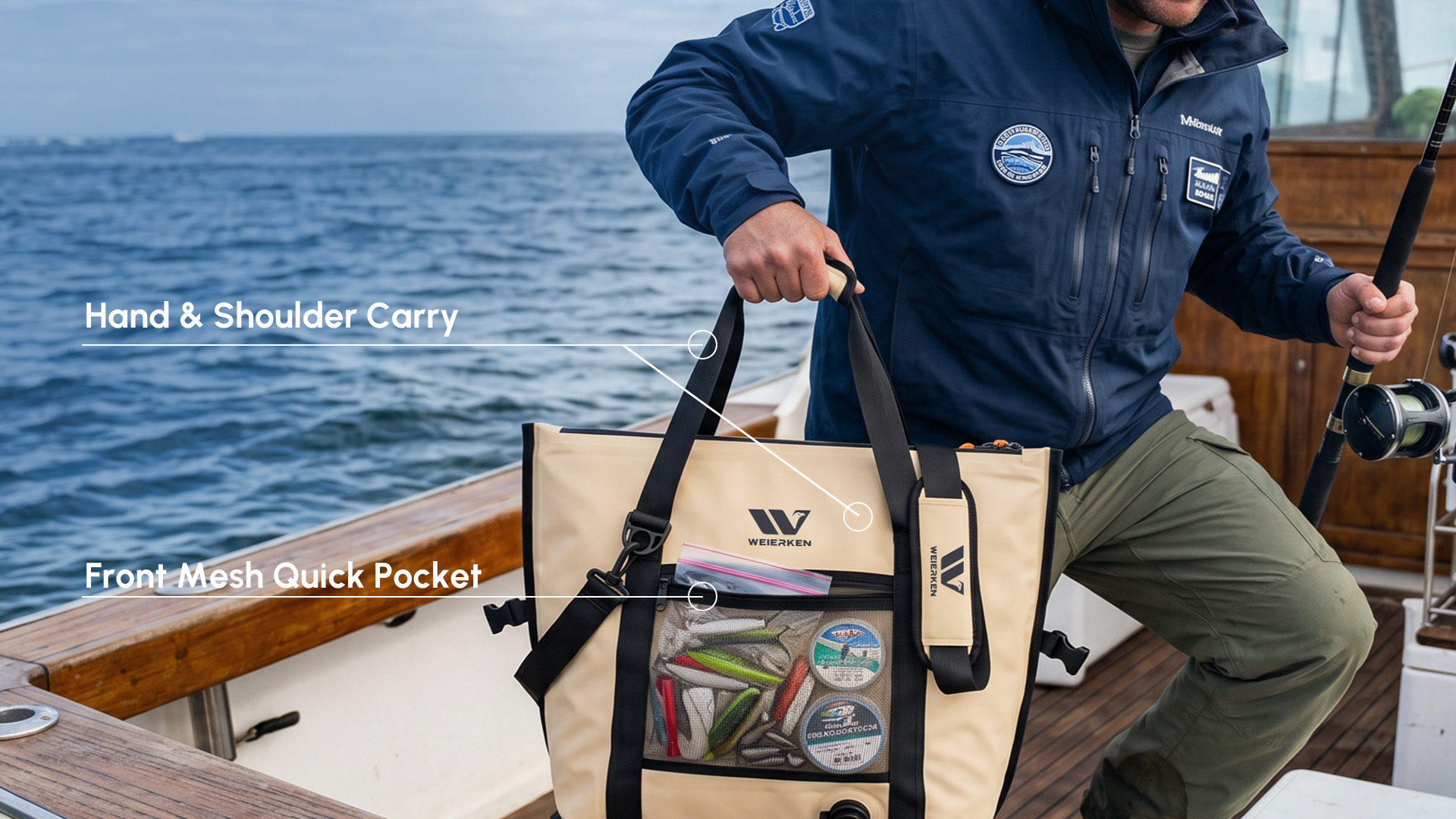
Load-Spreading Welded Patches: Carrying straps must not be stitched directly to the outer shell. Instead, heavy-duty webbing should be stitched to reinforced TPU anchor plates and then high-frequency welded directly onto the bag body. This design distributes the load across a broad surface area.
Cross-Box Bar-Tacking: All structural webbing uses industrial nylon thread with reinforced cross-box bar-tack patterns rated for loads exceeding 200 lbs (90 kg).
Marine Drain Plug Assembly: An integrated screw-in, gasketed drain valve at the bottom corner allows anglers to drain warm meltwater without unzipping the main chamber. Removing excess water keeps the remaining block ice solid for longer periods.
Tie-Down D-Rings: Heavy-duty, corrosion-resistant D-rings made from 316 stainless steel or reinforced POM plastic let users secure the bag to boat deck cleats, truck beds, or kayak hulls during rough transits.
Why Top Outdoor Brands Partner with Weierken for OEM/ODM Production
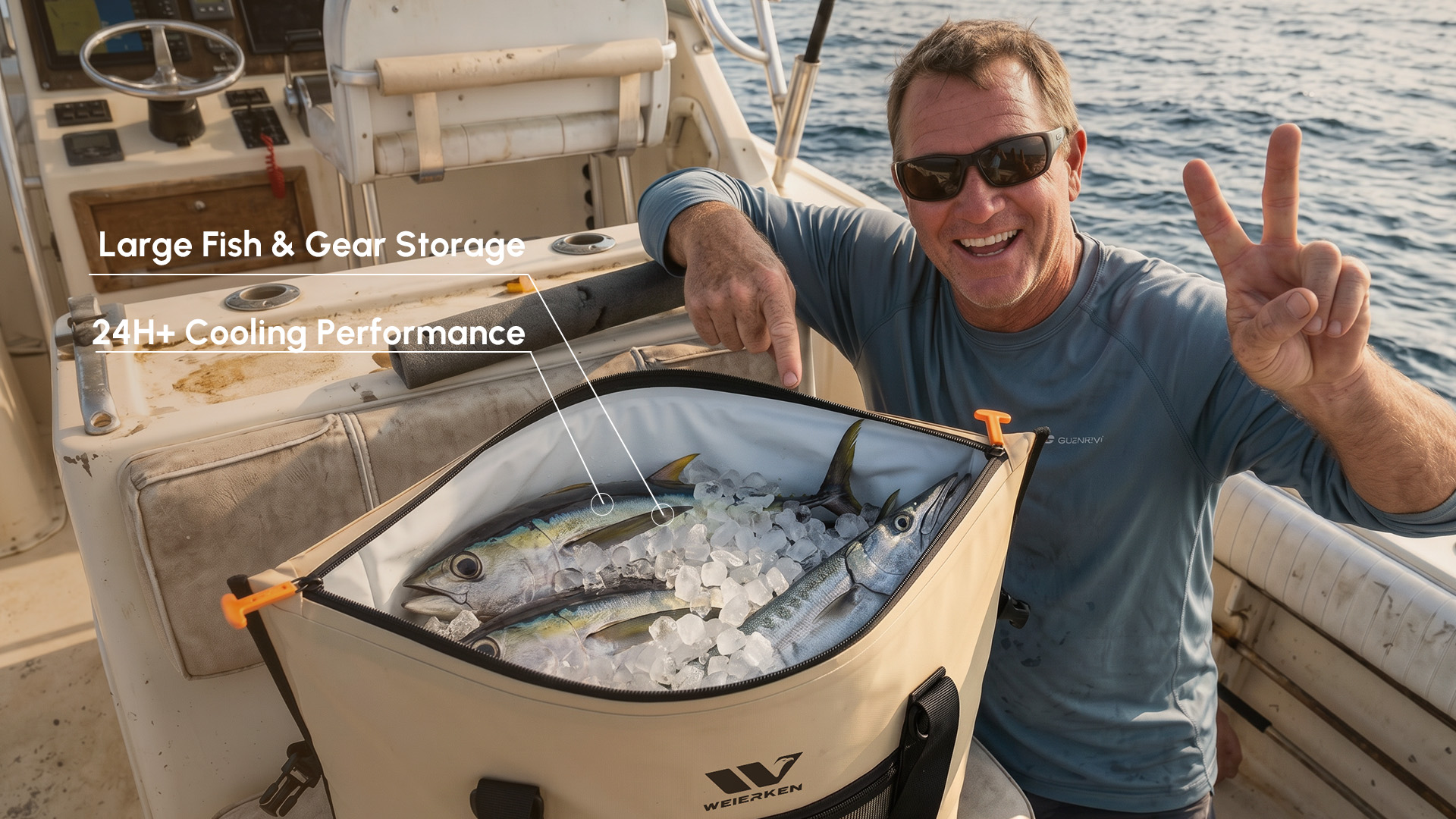
Manufacturing a soft-sided kill bag that holds ice for 48 hours requires strict quality control, specialized machinery, and deep material expertise. Outdoor gear brands worldwide choose Weierken as their preferred custom fish cooler bag OEM partner for several strategic reasons:
20 Years of Manufacturing Heritage (Since 2006): Weierken has spent two decades perfecting waterproof welding, high-performance soft coolers, and heavy-duty technical outdoor bags.
Dual-Base Production (China & Cambodia): With three self-owned manufacturing facilities spanning over 80,000 square meters and 3,000+ skilled workers, Weierken offers reliable production capacity. Our Cambodia facility provides significant tariff mitigation benefits for North American and European imports.
Rigorous Testing Protocols: Every batch undergoes 100% airtight pressure testing, tensile pull tests on load-bearing handles, zipper cycle durability tests, and thermal chamber ice-retention verification.
Turnkey OEM & ODM Capabilities: From rough concept sketches and 3D CAD modeling to rapid physical prototyping and full-run manufacturing, our engineering team tailors every detail to your brand's technical and pricing requirements.
Frequently Asked Questions (FAQ)
Q1: What is the typical minimum order quantity (MOQ) for custom fish cooler bag OEM projects?
A1: Standard OEM production runs typically start at 300 to 500 units per size and colorway. For fully customized tooling, unique camouflage fabric prints, or custom hardware molds, MOQs may vary based on raw material batch requirements. Contact our sales engineering team for specific program quotes.
Q2: How does Weierken test and verify the 48-hour ice retention performance?
A2: We perform controlled environmental chamber tests. Bags are loaded with a standardized 2:1 ice-to-contents ratio and placed in temperature-controlled rooms maintained at 90°F (32°C). Calibrated digital sensors monitor internal temperatures every 30 minutes until the ice fully melts, ensuring the design holds internal temperatures below 40°F (4.4°C) for the full 48-hour window.
Q3: Can your Cambodia factory help us lower import duties?
A3: Yes. For United States and European buyers facing tariffs on goods manufactured in China, our Cambodia manufacturing base provides duty-saving advantages. Our dual-facility structure allows you to optimize your supply chain without sacrificing product quality.
Q4: What customization options are available for private label fish bags?
A4: We provide comprehensive OEM customization, including custom dimensions (from 30-inch kayak bags to 90-inch giant tuna bags), pantone-matched TPU colors, high-definition screen printing, molded rubber logo patches, custom zipper pulls, integrated ruler scales, and specialized valve placements.
Q5: What is the average lead time from initial 3D design to sample delivery?
A5: Once CAD technical drawings are approved, physical prototypes are usually completed within 7 to 14 working days. Mass production lead times generally range between 35 and 45 days after pre-production sample sign-off, depending on order volume and material specifications.
Q6: Are the hardware and zippers resistant to saltwater corrosion?
A6: Yes. We use marine-grade components, including 316 stainless steel hardware, non-corrosive POM composite D-rings, and heavy-duty TPU-coated airtight zippers with salt-resistant polymer sliders, ensuring reliable performance in harsh marine environments.
Start Your Custom Fish Cooler Bag Project Today
Launching a high-performance soft-sided fish cooler bag line requires an experienced manufacturing partner who understands marine demands, thermal dynamics, and airtight welding technologies.
Whether you need to engineer a premium kill bag from scratch or expand your existing outdoor product portfolio, Weierken delivers the technical expertise, production scale, and global supply chain advantages your brand needs.
Contact the Weierken engineering team today to request a technical consultation, order material swatch kits, or receive a fast, detailed quotation on your next custom fish cooler bag OEM order.