

Hauling a 300-pound bluefin or yellowfin tuna over the gunwale tests every piece of gear on deck. Massive pelagic fish carry sharp dorsal spines, powerful tail scutes, and tremendous body weight. Standard retail coolers cannot handle that physical punishment.
Commercial charter captains and offshore tournament anglers demand specialized insulated bags that preserve prime sashimi-grade meat. When brands source offshore coolers, they cannot afford split seams, leaking blood water, or sheared lift handles. A single catastrophic failure offshore ruins an expensive catch and destroys customer trust.
Top gear brands work with specialized factories to build commercial-grade products from the ground up. At Weierken, our engineering teams build heavy-duty cooling solutions that bridge technical design and brutal offshore reality. Here is the step-by-step OEM process for delivering reliable custom tuna kill bags wholesale.
Stage 1: CAD Modeling and Structural Engineering
Every reliable kill bag begins as a precise technical blueprint. Fabricating marine gear without rigorous CAD modeling leads to poor load distribution and premature seam failure.
3D CAD Modeling and Volumetric Planning
Different pelagic species require tailored internal volumes. Bluefin require broad girth dimensions, while wahoo and kingfish need long, narrow profiles. OEM engineers run 3D software to calculate internal capacity accurately:
- Small Pelagic Profiles: 20" x 45" models engineered for mahi-mahi, bonito, and school tuna.
- Standard Offshore Dimensions: 30" x 60" or 30" x 72" bags suited for mid-sized yellowfin and bigeye tuna.
- Giant Tuna Enclosures: Heavy-capacity 40" x 98" or larger custom designs built to house giant bluefin alongside hundreds of pounds of slurry ice.
Fluid Dynamics and Load-Bearing Calculations
Slurry ice and heavy fish act as a shifting liquid load. When a boat cruises through heavy swell, water sloshes violently against the internal walls. CAD engineers model these dynamic stress spikes across the lower seams.
The design must redirect lateral hydrostatic pressure away from raw corners. Curving the bottom corners and sizing the floor panels ensures that internal fluid weight pushes downward into the boat deck, not outward against the zipper line.
Drain Valve Engineering and Placement
Draining bloody seawater is messy work. The drain plug cannot sit arbitrarily on the face of the bag. OEM engineers run parametric studies to locate the lowest gravitational drain point based on deck pitch.
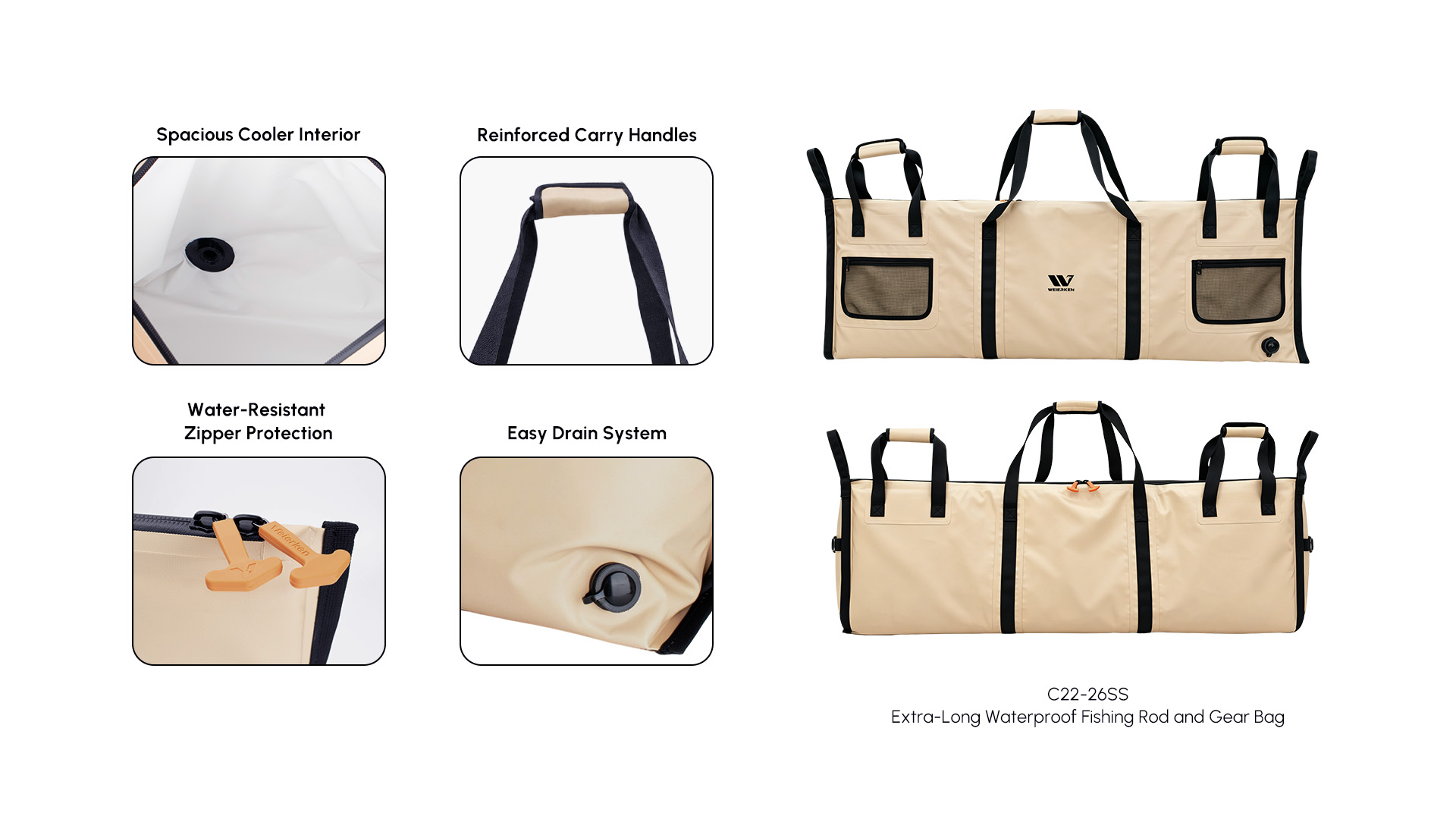
Engineers specify marine-grade, threaded garden hose bibs or knurled screw valves. These fittings bond directly into the sidewall through reinforced thermal grommets, ensuring an airtight seal that lets deckhands screw in a hose to dump wash water overboard cleanly.
Stage 2: Marine-Grade Raw Material Selection
Extreme thermal protection demands heavy industrial components. A premier OEM insulated fish bag manufacturer does not build with budget camping textiles. Only true marine-rated composites will survive offshore conditions.
Heavyweight Outer Armor (22oz or 1000D+ Marine PVC Tarpaulin)
The exterior shell absorbs non-stop abuse from gaffs, sharp fins, rough non-skid decks, and constant solar radiation. Production specifications prioritize toughness:
- 1000D Interlocking Polyester Scrim: Delivers extreme tensile strength and stops punctures from turning into long fabric tears.
- 22oz Heavy Polyvinyl Coating: Shields internal fibers from saltwater intrusion, oil residue, and engine grime.
- UV-Resistant Chemical Stabilizers: Prevents the outer shell from yellowing, cracking, or turning brittle after weeks of open-sun exposure.
Core Thermal Barrier (High-Density Closed-Cell Foam)
Open-cell foam acts like a sponge, soaking up foul blood water and rotting from the inside out. High-performance fish bags use 0.5-inch to 1.0-inch thick closed-cell polyethylene or EVA foam.
The gas-trapping cells inside closed-cell foam remain sealed off from one another. Even if a needle punctures the bag liner, the core material will not absorb liquid. This dense foam layer forms an unbroken cold barrier, keeping ice solid for up to 3 to 5 continuous days in blistering heat.
Sanitary Food-Grade Internal Liners
Tuna meat commands a high market price, making hygiene paramount. The interior lining uses ultra-smooth, food-grade PVC or heavy polyurethane film. This surface prevents fish scales and coagulated blood from embedding in the material.
Deckhands can clean the slick liner with a high-pressure hose and mild soap. The surface resists fish oils and leaves no lingering, rancid odors behind after cleaning.
Stage 3: Advanced Manufacturing and HF Welding
Traditional stitching punches thousands of holes through fabric. When dealing with water pressure, stitched needle holes leak blood onto clean fiberglass decks. Advanced production lines eliminate needle stitching on primary liquid reservoirs.
Radio-Frequency (RF) and High-Frequency (HF) Welding
Experienced factories rely on high-frequency welding machines. These industrial presses use electromagnetic energy to excite the polymer molecules in adjacent fabric panels.
The vinyl panels fuse together at the molecular level, creating a continuous, seamless joint. The welded seam matches or exceeds the tensile strength of the raw fabric, delivering a 100% waterproof seal that will not leak a single drop of slush ice.
Cradle-Style Continuous Webbing Harness
Lifting a 400-pound bag full of fish and ice by its handles generates massive kinetic forces. If the handles are simply stitched to the top fabric edge, they will tear off during crane or dock lifts.
Reliable factories design a complete cradle system. Heavy military-spec webbing straps run entirely under the bag base, wrapping the perimeter in an unbroken loop. The bag rests inside a continuous structural sling that supports the payload from underneath, safely distributing weight across the entire bottom plane.
Marine-Grade Airtight Zipper Systems
The zipper is often the weakest link on commercial kill bags. A quality heavy-duty tuna bag supplier equips bags with oversized, tooth-molded waterproof zippers or flexible airtight drysuit zippers.
These specialized zipper tracks keep cold air locked inside and prevent hot ambient air from penetrating the core. Rugged, oversized sliders operate smoothly despite drying saltwater, avoiding frozen tracks or snapped teeth during fast-paced deck operations.
Stage 4: Private Label Customization Options
To win retail shelves, brands must establish a unique visual footprint. Factories like Weierken provide comprehensive tooling and branding services for companies building out their custom tuna kill bags wholesale catalog.
Tailored Geometries and Bag Profiles
Offshore boats feature wildly different cockpit designs. Manufacturers build specialized bag configurations tailored to specific vessels:
- Flat-Bottom Gusseted Bags: Stand upright independently on the deck, making it easy for one angler to load fish and ice unassisted.
- Bow-Contoured Triangular Bags: Fit snugly inside the unused bow area of center console boats, freeing up precious walking space around the cockpit.
- Roll-Up Space Savers: Equipped with integrated compression straps so anglers can fold, roll, and stow the bag cleanly inside a deck hatch until hookup.
Durable Private Label Branding
Brand logos on marine equipment face mechanical abrasion and harsh chemical washdowns. Factories apply distinct decorative processes that resist wear:
- Industrial Thick-Plate Screen Printing: Uses elastomeric inks that flex with the PVC fabric without cracking or peeling.
- Molded Silicone and 3D Rubber Patches: Give a premium, rugged look that stands up to direct saltwater and UV exposure.
- Integrated Deck Rulers: Clear, screen-printed measurement rulers running along the outer top panel, letting crews quickly confirm tournament-legal fish lengths before unhooking.
Custom Structural Accessories
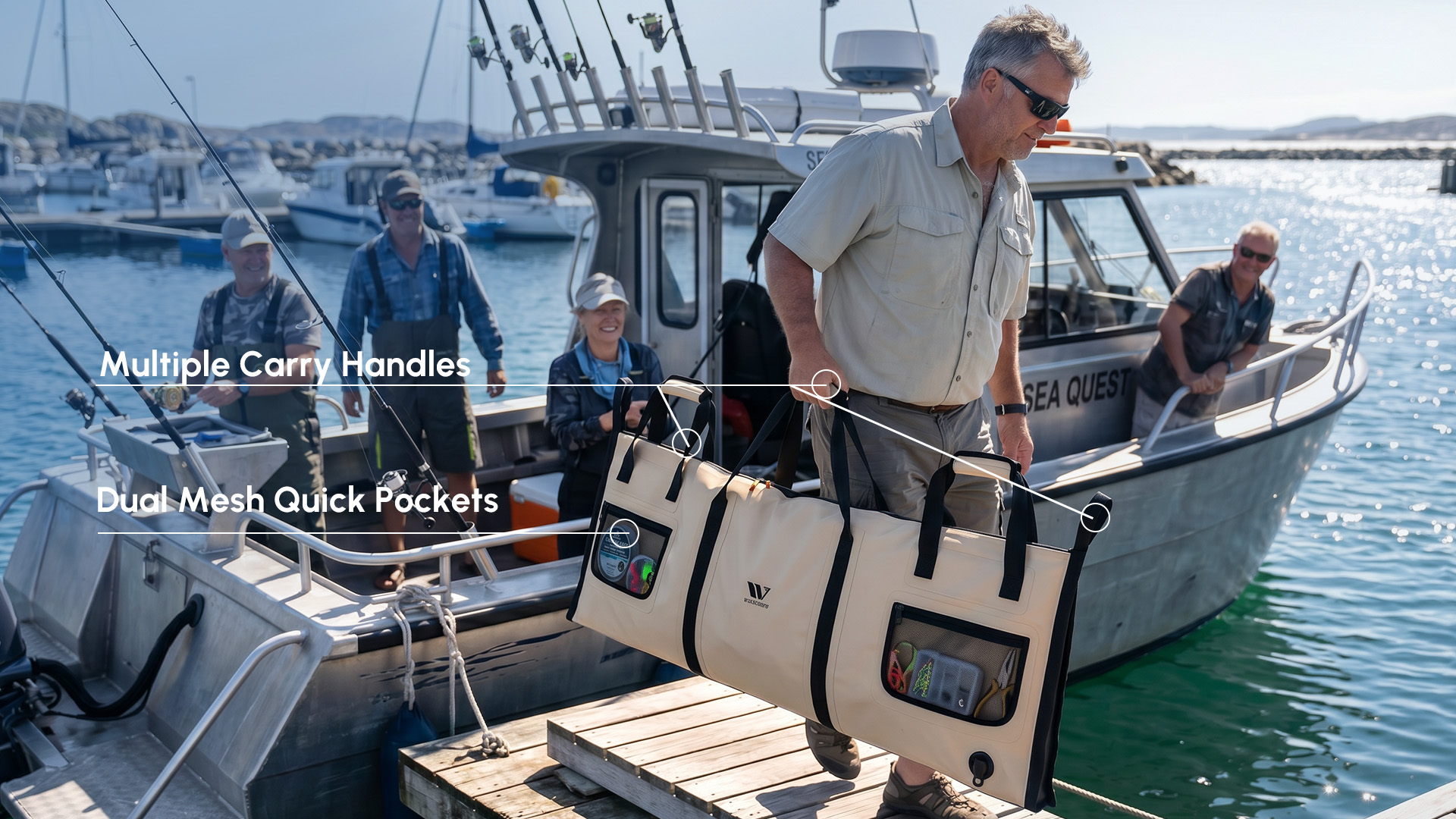
Brands can enhance baseline designs with functional hardware options, such as removable non-skid base pads, exterior utility pockets for catch tags, heavy-duty padded shoulder straps, and modular tie-down D-rings to secure the bag to deck cleats.
Stage 5: Quality Control and Destructive Sea-Trial Testing
Before launching full-scale distribution, designs must survive aggressive factory quality control protocols. Good engineering requires verifiable testing data.
Static Hydrostatic Leak and Crane Suspension Tests
Quality inspectors verify structural integrity using harsh, destructive testing methods:
- Hydrostatic Leak Testing: The factory fills the kill bag to full volume with water and lets it stand for 72 hours. Inspectors monitor every welded seam for sweating, damp spots, or weeping.
- Crane Load Suspensions: The bag is loaded with dead weights exceeding its maximum rated capacity by 150%, then suspended in midair by crane handles to confirm that seams and webbing will not fail.
Thermal Retention Benchmarking
Engineers evaluate foam insulation using standardized melt tests. Bags filled with measured block and crushed ice sit inside specialized thermal environmental chambers set to 100°F (38°C). Inspectors track internal temperatures over 96 hours to verify that the core barrier maintains freezing conditions under extreme heat.
ASTM B117 Salt Fog Corrosion Testing
Every piece of exterior hardware must resist coastal salt exposure. Drain components, zipper sliders, and metal D-rings endure hundreds of hours inside an ASTM B117 salt spray chamber to verify they will not pit, corrode, or freeze up in ocean environments.
Stage 6: Bulk Production, Packaging, and Freight Optimization
High shipping rates can destroy retail profit margins. Bulky, foam-filled fish coolers take up massive cargo volume if left uncompressed during transit.
High-Density Compression Packaging
To support global supply chains, factories develop strategic folding and packaging procedures. Technicians compress the heavy insulated bags flat using vacuum fixtures and strap them into tight cartons. This process reduces outer packaging volume by up to 30%, lowering ocean freight costs per unit.
Flexible MOQs and Predictable Production Timelines
Managing an offshore gear catalog requires flexible manufacturing runs. Professional suppliers run optimized production schedules that balance reasonable Minimum Order Quantities (MOQs) with reliable delivery cycles, ensuring stock arrives well ahead of regional tournament and fishing seasons.
Frequently Asked Questions (FAQ)
Q1: What materials are standard for heavy-duty wholesale tuna kill
bags?
A1: The exterior typically uses 22oz heavy-duty marine PVC
tarpaulin with a 1000D polyester scrim. The insulation core uses 0.5-inch to
1.0-inch high-density closed-cell polyethylene foam, paired with a non-staining,
food-grade PVC or TPU interior liner.
Q2: How long do marine-grade fish cooler bags hold
ice?
A2: With quality 0.5-inch to 1.0-inch closed-cell foam and
welded construction, a commercial kill bag keeps ice solid for 3 to 5 days,
depending on ambient sun exposure and the ratio of ice to fish.
Q3: Why is high-frequency welding critical for fish kill
bags?
A3: HF welding fuses the thermoplastic fabric panels at a
molecular level without needle punctures. This creates a completely waterproof,
seamless vessel that prevents blood and melted slurry ice from leaking onto boat
decks.
Q4: Can we order custom sizes to match specific boat bow
lockers?
A4: Yes. OEM manufacturers build custom shapes based on
your CAD drawings or dimensional specs. Custom shapes include tapered bow bags,
rectangular deck boxes, and extra-long billfish envelopes.
Q5: What is the typical lead time for custom tuna kill bag bulk
orders?
A5: CAD modeling and sample prototyping generally take 7 to
14 days. Once golden samples receive approval, mass production typically takes
35 to 45 days, depending on hardware specs and order quantities.
Build Your Custom Offshore Marine Line
Offshore boaters, charter operations, and professional tuna hunters hold their gear to high standards. Flimsy seams and weak materials do not survive the ocean. Developing a market-leading commercial cooler bag requires sound naval engineering, heavy-gauge fabrics, and airtight manufacturing.
Weierken works directly with tackle brands, commercial outfitters, and marine retailers to build tough, customized cooling solutions. Our engineering teams manage the entire production chain, from initial CAD modeling and stress testing to final container loading.
Ready to expand your offshore marine catalog? Contact our engineering team today to review our technical specs, request a sample, or get a factory-direct quote on custom tuna kill bags wholesale.