
A failed dry bag on open water is not just an inconvenience. It is a brand killer.
When saltwater leaks through a compromised seam and destroys a customer's expensive navigation equipment or marine radio, your brand takes the blame. Product recalls in the marine and paddle sports sector can easily wipe out tens of thousands of dollars in inventory, logistics costs, and customer goodwill.
Placing a bulk purchase order with a custom boat dry bag supplier requires far more diligence than comparing catalog pricing and ordering a single golden sample. Sourcing teams in 2026 must evaluate engineering depth, automated machinery, raw material resilience, and supply chain agility. Specialized manufacturers like Weierken build their reputations on surviving these strict factory audits.
Use this field-tested audit guide to vet any custom boat dry bag supplier before you transfer your next production deposit.
1. Machinery Audit: Assessing Marine-Grade Production Assets
Standard outdoor backpacks use stitched seams covered with PU seam tape. That construction works for light trail rain, but it quickly fails inside a wet boat deck or kayak hatch. Marine environments demand fused molecular bonds.
High-Frequency (RF) and Hot-Air Welding Capacity
Marine bags rely on Radio Frequency (RF) welding or high-temperature hot-wedge welding to melt polymer coatings together under pressure. The result is a single, impervious sheet of material.
- Dedicated Welding Stations: Confirm the factory owns high-tonnage RF welding machines rather than outsourcing the core assembly to third-party workshops.
- Custom Tooling & Mold Design: Complex cylindrical bases, contoured boat duffels, and three-dimensional deck bags require proprietary tooling. Ask how quickly their tooling shop develops and modifies brass or aluminum welding dies.
- Consistent Dwell Time & Pressure: Inspect whether their machines feature programmable logic controllers (PLCs) to guarantee identical temperature, dwell time, and pressure across every production shift.
Airtight and Water-Tight Zipper Assembly
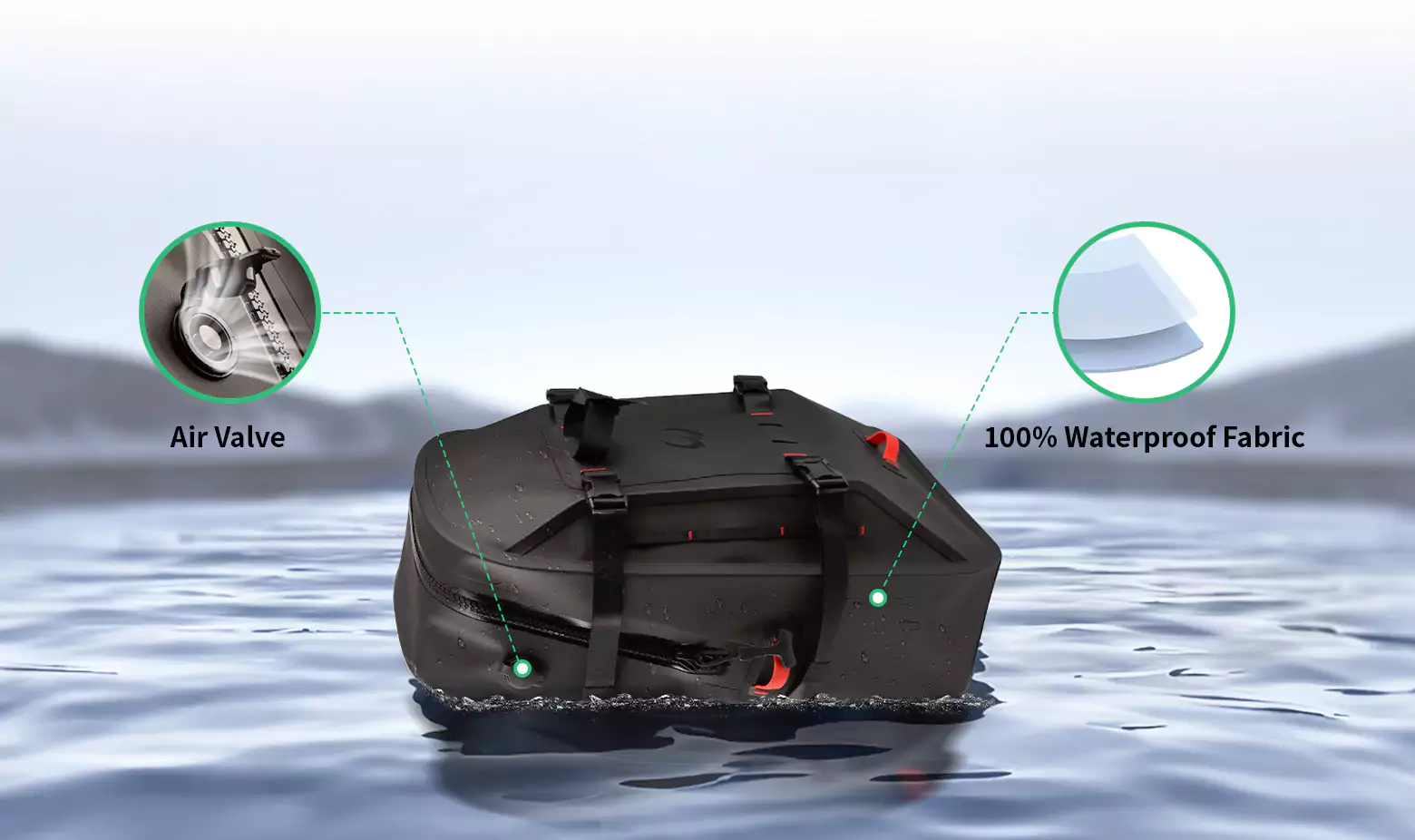
True submersible boat bags (rated IPX7 or IPX8) feature heavy-duty airtight zippers. Installing these closures is one of the most difficult steps in technical bag manufacturing.
Check how the custom boat dry bag supplier welds the zipper teeth stop and fabric tape to the main body panels. Sloppy transitions at the terminal ends of an airtight zipper represent the single most common leak point. The factory must use dedicated perimeter welding dies to ensure zero pinholes where the zipper meets the seam.
Prototyping Turnaround Times
A capable custom boat dry bag supplier should translate technical tech packs into functional prototypes within 12 to 30 days. Prolonged sampling phases usually indicate that the vendor lacks an internal pattern-making team or struggles to procure marine-grade materials quickly.
2. Raw Material & Weathering Audits: Defeating Deck Degradation
Sun, salt, and fuel exposure break down cheap fabrics within a single boating season. Your audit must verify material traceability down to the base yarn and laminate coating.
PVC vs. TPU: Matching the Marine Application
Different boating categories require different polymer formulations:
- 500D / 840D PVC Tarpaulin: The traditional workhorse for commercial fishing and offshore charter gear. It offers exceptional puncture resistance and cost efficiency, though it is heavier and can stiffen in cold climates.
- TPU (Thermoplastic Polyurethane) Laminates: The gold standard for performance marine gear. Polyether-based TPU resists microbial breakdown, stays flexible below freezing, and provides superior abrasion resistance at roughly half the weight of heavy PVC.
The Marine Triple-Test Protocol
Never rely on a raw material vendor's generic spec sheet. Require your prospective custom boat dry bag supplier to demonstrate proof of three marine-specific tests:
1. Salt-Spray Resistance (ASTM B117): Marine hardware, buckles, and zipper sliders must endure at least 48 to 72 hours of continuous salt-fog exposure without seizing, pitting, or showing surface rust.
2. UV & Hydrolysis Testing: Marine bags bake on open fiberglass decks all day. Materials must withstand accelerated QUV exposure without chalking, color fading, or delaminating. Polyether TPU must show zero hydrolysis breakdown after accelerated humidity chamber runs.
3. Tear and Puncture Strength (ASTM D751): Check the tear-propagation resistance of the scrim fabric. Sharp tackle hooks, gaffs, and rocky shorelines punish thin fabrics. The base weave must stop punctures from running into full tears.
3. In-Line Quality Control: Engineering a 99%+ Yield
Pre-shipment AQL (Acceptable Quality Limit) inspections at the final packing stage are insufficient for airtight products. Once an airtight duffel is boxed, finding a leak requires destructive or labor-intensive unboxing. Quality control must happen in-line.
100% Pressure Decay and Submersion Testing
For IPX7 or fully airtight boat bags, spot checks do not work. Premium manufacturers like Weierken run 100% testing on sealed chambers before outer accessories are stitched.
Audit their inspection lines for two distinct stations:
- Pressure Decay Stations: The bag is inflated to a fixed PSI (typically 1.5 to 3.0 PSI), valved off, and monitored for 15 to 30 minutes. Digital pressure sensors flag any pressure drops, identifying micro-leaks before packing.
- Water Dunk Tanks: For rapid feedback during welding setup, submerged bags are pumped with low-pressure air to visually catch escaping bubble streams around handles and corners.
Destructive Pull Tests on Stress Points
Boat dry bags carry heavy payloads, including wet anchors, dive weights, and frozen catch. Welded carry handles, shoulder strap anchor patches, and perimeter D-rings must not tear away from the bag body under sudden shock loads.
Verify that the factory utilizes calibrated tensile test machines. Welded patches should support loads exceeding 25 to 35 kg without delamination. The fabric coating should rip away from the scrim before the RF weld bond itself separates.
4. Supply Chain Resilience and Compliance in 2026
Geopolitical friction, shifting freight lanes, and tariff volatility make factory location as important as factory capability. Sourcing professionals can no longer depend on single-region production.
The Dual-Hub Model: China & Southeast Asia
The most resilient partners operate multi-country production footprints. Sourcing your product line through a custom boat dry bag supplier with dual manufacturing hubs in China and Cambodia offers tangible business protections:
- China Facilities: Ideal for rapid prototyping, access to high-end raw material supply chains, complex mold creation, and highly technical IPX8 airtight builds.
- Cambodia Facilities: Essential for cost-effective volume manufacturing, tariff mitigation into North American and European markets, and long-term duty savings.
This dual footprint protects your gross margins against sudden trade policy shifts while preserving access to specialized engineering resources.
Social Compliance and Environmental Governance (ESG)
Global outdoor brands cannot afford brand damage from factory labor violations. Request up-to-date audit reports for:
- BSCI / SEDEX (SMETA): Verifies fair wages, reasonable working hours, and safe factory conditions.
- ISO 9001: Proves that the supplier maintains documented, repeatable quality management systems across every shift.
- GRS (Global Recycled Standard) & REACH: Essential if your boat dry bag line incorporates recycled nylon/polyester shells or non-toxic, phthalate-free coatings for the European Union.
DDP Shipping Execution
A reliable custom boat dry bag supplier should not stop their service at the factory loading dock. Inquire about their Delivered Duty Paid (DDP) logistics capabilities. Suppliers who manage export clearance, ocean freight, customs brokerage, and domestic line-haul delivery remove operational burdens from your internal team.
5. The 2026 Marine Dry Bag Audit Checklist
Take this checklist with you on your next physical plant tour or third-party audit:
- [ ] Factory owns and operates high-frequency (RF) welding machines with automated PLCs.
- [ ] In-house tooling department can build or modify custom welding dies.
- [ ] Factory can present third-party lab reports for salt-spray (ASTM B117) and UV weathering.
- [ ] In-line 100% inflation pressure decay testing is active on the production floor.
- [ ] Tensile testing equipment regularly logs weld-strength data for D-rings and handles.
- [ ] Supplier provides flexible production hubs (e.g., China for R&D/speed; Cambodia for tariff optimization).
- [ ] Factory holds valid BSCI, SEDEX, or ISO 9001 certifications.
- [ ] Traceable lot control exists from raw roll stock to finished carton.
Frequently Asked Questions (FAQs)
Q1: What is the main difference between an outdoor dry bag and a boat dry bag?
A1: Standard outdoor dry bags focus on low weight for hiking and use thin fabrics with taped seams. Boat dry bags must endure harsh marine environments: constant pooling water, engine fuel residue, sharp deck hardware, high UV exposure, and saltwater corrosion. Consequently, boat dry bags use heavier 500D-840D PVC or heavy-duty TPU fabrics joined via seamless RF welding, often incorporating airtight immersion zippers and anti-corrosion hardware.
Q2: Why is RF welding mandatory instead of regular sewing for boat bags?
A2: Sewing creates thousands of needle punctures through the fabric. While seam tape can temporarily cover those holes, flexing, humidity, and heat inside boat compartments cause tape adhesives to degrade and peel. RF welding uses electromagnetic energy to fuse the polymer coatings at a molecular level, creating a permanent, leak-proof seam that is just as strong as the original fabric.
Q3: What minimum waterproof rating should I request from my custom boat dry bag supplier?
A3: It depends on the bag's intended function. For roll-top deck bags designed to handle rain and ocean spray, an IPX6 rating (resistance to high-pressure water jets) is standard. For boat duffels, ditch bags, and electronics dry cases that may fall overboard or sit submerged in a flooded bilge, you should specify IPX7 (immersion up to 1 meter for 30 minutes) or IPX8 (custom depth and duration thresholds).
Q4: How do dual-base operations in China and Cambodia benefit international buyers?
A4: China offers deep access to technical raw materials, rapid molding setups, and advanced technical engineering. Cambodia offers lower labor costs and favorable tariff treatments into key Western markets. Partnering with a custom boat dry bag supplier that operates facilities in both countries allows you to handle product development and initial runs rapidly in China, then scale mass production in Cambodia to minimize landed costs.
Q5: How many samples should I test before approving mass production?
A5: Never approve a bulk order based on a single sample. Request at least three to five pre-production samples made from production-run materials and production tooling. Test one sample destructively for seam pull strength, subject one to field submersion testing with ballast weights, and run one through accelerated salt-water immersion to check the zippers and trims.
Conclusion: Choose a Manufacturing Partner, Not Just a Vendor
Vetting a custom boat dry bag supplier requires evaluating engineering processes, raw material verifications, and strict pressure-testing standards. Taking shortcuts during your supplier audit puts your inventory and brand reputation at serious risk once your products reach open water.
At Weierken, we design, engineer, and manufacture marine-grade waterproof luggage, airtight gear bags, and technical boat accessories for demanding global brands. With our specialized RF welding lines, rigorous pressure-decay quality control, and flexible manufacturing footprint across China and Cambodia, we protect your brand's reputation on the water.
Ready to elevate your marine gear lineup? Contact the Weierken engineering team today to review your tech pack, request a factory audit report, or receive a fast, detailed quotation for your upcoming bulk order.