
A failed gear bag on open water is a brand killer. When an offshore duffel leaks or a dry deck bag tears along a seam, your customer does not blame the factory. They blame your brand. The return rates skyrocket, negative reviews pile up, and your distributor relationships suffer.
Boating gear bags belong to an entirely different engineering category than standard travel backpacks. They must resist corrosive salt spray, handle constant solar radiation, and maintain total watertight integrity under wave impact. Partnering with a standard cut-and-sew supplier will almost certainly result in product failures.
Finding a reliable partner for your OEM boating gear bags requires a methodical, technical audit. Experienced manufacturers like Weierken build marine equipment around thermal welding and specialized polymers rather than simple needle-and-thread assembly. This guide provides a direct, on-the-ground framework to evaluate a production facility before you issue a single purchase order.
1. Pre-Audit: Why Boating Gear Bags Require Specialized OEM Capabilities
Before booking a flight or hiring a third-party auditor, you must establish clear manufacturing criteria. Marine accessories face harsher working environments than almost any other consumer bag category.
The Critical Difference: Sewn Bags vs. Welded Construction
Traditional luggage relies on needle stitches. Every needle strike creates a microscopic hole through the fabric. Taping these stitched seams can offer basic splash protection, but the tape frequently delaminates after prolonged exposure to humidity and saltwater.
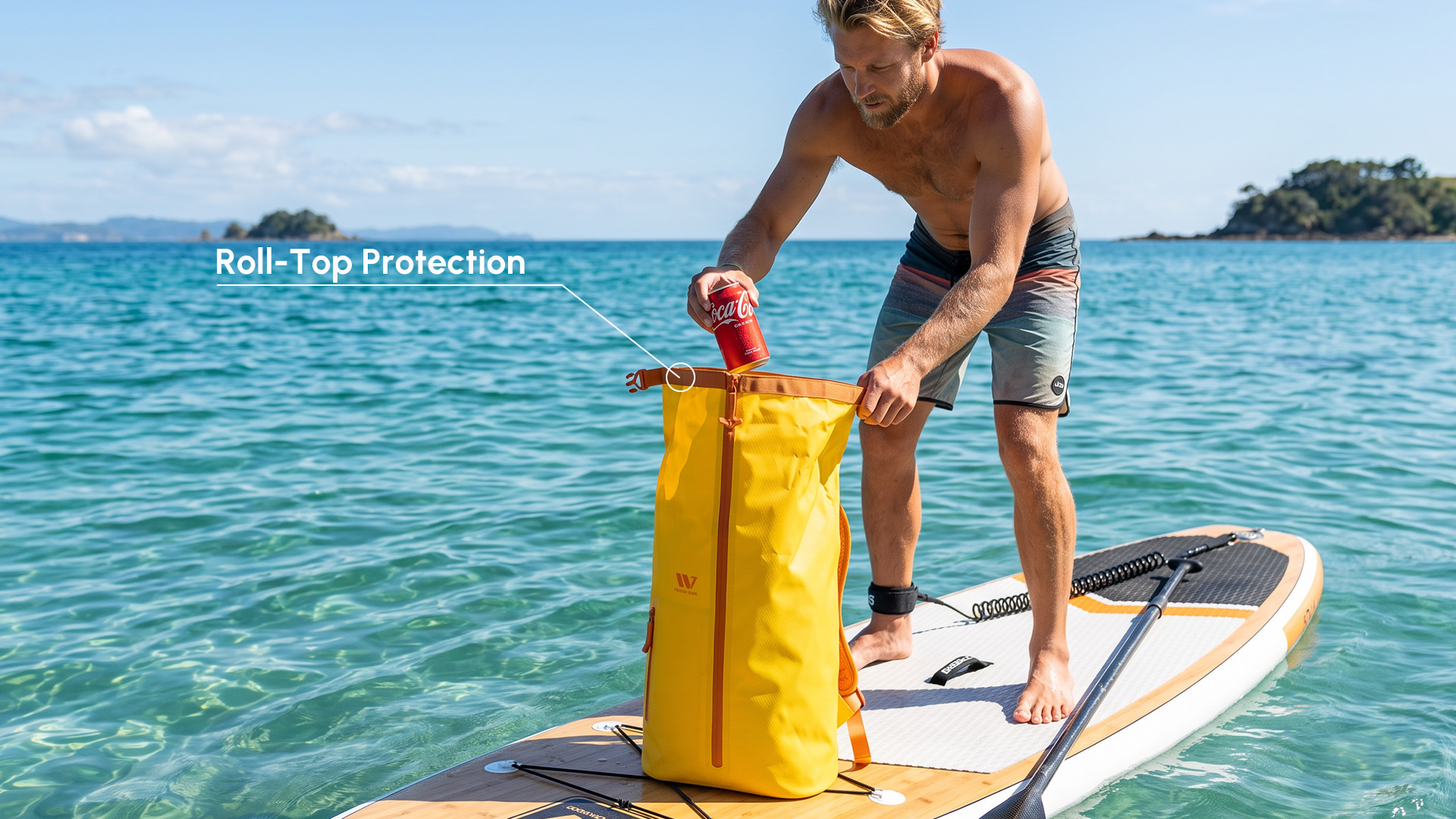
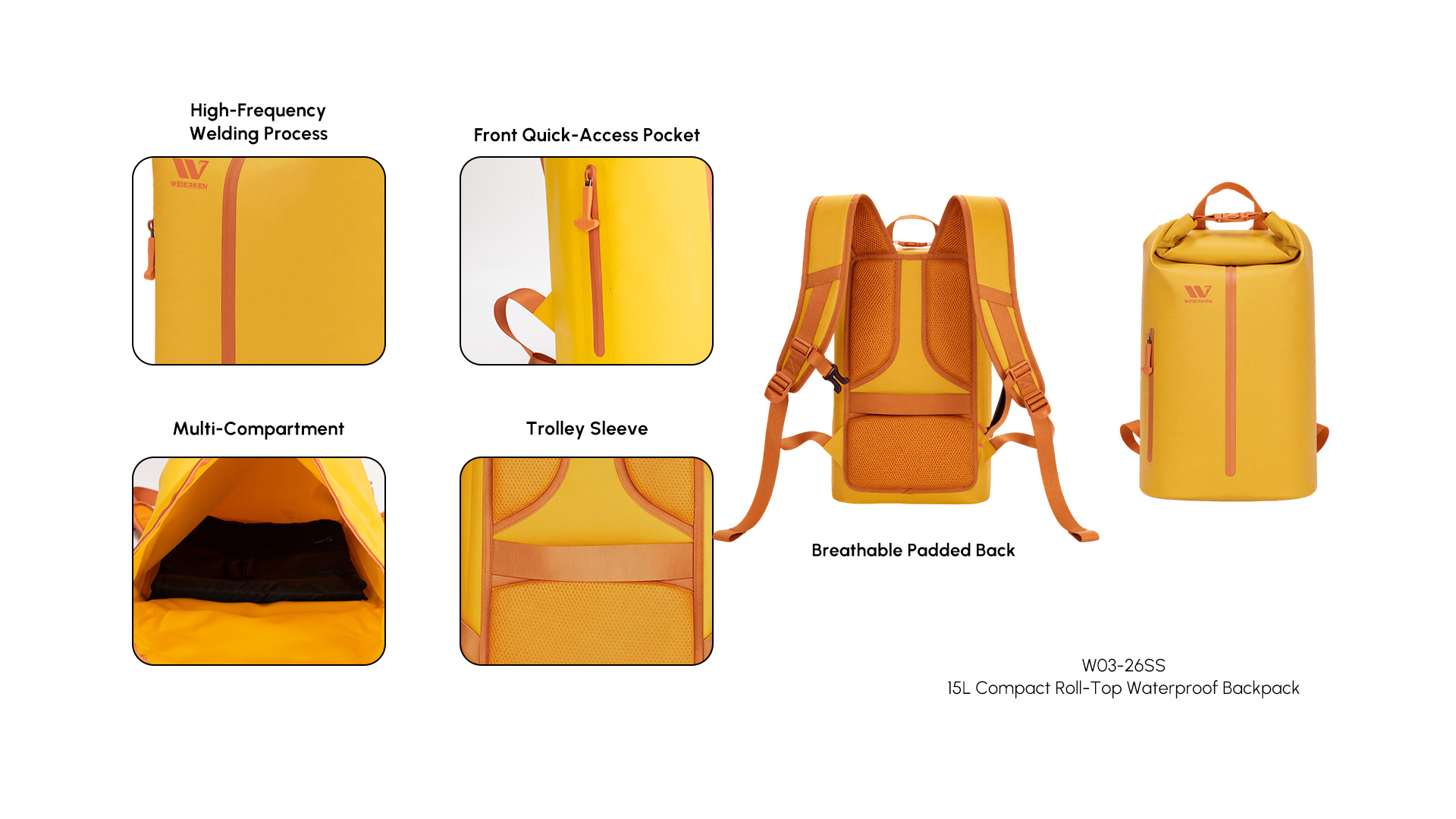
Professional marine gear bags rely on weld seams. High-frequency or thermal welding melts thermoplastic coatings together, fusing the fabric panels at a molecular level. The joint becomes as strong as the base fabric itself, creating a seamless, airtight barrier that handles heavy water pressure.
Marine Environment Challenges
A specialized factory must design and build for three hostile elements:
- Saltwater Corrosion: Salt crystals chew through standard
metal sliders and degrade cheap nylon threads within weeks.
- UV Degradation: Intense solar exposure breaks down
low-grade PVC, turning bags brittle, sticky, or discolored.
- Hydrostatic Pressure: Deck washdowns, rainstorms, and
accidental submersion require certified IPX ratings (typically IPX6 for heavy
spray or IPX7 for brief immersion).
2. Core Manufacturing Capabilities to Inspect on the Factory Floor
During a factory walk-through, look past the showroom. The real story lives in the machinery, tooling maintenance, and production floor discipline.
Sealing & Welding Technologies
Walk straight to the welding department. A genuine marine-grade gear bags OEM relies on these machines for core production, not just edge cases:
- High-Frequency (RF) Welding Machines: Look for stable,
high-tonnage RF presses. They offer precise voltage regulation to prevent
burning the fabric core while ensuring an airtight seal.
- Hot Air / Hot Wedge Welding: Essential for continuous seams
on cylindrical duffels, holdalls, and dry cylinders.
- Ultrasonic Sealing: Often used for tacking composite layers
together cleanly before primary welding.
Automated Cutting & Precision
Welded seams tolerate zero margin of error. If two panels do not align perfectly, the RF mold creates uneven pressure, causing weak spots and pinhole leaks.
Check if the facility uses automated CNC oscillating knife cutters or laser cutting tables. Manual hand cutting with cardboard templates is a red flag for technical dry bags. Digital cutting ensures every batch maintains sub-millimeter edge tolerances.
Heavy-Duty Stitching & Stress-Point Reinforcement
While the main body must be welded, grab handles, shoulder straps, and MOLLE loops require heavy stitching. However, sewing through a waterproof compartment ruins the seal.
Examine how the factory mounts load-bearing hardware. Reliable facilities weld reinforced backing patches (anchor pads) onto the main body first. Then, they sew the webbing to the patch using automated programmable bartack machines. Look for bonded nylon or polyester thread treated for UV resistance.
3. Material Sourcing & Hardware Verification
Superior machinery cannot save substandard raw materials. Marine bags take substantial mechanical beating, requiring verified, traceable supply chains.
Marine-Grade Fabrics: TPU vs. PVC
Ask the factory to present raw material technical data sheets (TDS) and mill certificates. Understand what your product line needs:
- Thermoplastic Polyurethane (TPU): The premier choice for
technical expedition gear. TPU stays flexible in freezing conditions, resists
hydrolysis (microbial rotting caused by damp storage), and has high abrasion
resistance. It is lightweight and environmentally cleaner.
- Polyvinyl Chloride (PVC) Tarpaulin: The industry workhorse
(usually 500D to 1000D). PVC is cost-effective, heavy, and exceptionally tough
against dock abrasion. However, confirm that the plasticizer package contains UV
inhibitors and anti-mildew additives.
Watertight Zippers & Hardware
A waterproof bag often fails at the closure. Inspect the factory's inventory bins:
- Zippers: Check whether they stock authentic
airtight/watertight zippers (such as TIZIP, YKK AquaGuard, or proven proprietary
airtight teeth zippers). Inspect how they join the zipper to the bag body—welded
zipper windows are mandatory for IPX7 ratings.
- Buckles and Clips: Verify brand-name hardware like
Duraflex, ITW Nexus, or marine-grade acetal hardware. Acetal resists impact and
will not become brittle in marine conditions. For metal components, insist on
316 stainless steel or anodized aluminum.
Eco-Friendly Compliance
If you sell in Europe or North America, material non-compliance can lead to severe border customs seizures. Ensure the factory routinely provides testing documentation for REACH, RoHS, and Prop 65. Progressive suppliers like Weierken also stock recycled TPU and PVC fabrics that meet Global Recycled Standard (GRS) parameters.
4. Quality Assurance (QA) & Lab Testing Capabilities
You cannot verify waterproof performance with a visual glance. A dependable factory tests its products using internal laboratory equipment.
IPX Rating and Hydrostatic Tests
Ask the quality manager to demonstrate their water-resistance testing equipment. The lab should have:
- Hydrostatic Head Tester: Measures the water pressure (in mm
of water column) the fabric and seams can withstand before weeping occurs.
Marine gear typically demands 10,000mm to 20,000mm ratings.
- Submersion Test Tank: A clean water basin used to submerge
sealed bags. Technicians look for air bubbles escaping under specified depths
and durations (IPX7 testing).
- High-Pressure Spray Booth: Used for verifying IPX6
performance against heavy seas and driving rain.
Marine Durability Tests
Top-tier suppliers do not guess how their products age; they simulate the marine environment indoors:
- Salt Spray Chamber: Tests metal rivets, zipper sliders, and
D-rings (typically running ASTM B117 for 48 to 96 hours) to confirm zero surface
rust.
- Tensile & Tear Strength Testers: Pulls webbing
attachments and welded seams apart to record maximum load failure ratings.
- UV Aging Chamber: Verifies that colored fabrics do not
fade, chalk, or crack under ultraviolet light.
In-Process QC (IPQC) & Final QC (FQC)
Ask a simple question: "How many finished bags undergo leakage testing?" If the answer is "we do AQL random sampling," dig deeper.
For high-end airtight bags, an elite factory runs 100% inflation testing. They inflate every single bag to 2–3 PSI, leave it on a rack for 12 to 24 hours, and check for pressure loss using a pressure gauge. Routine random sampling is only acceptable for simple roll-top gear sacks.
5. Social Compliance, Certifications, and Business Ethics
Operational integrity protects your brand reputation as much as product quality does. Institutional buyers and retail chains require complete supply chain transparency.
Essential Certifications
Verify original copies of factory certifications, checking expiration dates and facility addresses carefully:
- ISO 9001: Confirms a documented, traceable quality
management system across raw material intake, production, and defect
quarantine.
- BSCI / Sedex (SMETA): Social compliance audits proving fair
wages, standard working hours, safety protocols, and no child labor. Major
retailers will not stock your goods without these credentials.
R&D and Prototyping Speed
A good OEM partner operates as an extension of your product design team. Assess their dedicated sample room. Do they have specialized pattern makers and CAD engineers who understand thermal shrink rates during welding?
A responsive OEM should deliver an initial paper-pattern review within 48 hours and a fully functional sample within 7 to 14 working days. Slow sampling almost always predicts frustrating production delays later.
IP Protection
Original mold designs, proprietary valve configurations, and unique styling must remain confidential. Does the factory have a standard, enforceable Non-Disclosure Agreement (NDA)? Look around their warehouse: are existing clients' custom products displayed openly, or are they packed discreetly under strict inventory controls?
6. Factory Audit Checklist for OEM Boating Gear Bags
Take this structured checklist with you or send it to your third-party auditing agency to score potential production partners.
| Audit Category | Inspection Checkpoint | Standard Requirement | Score (1-5) |
|---|---|---|---|
| Welding Equipment | High-frequency & hot-air machines | Clean molds, stable pressure, digital timers | |
| Cutting Precision | Automated CNC/Laser cutting | Smooth edges, zero manual variance | |
| Fabric Integrity | Marine TPU / PVC material storage | Climate-controlled, lot-numbered, TDS verified | |
| Hardware Quality | Zippers, buckles, stainless steel | Brand authenticity certificates, anti-corrosion proof | |
| Waterproof QC | Air retention and immersion testing | 100% inflation test for airtight bags; tank on site | |
| Stress Reinforcement | Webbing, carry straps, D-ring anchors | Welded base plates with computer bartacking | |
| Social Compliance | Labor standards and safety protocols | Valid BSCI, Sedex, or ISO 9001 audit report | |
| Engineering Support | R&D sample room capacity | In-house CAD pattern makers and mold tooling |
Frequently Asked Questions (FAQ)
Q1: Why can't standard luggage factories produce high-quality OEM
boating gear bags?
A1: Standard luggage plants rely on traditional
stitching and lining methods. Marine gear bags require high-frequency thermal
welding to create impermeable seams, specialized airtight zipper installations,
and deep knowledge
Q2: What is the typical Minimum Order Quantity (MOQ) for custom
marine gear bags?
A2: For custom colors and specialized fabric
coatings, MOQs generally range from 500 to 1,000 units per colorway. This
minimum is often set by the fabric mills that coat the TPU or PVC, rather than
the bag assembly lines. If you use the factory's in-stock fabric colors, MOQs
can sometimes drop to 300 units.
Q3: Which material is better for offshore duffel bags: TPU or
PVC?
A3: TPU offers superior abrasion resistance, better
low-temperature flexibility, lower weight, and long-term resistance to
hydrolysis. It represents the premium, eco-friendly tier. PVC is heavier and
more cost-effective, making it ideal for commercial, budget-conscious, or
industrial marine gear. Both perform well when welded correctly.
Q4: How does a factory test a bag to certify an IPX7
rating?
A4: An IPX7 rating requires the bag to prevent water ingress
when submerged in water up to 1 meter deep for 30 minutes. Qualified factories
test this using a submersion tank equipped with weighted cages, followed by an
internal visual check, dry-wipe inspection, and moisture-sensor validation.
Q5: How long does the OEM tooling and sampling process
take?
A5: Standard prototyping with stock materials typically takes
7 to 14 days. If your design requires custom welding dies, bespoke
injection-molded handles, or unique valve attachments, tooling development
usually adds another 15 to 25 days before sample completion.
Conclusion & Next Steps
Selecting the right manufacturing partner for your OEM boating gear bags is an investment in your brand equity. A thorough factory audit protects your supply chain against water leaks, seam splits, and customs delays before full-scale production begins.
Prioritize suppliers with dedicated high-frequency welding lines, verified marine materials, in-house pressure testing labs, and transparent quality management systems. Manufacturers like Weierken focus specifically on these marine engineering standards, helping brands launch dependable water-sports gear worldwide.
Ready to develop your next line of marine bags? Contact our engineering team today to review your tech packs, request material swatches, or schedule a direct technical evaluation.