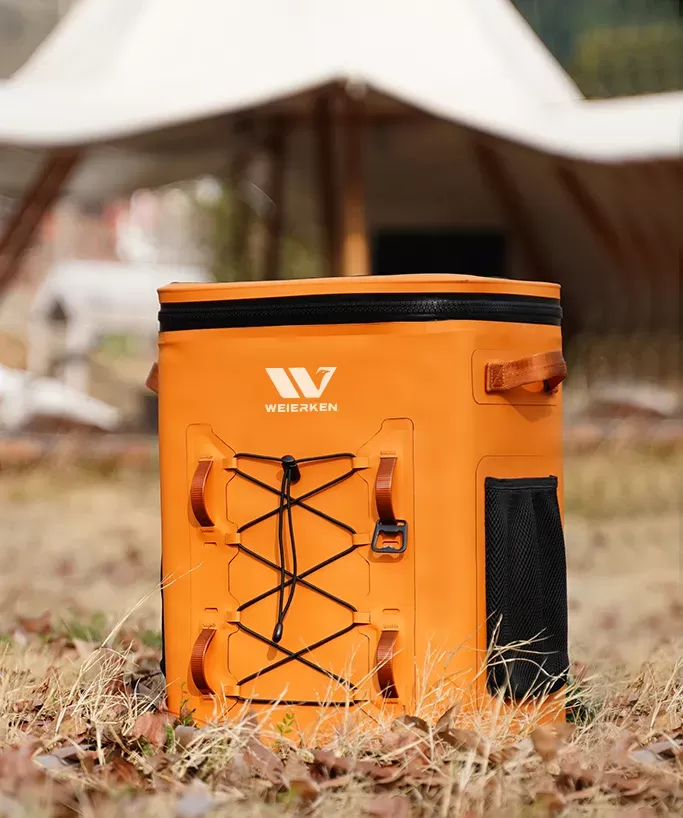

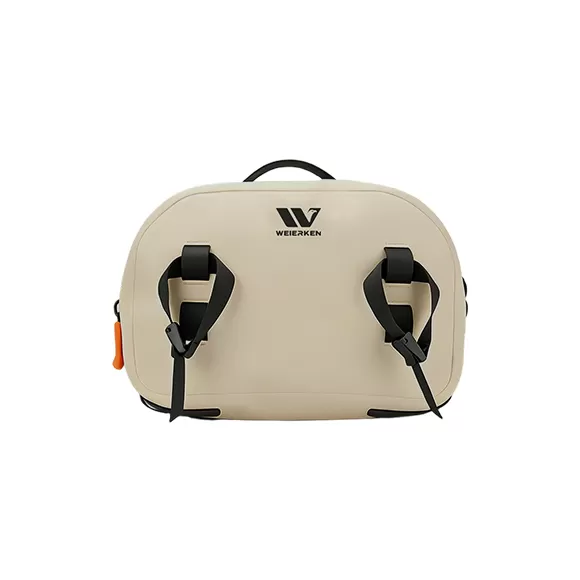
When your fishing vest or tactical rig depends on a compact pouch to hold pliers, terminal tackle, and essential tools, the choice of a modular fishing attachment pouch supplier directly impacts performance on the water. Not all suppliers understand the precision required for MOLLE compatibility, saltwater resistance, or one-handed operation. This guide breaks down the six critical criteria we use at Weierken—based on real production experience and field failures—to help you source pouches that actually work.
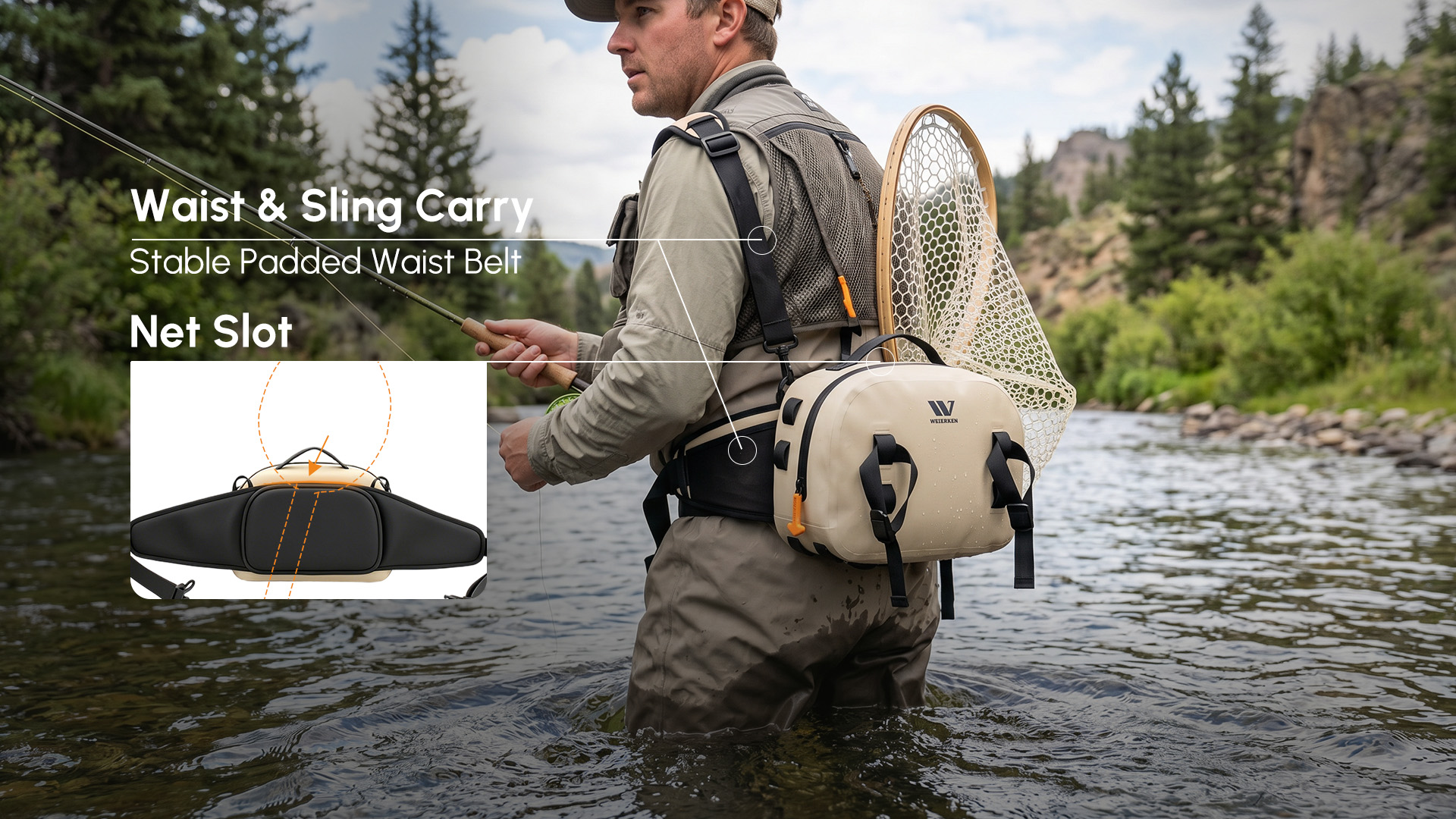
1. MOLLE Compatibility & Mounting Precision – The Non-Negotiable
Foundation
The "modular" promise lives or dies by the attachment system. A pouch that wobbles, slips, or detaches during a cast isn't just annoying—it's a safety hazard when you reach for a hook remover while fighting a fish. Your modular fishing attachment pouch supplier must treat mounting precision as a primary specification, not an afterthought.
MOLLE Webbing Spacing and Stitch Strength
Industry standard MOLLE spacing sits at 1 inch (25mm) between webbing rows, with individual webbing widths of either 25mm or 38mm. Any deviation—even 1.5mm—and the pouch won't weave properly into tactical vests, backpacks, or duty belts. We've rejected entire production runs for less.
Stitching method separates professional suppliers from bargain-bin vendors. Look for double bartacks at every stress point, with each attachment loop tested to hold at least 15kg of static load. Cheap suppliers run a single straight stitch through the surface—it looks like MOLLE until you hang a heavy reel or plier case, then the threads pop like overstretched rubber bands.
Material choice for webbing itself matters. High-density polyester resists moisture absorption and mildew, unlike nylon blends that stay damp for hours after a saltwater trip. Ask your supplier for webbing tensile test reports before cutting any fabric.
Belt Loops and D-Ring Positioning
Belt loops must accommodate both 50mm (2-inch) tactical belts and 38mm (1.5-inch) casual belts—not one or the other. A fixed-width loop forces users to choose between comfort and compatibility, which means lost sales for your brand.
D-ring placement deserves equal scrutiny. Top-mounted or rear-positioned D-rings allow anglers to clip additional tools, lanyards, or even a secondary pouch. Poorly located D-rings create imbalance when loaded, causing the pouch to tilt forward or sag.
Real-world example from our floor: A batch of pouches from a prospective modular fishing attachment pouch supplier arrived with MOLLE spacing off by 2mm across all 500 units. Not one fit the test vests we keep on hand. The entire order went back, and we now gauge every roll of webbing before it hits the cutting table. That single lesson saved us six figures in returns and angry customer emails.
2. Balancing Lightweight Design with High-Durability Materials
Anglers hate unnecessary weight, but they also hate pouches that fall apart after one season. The sweet spot lies in material science, not marketing fluff. A competent modular fishing attachment pouch supplier will walk you through trade-offs instead of pushing one "miracle" fabric.
Fabric Selection – Light Doesn't Mean Thin
Three fabric families dominate this category:
500D Cordura® nylon – Best balance of abrasion resistance and low weight.
840D high-tenacity nylon – Heavier but stands up to repeated rubbing against boat gunnels.
1000D PVC-coated mesh – Maximum waterproofing, but adds noticeable heft.
For attachment pouches, we generally recommend 500D to 840D range. That keeps empty pouch weight under 200g while still surviving years of weekly use. Anything heavier, and your customers will complain about sagging vests.
UV and salt spray testing separate serious suppliers from the rest. Demand QUV accelerated weathering tests (500 hours minimum) and ASTM B117 salt fog exposure. Without these, your pouch fabric may turn brittle and fade within one summer on a deck boat.
Zipper and Buckle Lightweight Options
Attachment pouches see more open-close cycles than main bags—sometimes dozens per fishing trip. Zippers should be #5 or #8 gauge with water-resistant coating. Glove-friendly pulls, like extended tabs or T-shaped sliders, make a noticeable difference in usability.
For buckles and clips, insist on POM acetal resin instead of metal. Metal corrodes in salt air and adds unnecessary weight. Acetal holds up to UV and impact while keeping the overall package light.
At Weierken, we enforce a "weight budget" for every attachment pouch project. Add a new pocket? Reduce fabric weight somewhere else. It's not obsessive—it's how we keep empty weights between 180g and 220g, which our field testers tell us is the comfort threshold.
3. Salt Spray and Water Resistance – The Ultimate Test Environment
Saltwater, fish slime, and repeated wet-hand contact attack attachment pouches twice as fast as main packs because there's no protective outer layer. Zippers seize, coatings peel, and buckles crack within months if the supplier cuts corners.
Salt Spray Test Standards for Hardware
The industry baseline is ASTM B117: 72 hours with no corrosion or functional degradation. We push that to 96 hours for attachment pouches because every time an angler reaches for a tool, the zipper tape gets exposed to salty fingers and spray.
Zipper sliders should feature resin coating or marine-grade stainless steel. Avoid standard nickel-plated or zinc-coated slides—the plating wears off quickly, exposing base metal that rusts and locks up. We've seen exactly this failure pattern across three different supplier samples.
Fabric Water Repellency
Full submersion protection isn't necessary for a pouch that sits on a belt or vest. But durable water repellent (DWR) treatment or a PU/TPU backing is non-negotiable. Without it, saltwater soaks into the fabric and corrodes the small terminal tackle inside—split rings, swivels, and hooks all suffer.
Seam sealing matters too. The bottom panel and zipper surround are the most vulnerable entry points. Tape those seams, or expect returns from customers whose pliers came out rusty after one rainy trip.
Our salt spray log: Standard coated zippers from one supplier started showing white oxidation at 48 hours and locked solid by 72 hours. The same zipper design with upgraded waterproof coating from our preferred partner ran smooth after 96 hours. That difference translates directly to three seasons of happy customers versus three months of complaints.
4. Quick-Access Design and One-Handed Operation
A fishing attachment pouch that requires two hands to open forces anglers to put down their rod or net. That's a non-starter. Every design decision—from zipper routing to closure type—should prioritize single-hand access.
Zipper Routing and Opening Angle
Inverted-V or curved zipper paths create a self-opening effect. When you pull the slider, the mouth naturally spreads wide enough to reach in without using your other hand to hold it open. Aim for an opening angle of at least 90 degrees.
Opening should accommodate fingers of varying sizes. We test with gloved hands and bare hands during our internal trials because anglers fish in all conditions.
Magnetic Closures and Quick-Release Buckles
Some high-end designs now use magnetic self-aligning closures—no zipper to pull, just push the flap closed and it snaps shut. Opening takes a fraction of a second, shaving valuable time when you need to grab a tool and release a fish quickly.
For rapid detachment in emergencies, side-release buckles with one-handed operation outperform standard center-clip designs. A simple thumb press drops the whole pouch, which can be a safety feature if an angler needs to shed weight quickly.
Our design process: Every new prototype goes through a "one-hand reach test" with a panel of recreational anglers. We time each operation—open, retrieve, close—and score usability. If the average time falls below our benchmark, the design goes back to the drawing board. No exceptions.
5. Production Consistency and Dimensional Tolerances
Small pouches demand tighter tolerances than large backpacks. A 1mm error in MOLLE spacing means a pouch that won't weave. A 2mm deviation in belt loop width means a pouch that wobbles on a tactical belt. These issues only surface in mass production if the supplier lacks rigorous quality controls.
Cutting Precision and Tooling Management
Laser cutting or high-precision die-cutting maintains dimensional accuracy within ±1mm for all panels. Suppliers who use manual cutting or worn tooling introduce variability that accumulates across multiple pattern pieces.
We require suppliers to log die usage and replace tooling after a set number of cuts. This prevents subtle drifts in dimension that creep in as tooling dulls.
Stitching Standards and Inspection Checkpoints
Stitch density directly affects both strength and flexibility. We specify 8 to 10 stitches per inch on all webbing attachments and stress seams. Too few stitches, and the seam tears under load. Too many, and the fabric puckers or tears along the stitch line.
Critical inspection points include:
MOLLE webbing spacing measured with a go/no-go gauge at three points per pouch.
Zipper open-close cycle test (minimum 500 cycles).
Buckle engagement and release force testing.
During factory audits, we don't just look at finished samples—we examine cutting tables, die storage, and maintenance logs. That's where you spot inconsistencies that sample rooms hide.
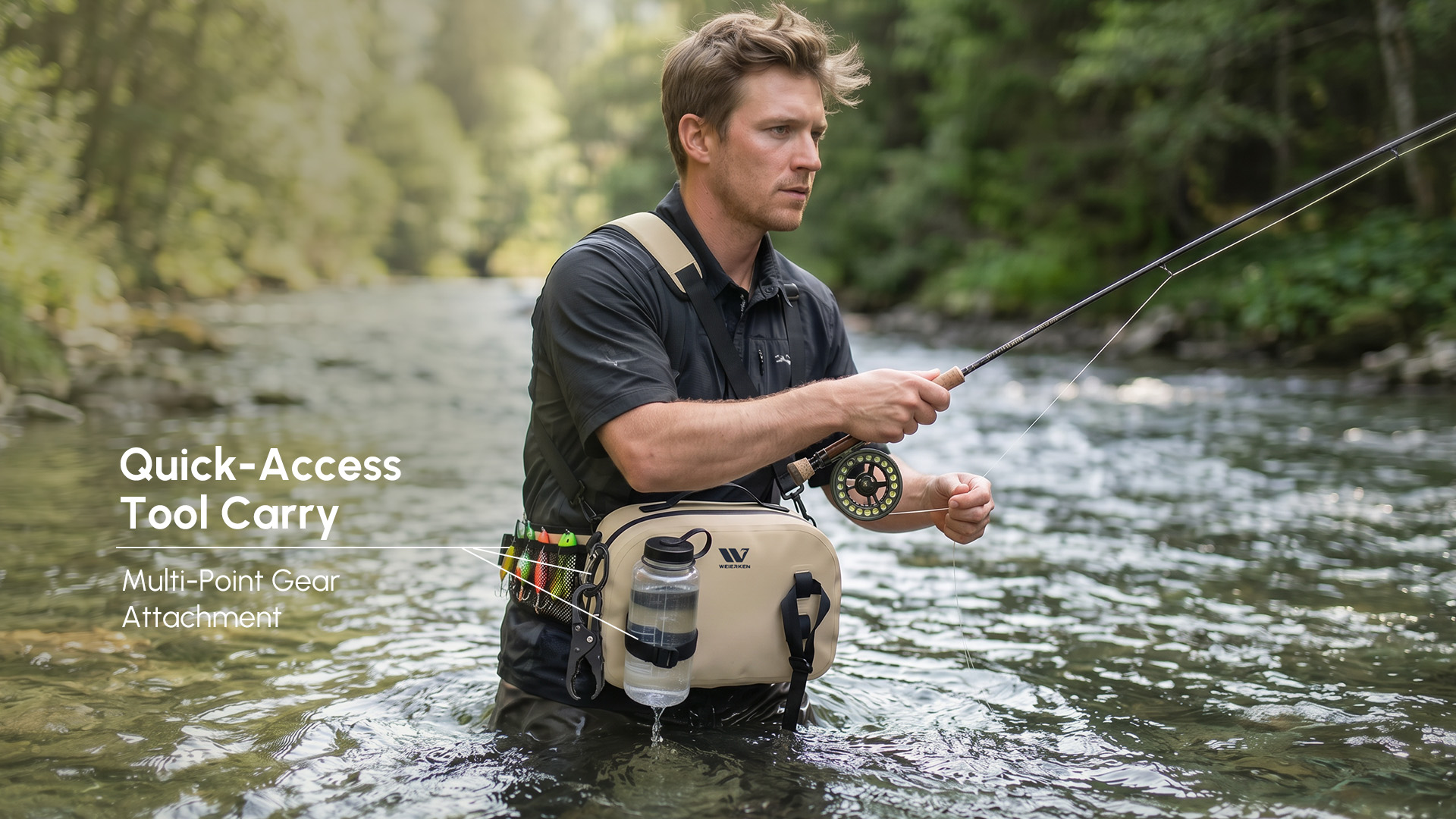
6. Customization Capabilities – From Logos to Functional Layouts
Attachment pouches often require more customization than larger packs because they serve specific tool-carrying needs. Your modular fishing attachment pouch supplier should treat each order as a unique project, not a "pick from our catalog" exercise.
Logo Application Methods
Screen printing: Cost-effective for large runs with simple artwork.
Heat transfer: Handles gradients and smaller quantities well.
Embroidery: Premium look with excellent longevity, but must be balanced against fabric thickness to avoid distortion.
Laser engraving: Permanent marking for leather or coated fabrics.
Interior Layout and Exterior Attachment Points
Internal organizer panels can include dedicated slots for pliers, snippers, and hook boxes. Exterior webbing or D-rings can be repositioned to match the user's existing vest layout—right-handed vs. left-handed access, for instance.
At Weierken, we start every attachment pouch project with a "feature matrix" that lists every pocket, strap, and D-ring required. Only after both sides sign off on that matrix do we move to sampling. That way, the final product isn't a modified standard item—it's purpose-built for the customer's exact specifications.
Frequently Asked Questions
Q1: What is the minimum order quantity (MOQ) for a modular fishing
attachment pouch from a reliable supplier?
A1: MOQs vary
significantly based on customization level. For standard colorways with minimal
logo work, expect MOQs around 500–1000 pieces. For fully custom layouts with
unique webbing configurations and multiple interior pockets, many suppliers
require 2000+ units to justify tooling costs. Weierken offers flexible tiers
starting at 500 pieces for approved designs, with sample runs available for
prototyping.
Q2: How can I verify a supplier's MOLLE spacing compliance before
placing a large order?
A2: Request physical samples and measure the
webbing spacing with a caliper at three separate points on the pouch. Also ask
for a "webbing gauge" that matches their production tooling—many professional
suppliers use metal templates to check every row before cutting. If a supplier
hesitates to provide samples or gauge measurements, that's a red flag.
Q3: What salt spray test duration should I specify for coastal
fishing applications?
A3: The industry baseline is 72 hours per ASTM
B117. For attachment pouches, we recommend specifying 96 hours because of the
high zipper exposure. Ensure your supplier provides a third-party lab report,
not just an in-house test, and confirm the test includes both the zipper and any
metallic hardware.
Q4: Can the same modular fishing attachment pouch fit both MOLLE
vests and standard belt loops?
A4: Yes, but only if the supplier
designs a dual-attachment system. The pouch needs removable or repositionable
belt loops that work with 38mm and 50mm belts, plus MOLLE webbing on the rear
panel. Some designs use a detachable clip system that covers both bases. Verify
the specific compatibility range with your supplier before production.
Q5: How do I ensure dimensional consistency across multiple
production batches?
A5: Require your supplier to maintain strict die
control—each die should have a usage log, and replacement should occur after a
set number of cuts. Also specify in your quality agreement that random samples
from each batch undergo the same dimensional checks as the initial PP sample. At
Weierken, we archive die parameters and use laser-cut templates for every
reorder to maintain ±1mm accuracy.
Selecting the right modular fishing attachment pouch supplier means examining MOLLE precision, material science, salt-spray resistance, one-handed access, and batch-to-batch consistency. Weierken has been through the trial-and-error process—failed batches, returned orders, and redesigned prototypes—so you don't have to. Every pouch we ship meets the gauge checks, seam strength tests, and salt spray validation we learned the hard way to enforce.
Looking for a supplier who treats attachment pouches with the same rigor as main packs? Request our pouch specification checklist and sample testing protocol.