
Serving corporate clients is a high-stakes business. When a law firm or a tech company orders lunch for 150 executives, a lukewarm chicken breast or a soggy side dish can destroy a catering contract instantly.
Standard delivery gear built for gig couriers cannot handle these demands. To protect food safety and brand prestige, caterers and ghost kitchens rely on commercial insulated bags for corporate meal delivery engineered to hold food above safe temperature thresholds for four hours or longer.
At Weierken, we design commercial-grade thermal transport gear for high-volume foodservice operations. In this guide, we break down the engineering required to hold safe temperatures, review the six best bag designs for corporate logistics, and explain how to audit suppliers before placing a bulk order.
What Are Insulated Bags for Corporate Meal Delivery (and Why Ordinary Courier Bags Fail)?
An insulated bag for corporate meal delivery is a heavy-duty, commercial-grade thermal carrier engineered to transport large-format, high-density food orders over extended transit windows while maintaining strict food safety temperatures.
Gig-economy delivery bags are built for 20-minute motorbike trips carrying two plastic containers. Using them for enterprise-level corporate drop-offs leads directly to catastrophic spills, crushed packaging, and cold food.
Commercial B2B meal distribution differs from standard retail delivery in three major operational areas:
Payload and Internal Weight Capacity: A typical corporate lunch delivery spans 40 to 200 individual portions or multiple heavy gastro pans. Bags carry between 20 kg and 50 kg of food. Flimsy retail delivery bags bend under this load, causing inner containers to collapse and spill sauce across the interior.
Extended Transit and Staging Windows: Individual food delivery takes under 30 minutes from pickup to doorstep. Corporate drop-offs involve bulk packaging in a central kitchen, long transit across urban traffic, access delays at security gates, freight elevators, and corporate staging tables. The entire timeline easily reaches 3 to 4 hours before clients open a single box.
Corporate Aesthetic and Hygiene Standards: Executive clients scrutinize delivery staff walking into corporate headquarters. Wrinkled, grease-stained delivery packs ruin the experience. Corporate delivery bags must maintain a crisp, upright structure, stay clean, and reflect a polished corporate image.
How Commercial Insulated Bags Maintain Heat for 4+ Hours
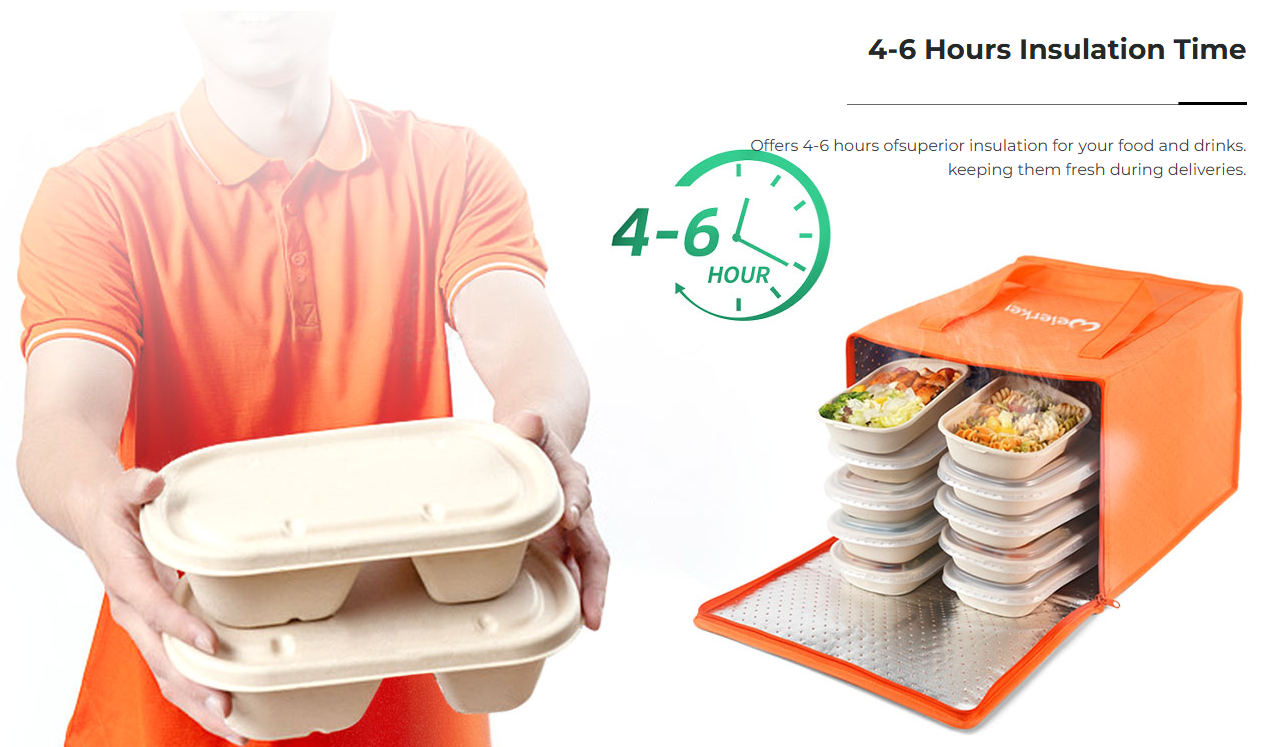
Holding food above 60°C (140°F) for extended periods without an electrical plug requires strict thermodynamic engineering. Bacteria multiply rapidly between 4°C and 60°C (40°F to 140°F), known under HACCP guidelines as the Danger Zone. Commercial-grade carriers prevent temperature drop by cutting off every path of heat transfer.
1. High-Density Conduction Barriers
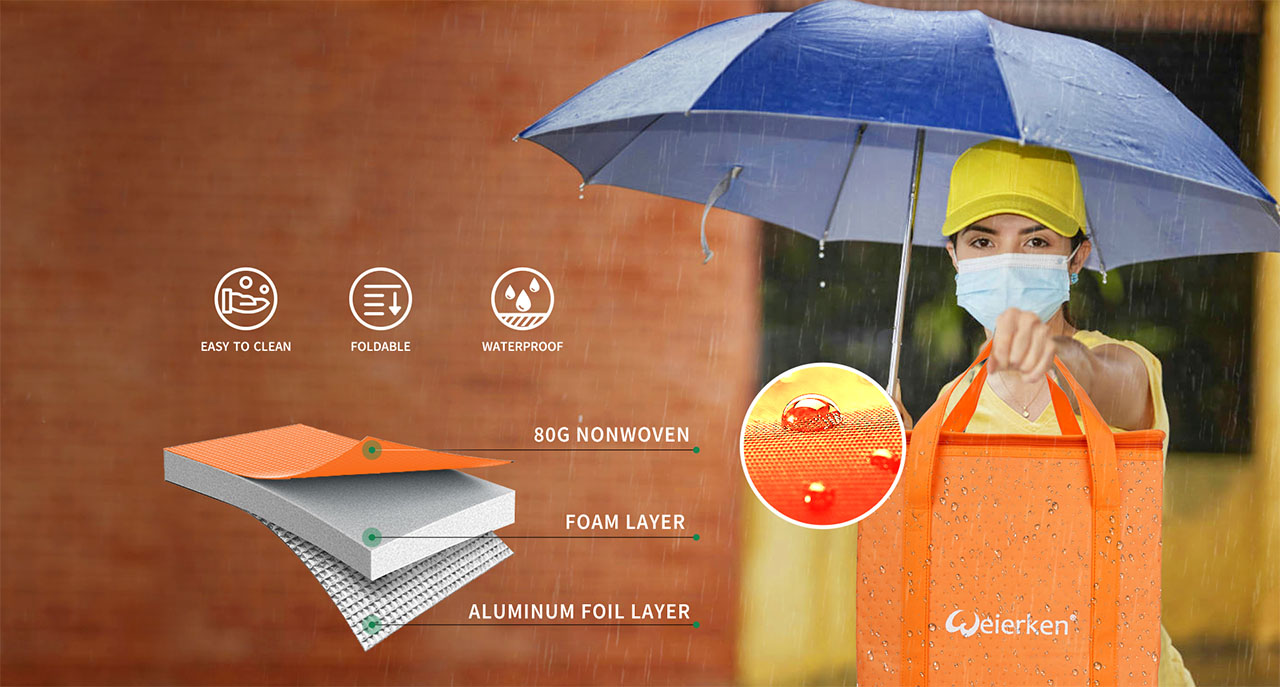
Heat naturally flows toward cold ambient air. High-performance bags block this flow using 15mm to 20mm layers of closed-cell Expanded Polyethylene (EPE) or Polyurethane (PU) foam. Unlike cheap open-cell sponge materials, closed-cell structures do not collapse under weight, ensuring the insulation thickness remains uniform even when fully loaded.
2. Thermal Radiation Reflection
Hot food constantly emits infrared thermal radiation. To trap this energy, top-tier corporate lunch delivery bags feature food-grade composite aluminum foil or heat-reflective silver TPU linings. These inner surfaces bounce up to 95% of emitted infrared radiation back toward the meal containers, keeping the air chamber naturally hot.
3. Airtight Sealing and Thermal Draft Baffles
Convection leaks kill internal temperatures. If warm air escapes through needle holes or zipper teeth, internal temperatures plummet within 45 minutes. Commercial carriers solve this with high-frequency ultrasonic welded seams that eliminate needle perforations. Heavy-duty waterproof zippers paired with internal magnetic thermal baffles form an airtight barrier that seals warm air inside.
6 Best Types of Insulated Bags for Corporate Meal Delivery
Every corporate meal delivery model presents unique physical challenges. Selecting the right carrier style prevents package deformation, eliminates temperature drop, and streamlines driver handling.
1. Executive Bento-Box Insulated Delivery Bags
High-end corporate meetings demand premium individual bento boxes. These meals typically feature multi-component dishes that cannot tilt, shake, or mix during transit.
Best For: Boardroom lunches, VIP executive conferences, and plated individual meals.
Core Features: Rigid interior wall structures paired with infinitely adjustable, hook-and-loop shelf dividers. Each meal tier rests on its own independent shelf, eliminating box crushing.
Thermal Profile: Thick 18mm high-density foam core holding safe serving heat for up to 4.5 hours.
2. Full-Size Pan (GN Pan) Catering Delivery Bags
Transporting buffet-style meals requires moving scorching-hot, heavy 1/1, 1/2, or 1/3 Gastronorm (GN) stainless steel or foil food pans.
Best For: Corporate buffets, company-wide parties, and large on-site cafeteria service.
Core Features: A reinforced base lined with high-temperature, heat-resistant baseboards capable of handling pans up to 120°C without melting. Riveted, heavy-duty side carry handles allow two couriers to lift 40kg safely.
Thermal Profile: Reflective aluminum interior combined with dense insulation guarantees standard pan drop-offs stay steaming hot past the 4-hour mark.
3. Heavy-Duty Rolling Insulated Bags
Navigating long underground loading docks, parking garages, and high-rise freight elevators with heavy orders quickly exhausts delivery teams.
Best For: High-density urban office towers, campuses, and orders above 35kg.
Core Features: Integrated industrial-grade alloy wheel frames, heavy-duty stair rails, and quiet, shock-absorbing rubber wheels. Couriers roll massive orders straight into executive pantries without breaking a sweat or tilting the food.
Thermal Profile: Sealed perimeter gasket construction with bottom thermal barrier shields that block ambient cold transfer from concrete floors.
4. Dual-Compartment Hot and Cold Delivery Bags
Modern corporate clients rarely order hot food alone. They expect hot braised mains served alongside chilled artisan salads, cold desserts, and iced drinks.
Best For: Complete corporate combo lunches, all-in-one lunch sets, and multi-course dining.
Core Features: A dense, insulated thermal bridge separates the bag into two distinct zones. The hot chamber holds meals above 65°C, while the cold side maintains beverages and salads below 4°C, preventing thermal bleed between compartments.
Thermal Profile: Independent double lids minimize thermal loss during loading and unloading.
5. Eco-Friendly rPET Corporate Meal Carriers
Multinational corporations and technology enterprises run strict ESG (Environmental, Social, and Governance) programs. They prefer food vendors that share their commitment to sustainability.
Best For: Catering businesses bidding on corporate vendor contracts with strict green standards.
Core Features: Exterior shells woven entirely from Global Recycled Standard (GRS) certified rPET fabric, manufactured from recycled consumer plastic bottles. The material features an upscale matte texture that signals environmental responsibility.
Thermal Profile: Lined with recyclable closed-cell foam cores that deliver equal thermal efficiency to conventional synthetic materials.
6. PCM Heat-Assisted Long-Distance Delivery Bags
Deliveries over long distances during freezing winter months drain passive insulation fast. Passive bags alone struggle to hold heat over four hours in sub-zero ambient conditions.
Best For: Sub-zero winter operations, long-distance regional corporate supply, and ghost kitchen distribution.
Core Features: Built-in structural pockets tailored for Phase Change Material (PCM) heat packs. These packs absorb and release thermal energy at a preset temperature of 65°C to 70°C, acting as an active thermal battery.
Thermal Profile: Extends safe temperature retention past 6 hours, even in freezing external conditions.
B2B Buyer's Checklist: How to Vet Commercial Delivery Bags
Purchasing corporate meal delivery bags in bulk requires a careful look at durability, operational fit, and hidden costs. Keep this checklist handy when assessing commercial samples:
Total Cost of Ownership (TCO): Never evaluate bags solely on unit cost. A low-cost $25 delivery bag that tears within 90 days costs far more than an industrial $70 bag that survives two full years of high-volume delivery cycles. Factor in replacement rates, broken zippers, food waste from spills, and cross-border shipping duties.
Wipe-Clean Sanitation and Grease Resistance: Food oils and gravies inevitably leak. The interior lining must feature heat-sealed TPU or seamless aluminum that wipes clean with mild sanitizers in seconds. Avoid stitched canvas interiors that absorb grease, grow mold, and generate foul odors.
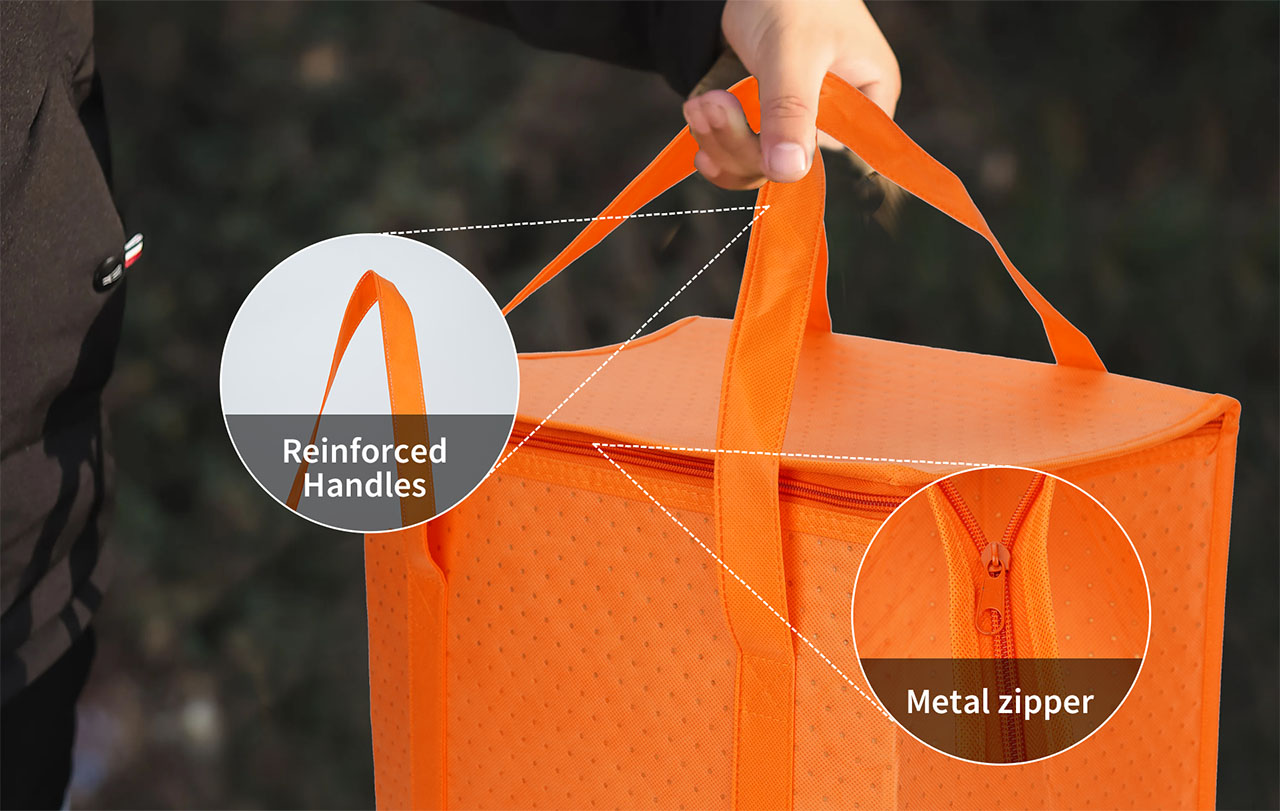
Reinforced Load-Bearing Hardware: Check the stress points where straps attach to the bag body. Commercial models require cross-box stitching, heavy-duty metal D-rings, and industrial-grade webbed straps tested to withstand at least 50kg of pull force without seam separation.
Brand Customization Precision: Your delivery fleet functions as mobile billboard advertising in corporate office parks. Partner with manufacturers that provide custom Pantone fabric matching, durable silk screening, reflective safety accents, and heat-transfer corporate logos that will not peel after repeated cleanings.
OEM Manufacturing Support: Weierken Enterprise Delivery Solutions
Procuring reliable commercial corporate meal delivery bags at scale requires a manufacturing partner with deep structural engineering expertise and a resilient supply chain. Weierken supports enterprise catering fleets, nationwide restaurant chains, and B2B ghost kitchens with bespoke delivery gear.
Our precision prototyping lab delivers custom-dimensioned bag samples tailored to your exact meal box shapes within 3 to 7 business days. We validate thermal performance inside specialized thermal testing chambers, providing verified temperature retention curves before mass production starts.
To shield clients from volatile trade policies, Weierken operates a dual-manufacturing footprint with production plants in both China and Cambodia. Our Cambodian facility offers full duty-mitigation advantages for imports into the North American and European markets, helping high-volume buyers optimize customs costs.
Our factories run under ISO 9001, BSCI, and GRS compliance, maintaining a 99.5% first-pass production yield. We handle international logistics end-to-end, offering full DDP (Delivered Duty Paid) shipping to ensure commercial orders arrive at your distribution facilities on time and ready for deployment.
Frequently Asked Questions
Q1: How do passive insulated bags hold temperature for 4+ hours without active heating elements?
A1: High-end passive bags rely on thermodynamic isolation rather than active heat generation. By combining 15mm+ thick closed-cell foam, radiant heat-reflective liners, and airtight sealed zippers, the bag traps the thermal mass of the hot food. If packed at capacity with items above 75°C, the collective thermal energy remains trapped inside the micro-environment, keeping heat above the 60°C safety line for four hours or more.
Q2: Can commercial corporate meal delivery bags be machine washed?
A2: Commercial thermal bags should not go into commercial washing machines or dryers. Agitation breaks down the internal foam structure and destroys the heat-sealed thermal tape along the seams. Instead, use commercial food-safe sanitizing sprays and micro-fiber cloths to clean the waterproof, non-porous interior surfaces daily, then hang the bag open to air-dry.
Q3: What outer fabric holds up best against daily freight elevator and concrete scuffs?
A3: Heavy-duty 900D to 1680D ballistic polyester or Oxford nylon with a matte Polyurethane (PU) backing offers the best tear, puncture, and abrasion resistance. These fabrics resist moisture, slide smoothly across concrete curbs without shredding, and maintain a clean, professional aesthetic in executive corporate environments.
Q4: Why does dual-facility manufacturing matter when sourcing B2B delivery bags?
A4: Sourcing from manufacturers with plants in both China and Southeast Asia (like Cambodia) helps buyers avoid sudden tariff hikes and trade disputes. High-volume buyers can source components efficiently while running final assembly in tariff-exempt regions, cutting total landing costs by 15% to 25% without sacrificing build quality.
Q5: What food-safety certifications should insulated bag linings hold?
A5: Bag linings must comply with FDA (Food and Drug Administration) requirements in the United States or LFGB testing standards in the European Union. These certifications guarantee that the interior lining material, reflective foils, and adhesives will not release toxic fumes, micro-plastics, or harmful chemicals when exposed to hot steam and oils.
Upgrade Your Corporate Delivery Operations Today
Cold, damaged food ruins corporate client relationships and triggers costly refunds. Equipping your fleet with custom-engineered insulated bags for corporate meal delivery safeguards meal temperatures, protects your food presentation, and reinforces your brand's commitment to quality at every high-rise drop-off.
Whether you need custom-molded bento box carriers, high-capacity rolling meal boxes, or sustainable rPET catering bags, Weierken can build the exact transport gear your fleet requires.
Contact the Weierken engineering team today to review your food box specifications, receive custom 3D design mockups, and request an industrial sample along with an import duty-optimization estimate for your upcoming project.