
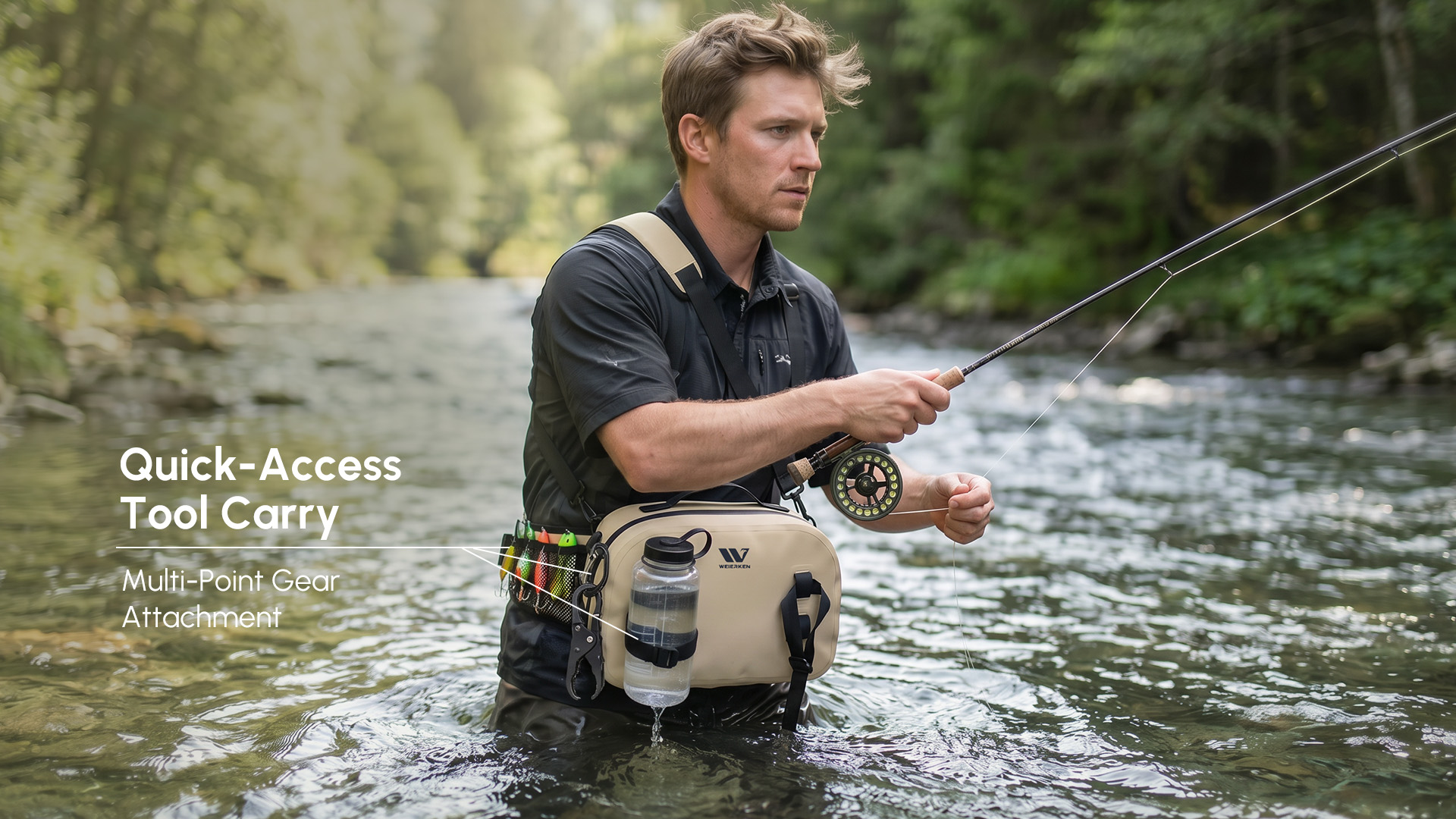
Fly fishing gear continues to move toward lighter, faster, and more specialized configurations. Modern anglers often bypass bulky vests in favor of technical sling packs. These packs provide quick access on the water without getting in the way of a double haul.
For outdoor brands, sourcing a dependable custom fly fishing sling pack manufacturer has grown complicated. Environmental rules are tightening across the EU and North America. Raw material costs shift constantly. Anglers now expect true submersible waterproofing rather than simple water resistance.
Whether you are scaling an established fly tackle label or launching a direct-to-consumer gear company, your manufacturing partner will define your product reputation. Specialized developers like Weierken have shown that technical precision separates functional fishing luggage from gear that fails mid-current. This guide breaks down the factory vetting process from initial design to final delivery.
1. Why Fly Fishing Sling Pack Manufacturing Demands Technical Rigor
Fly fishing packs take relentless abuse. They endure deep wading, sharp hooks, UV exposure, and abrasive riverbanks. Standard cut-and-sew factories simply cannot build bags that withstand these conditions.
Submersible Waterproofing and Fabric Standards
Anglers frequently wade chest-deep or drop their bags onto wet gravel bars. A high-performance sling pack must meet rigorous ingress protection standards, typically IPX7 (temporary submersion) or IPX8 (continuous submersion under pressure).
- TPU-Coated Nylon: 420D to 840D high-density nylon with double-sided thermoplastic polyurethane (TPU) coating provides superior puncture resistance and creates a dependable airtight barrier.
- Recycled Technical Fabrics: Sourcing GRS-certified (Global Recycled Standard) ocean-bound plastics and recycled nylon is becoming a baseline requirement for tackle brands targeting eco-conscious fly fishers.
- Welding vs. Stitching: Traditional sewing needles punch thousands of tiny holes through the textile. A professional waterproof fishing sling pack factory uses radio frequency (RF) or high-frequency (HF) welding to fuse TPU layers together at the molecular level, creating 100% leak-proof seams.
Ergonomics and Specialized Fly Fishing Features
A sling pack must rotate smoothly from back to chest while keeping the angler balanced on slick river rocks. Bad geometry causes shoulder strain and interferes with casting strokes.
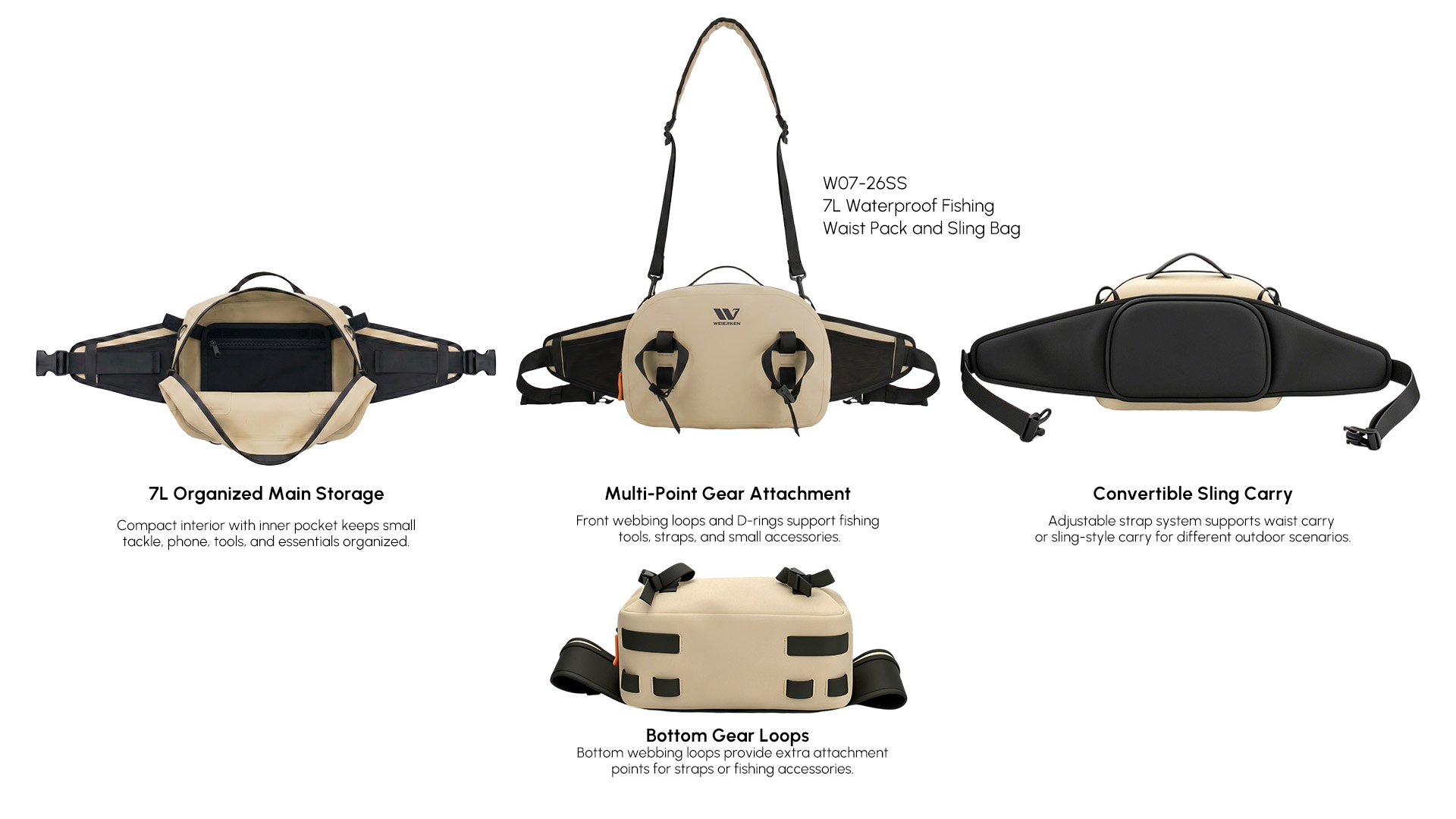
- Casting Clearance: The pack contour must sit clear of the dominant casting arm and avoid catching fly lines during retrieval.
- Ambidextrous Sling Systems: Top-tier designs allow users to switch the shoulder strap orientation without losing access to main compartments.
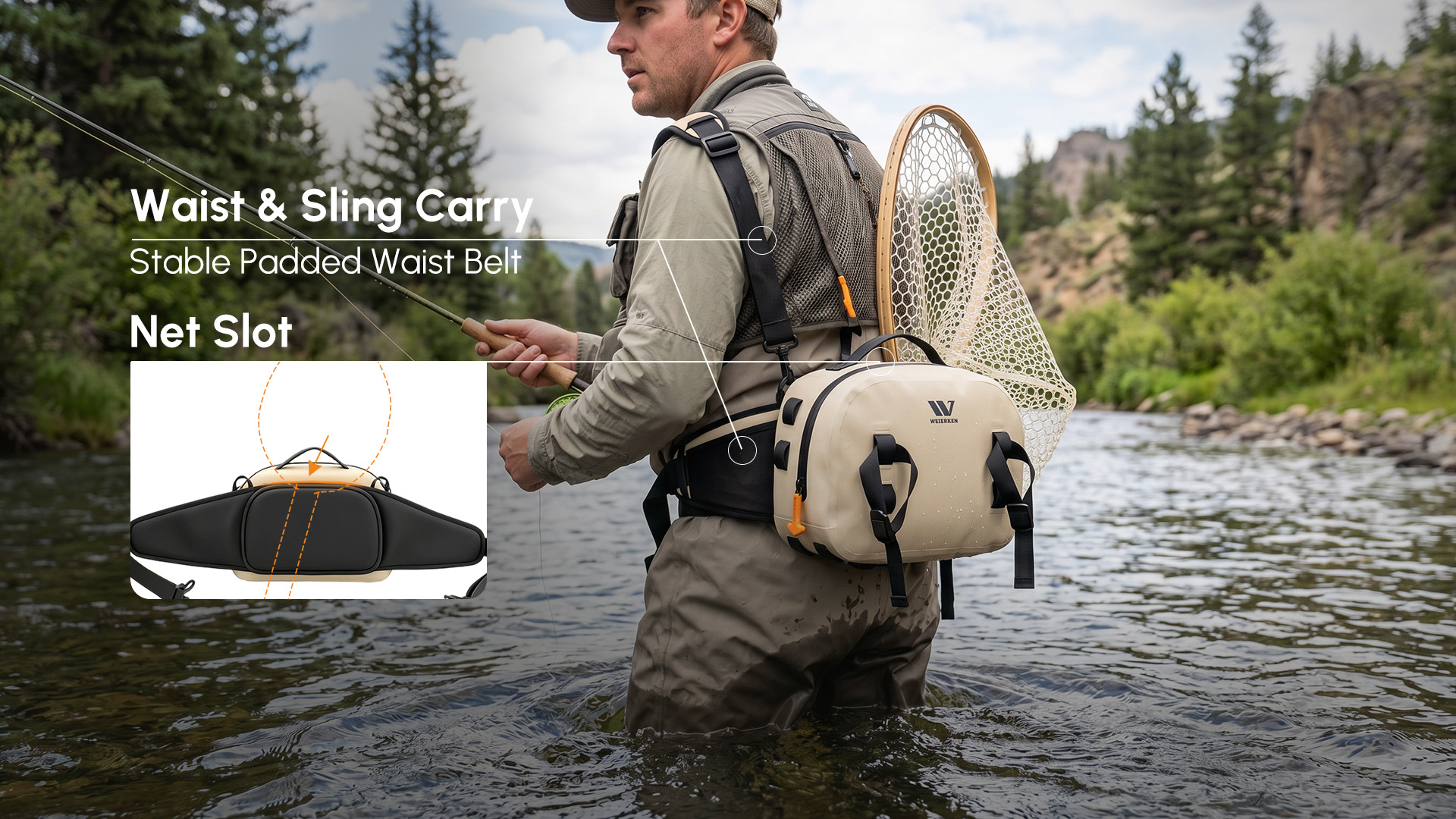
- Integrated Tool Stations: Dedicated net holsters, magnetic fly patches, tippet spool tenders, and forceps sheaths must be integrated directly into the chassis.
- Submersible Zippers: Reliable packs utilize toothless waterproof zippers (such as TRU Zip) or heavy-duty coated mechanical zippers (like YKK AquaGuard) tested against hydrostatic head pressure.
2. OEM vs. ODM: Determining the Right Path for Your Gear Brand
Before contacting suppliers, decide whether an OEM or ODM model aligns with your operational budget and technical capabilities.
OEM (Original Equipment Manufacturer)
You supply the complete tech pack, material specifications, bill of materials (BOM), and digital patterns. The factory serves strictly as your production arm. This route gives you total control over branding, pocket architecture, and unique features. It requires technical design experience and higher upfront capital for custom molds and tooling.
ODM (Original Design Manufacturer)
The supplier provides proven, pre-engineered base designs. You select an existing platform and customize the colors, branding, zipper pulls, and exterior tool attachments. Working with an ODM fly fishing gear supplier reduces product development cycles from nine months down to several weeks. It offers a practical starting point for boutique fly shops and growing apparel brands.
Proprietary Tooling and IP Protection
If you engineer a proprietary net sleeve, custom shoulder harness, or specialized mold, ensure your manufacturing contract explicitly covers intellectual property rights. A trustworthy custom fly fishing sling pack manufacturer will sign a bilingual non-disclosure agreement (NDA) before reviewing your technical files.
3. How to Vet a Custom Fly Fishing Sling Pack Manufacturer
Many trading firms display impressive pack designs online but outsource their assembly to basic sewing workshops. Use the following criteria to evaluate real technical capability.
Quality and Sustainability Certifications
Look for internationally recognized operational certifications. ISO 9001 shows consistent quality management systems. Social compliance audits, such as BSCI or SMETA, protect your brand from supply chain labor risks. For sustainable collections, ensure the plant holds valid GRS, OEKO-TEX Standard 100, or Bluesign system partner credentials.
Workshop Equipment and In-House Testing
Ask for a live video audit or plant walkthrough. A capable factory will feature distinct production zones:
- RF/HF Welding Machines: Dedicated heat-sealing and radio frequency bonding lines, not just rows of standard single-needle lockstitch machines.
- Laser Cutters: Computer-controlled laser tables that cut TPU and synthetic laminates with sealed edges that resist fraying.
- Inflation and Water Submersion Tanks: Quality control staff should inflate finished TPU fly fishing pack units and submerge them under water to monitor for micro-bubbles along seams and zippers.
- Abrasion and Tensile Testers: In-house labs to measure strap pull-strength and fabric tear resistance under load.
R&D and Prototyping Speed
Experienced technical manufacturers provide engineering feedback rather than blindly following flawed tech packs. They should point out high-stress points, suggest better welding radiuses, and deliver a physical sample within 10 to 18 business days.
Minimum Order Quantities (MOQ) and Production Flexibility
RF welded waterproof bags require custom machine jigs for each seam profile. Because setup times are labor-intensive, typical factory MOQs range from 500 to 1,000 units per colorway. Forward-thinking manufacturers like Weierken work with growing brands by providing tiered production schedules or split colorways across a shared bag chassis.
4. Sourcing Channels to Find Top Fly Fishing Gear Factories
Locating the right production partner takes targeted research and direct engagement.
Targeted B2B Sourcing Queries
Skip generic search terms. Use targeted queries such as "OEM airtight fishing bag supplier", "high frequency welded TPU sling pack factory", or "custom waterproof tackle pack manufacturer". Review their product galleries to verify they build genuine outdoor gear, not cheap promotional dry sacks.
Industry Trade Shows
Meeting suppliers face-to-face allows you to inspect build quality, seam clean lines, and zipper alignment firsthand. Useful shows include:
- ICAST: The premier sportfishing trade event, ideal for connecting with niche tackle pack producers.
- EFTTEX: The European fishing tackle trade exhibition, focused on technical angling gear.
- Outdoor Retailer (OR): A hub for technical fabric suppliers and advanced pack assembly factories.
Regional Manufacturing Hubs: China vs. Vietnam
China remains the clear leader in RF welding technology, TPU supply chains, and specialized hardware availability. Prototyping speeds and technical problem-solving move very quickly here. Vietnam is an excellent alternative for high-volume orders targeting tariff diversification, though component supply chains frequently still route through Chinese raw material mills.
5. From Tech Pack to Shipment: The Step-by-Step Production SOP
Maintain clear communication throughout the production cycle to prevent costly delays and rework.
Step 1: Tech Pack and BOM Finalization
Provide 2D/3D vector files detailing exact pocket dimensions, seam weld widths, D-ring coordinates, loop velcro placements, and fabric deniers. List all primary brand components, including custom zipper pullers and Hypalon utility patches.
Step 2: Quotation and Tooling Sign-Off
The factory reviews your files and delivers a detailed quotation. If your design features unique molded pads or ergonomic harness components, you will pay a one-time tooling/mold fee before sampling starts.
Step 3: Sample Prototyping and Field Testing
Never approve mass production based on digital renderings. Order physical prototypes and take them directly to the river. Check the following:
- Does the net slip out when you lean forward to land a fish?
- Do the zipper tracks bind when the sling pack holds heavy fly boxes?
- Does water leak into the primary compartment during a 10-minute full submersion test?
Step 4: Pilot Run and AQL Inspection
Once you approve the golden sample, place your purchase order. Define your inspection threshold using the international standard AQL 2.5 (Acceptable Quality Limit). Third-party inspectors should check seam alignment, logo crispness, zip smoothness, and packaging integrity before the shipment leaves the factory floor.
Step 5: Logistics and Custom Clearance
Work with your factory to establish clear shipping terms. FOB (Free on Board) works well if you manage your own freight forwarder. DDP (Delivered Duty Paid) suits smaller brands that prefer the manufacturer to handle ocean freight, customs tariffs, and local warehouse trucking.
6. Common Pitfalls to Avoid When Sourcing Fly Fishing Packs
Building technical gear leaves little room for error. Watch out for these operational red flags:
- Trading Intermediaries Posing as Direct Factories: If a contact hesitates to show real-time video of an active welding floor or cannot explain their RF jig calibration, you are likely dealing with an agent who adds margin without adding technical value.
- Counterfeit or Grey-Market Waterproof Zippers: Water-tight zippers make up a large portion of total pack costs. Shady producers sometimes swap genuine TRU Zip or YKK components for unbranded knockoffs that split under moderate lateral tension.
- Underestimating Seam Tolerances: In RF welding, a discrepancy of two millimeters can result in a cold weld, leading to micro-leaks along the bottom panel. Require factory pressure-testing documentation on every production batch.
Frequently Asked Questions (FAQ)
Q1: What is the typical lead time for custom fly fishing sling pack production?
A1: Initial R&D and sampling generally require 2 to 4 weeks, depending on mold requirements. Once you approve the pre-production sample, bulk manufacturing takes between 45 and 60 days. Factor in an additional 20 to 35 days for ocean freight, depending on your home port.
Q2: Can we manufacture completely submersible fly fishing sling packs using recycled fabrics?
A2: Yes. Recycled nylon or polyester laminates coated with thermoplastic polyurethane (TPU) work effectively with RF welding machinery. Make sure your supplier provides valid GRS (Global Recycled Standard) transaction certificates for every raw material lot.
Q3: What makes a fly fishing sling pack different from a standard outdoor sling bag?
A3: Fly fishing slings prioritize casting ergonomics, balance stability, and specific tool integration. They feature dedicated landing net pockets, fly-drying patches, tippet spool docks, non-corrosive materials, and waterproof construction that withstands deep river wading.
Q4: How do factories test the waterproof integrity of completed packs?
A4: Reputable plants use air inflation testing. Technicians pump low-pressure air into the sealed bag through a temporary valve or check-fixture and submerge the pack in a clear water tank. Any continuous stream of bubbles indicates a seam defect or zipper leakage.
Q5: What are standard payment terms when working with an overseas gear manufacturer?
A5: The typical industry term is a 30% deposit upon signing the sales contract to secure raw materials, with the remaining 70% balance paid after final quality inspection and before bill-of-lading release.
Work With a True Technical Manufacturing Partner
Fly anglers are notoriously demanding with their gear. They notice uneven stitching, flimsy buckles, and seams that weep water during rainstorms. Building a successful fly fishing luggage brand requires moving past generic gear catalogs and partnering with a dedicated production facility.
A capable custom fly fishing sling pack manufacturer acts as an engineering partner, refining your functional concepts into hard-wearing products that build customer loyalty season after season. Contact technical development teams like Weierken to review your tech pack, explore fabric options, and request a detailed production quote today.