
The global standup paddleboarding market faces a clear operational reality in 2026. Inflatable SUP boards are heavy, expensive to ship, and cutthroat on margins. Established board companies and rising outdoor labels cannot rely on board sales alone to sustain healthy cash flow.
High-margin accessories bridge this gap. Every paddler needs a way to protect their phone, car keys, towels, and dry clothes on the water. Yet, many brands slap a generic logo on an open-mold PVC dry cylinder and call it a day.
Those generic products create price wars, generate bad customer reviews when seams split, and drag down your brand equity. Winning brands work directly with specialized OEM partners. Working with an agile custom SUP dry bag manufacturer like Weierken gives direct-to-consumer labels and distributors the exact engineering edge they need to stand apart.
Why Custom Dry Bags are the Growth Engine for Watersports Brands in 2026
Hardware gets paddlers onto the water. Accessories make the business profitable. As freight costs fluctuate, shipping a 12-kilogram board package yields far lower net returns per cubic meter than shipping a crate of precision-engineered waterproof packs.
High Margins and Repeat Purchases
Paddleboards have a multi-year replacement cycle. Most customers will not buy another board for three to five years. In contrast, paddlers buy bags frequently for different activities, day trips, and gear loads.
- Gross margins on branded technical bags regularly sit between 60% and 75%, compared to 30% to 40% on complete board packages.
- Compact package sizes slash your landed shipping costs per unit across ocean and air routes.
- Lower price thresholds encourage repeat buys from loyal customers throughout the paddling season.
Moving Billboards on the Water
A board spends hours strapped to a roof rack or stored away in a garage. A dry bag travels everywhere. Paddlers carry their bags onto the dock, up to beachside cafes, and into campgrounds.
A unique silhouette, clean color blocking, and sharp branding turn every customer into an active brand ambassador. Stock bags from generic wholesalers make your business look like an amateur reseller. Purpose-built gear creates authentic brand authority.
Strategic Bundling to Lift Average Order Value
Top watersports brands rarely sell naked boards anymore. They sell full adventure setups. Bundling a custom-fitted deck bag with an inflatable SUP package increases your checkout conversion rate.
You can offer the bag as an upsell module at checkout, instantly lifting your Average Order Value (AOV). Customers perceive massive value because the bag matches the board's aesthetics and tie-down points perfectly, eliminating guesswork for the paddler.
4 Non-Negotiable Standards of a Future-Ready Custom SUP Dry Bag Manufacturer
Finding a reliable factory requires more than browsing online supplier directories. Waterproof construction demands industrial discipline. If a factory primarily sews canvas backpacks, they cannot build reliable marine-grade dry gear. You need a dedicated SUP accessories supplier with deep manufacturing roots.
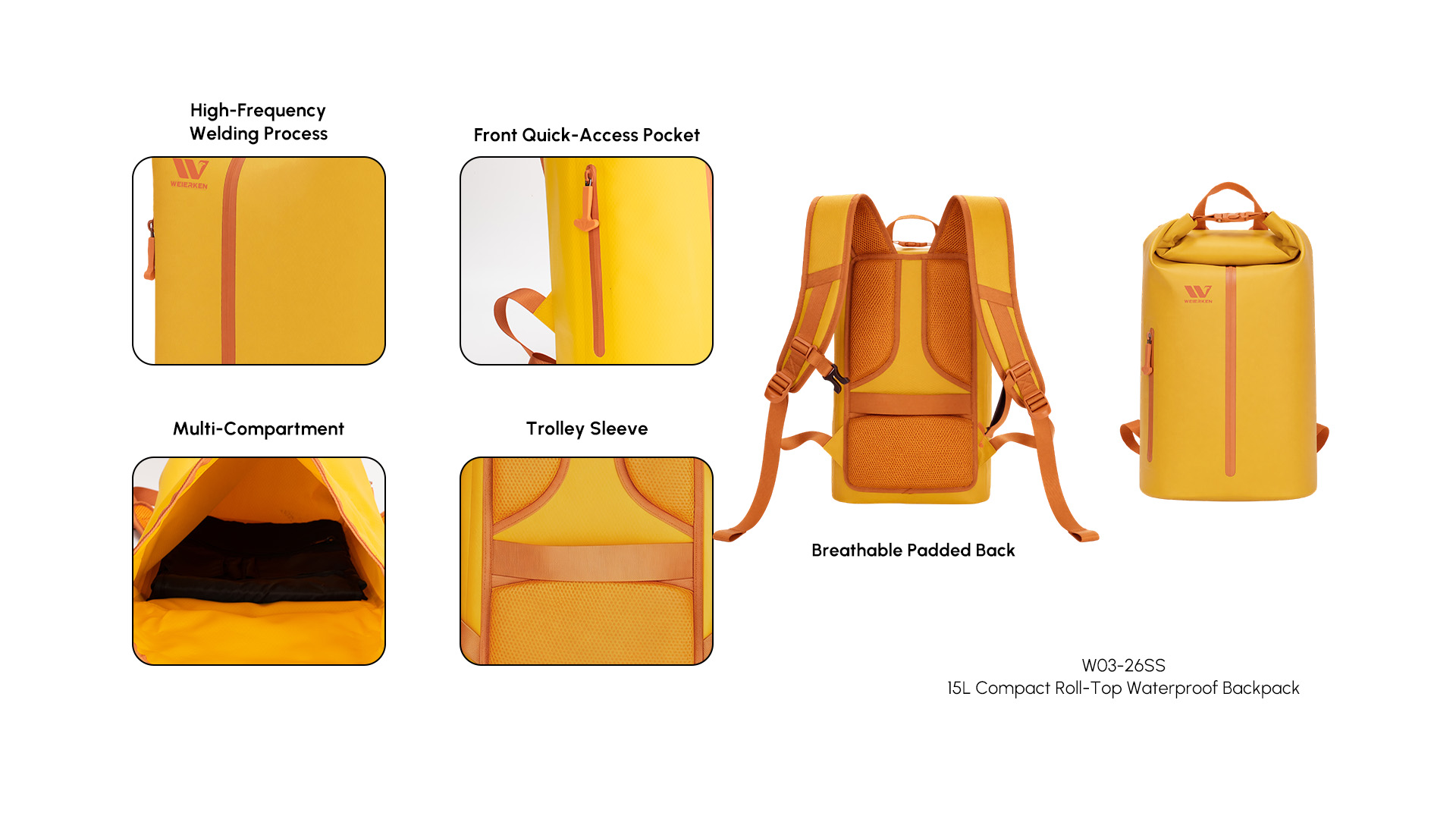
1. High-Frequency Welding Over Stitched Seams
Traditional needle-and-thread construction creates thousands of tiny holes. Even when taped, stitched seams fail under repeated water immersion, thermal expansion, and mechanical stress.
A premier custom SUP dry bag manufacturer relies strictly on High-Frequency (HF) welding and Radio Frequency (RF) heat sealing. This process fuses the molecular structure of coated fabrics together using electromagnetic energy and pressure.
- The resulting weld forms a continuous, leak-proof bond stronger than the surrounding base fabric.
- Welded construction delivers true IPX6 (heavy wave blast resistance) to IPX8 (continuous immersion) ratings.
- Clean welded seams prevent edge fraying, mold growth, and water absorption inside the fabric weave.
2. 2026 Sustainability and Material Compliance
Environmental standards in North America and the European Union are tightening quickly. Buyers in 2026 care deeply about the materials used in their gear. Traditional, cheap PVC coated fabrics release harmful phthalates and crack when exposed to cold water or intense UV rays.
Forward-thinking factories have shifted production toward clean, sustainable alternatives:
- Thermoplastic Polyurethane (TPU): Highly flexible, abrasion-resistant, fully recyclable, and free from toxic plasticizers.
- RPET (Recycled Polyethylene Terephthalate): Technical fabrics woven from post-consumer plastic bottles and laminated with waterproof TPU films.
- Fluorine-Free DWR Treatments: Meeting global bans on PFAS chemicals without sacrificing water repellency.
Experienced manufacturers like Weierken maintain testing documentation for REACH, RoHS, and Prop 65 compliance, protecting your brand from costly customs holds and legal penalties.
3. True Technical OEM/ODM Capabilities
Your brand needs features built specifically for paddleboarders, not generic dry sacks meant for river rafting. An experienced custom SUP dry bag manufacturer will provide internal industrial design, CAD patterning, and 3D prototyping support.
Essential technical features paddlers demand include:
- Low-profile bungee and carabiner attachment systems that clip directly onto board D-rings without shifting.
- Waterproof air release purge valves that compress extra volume out of the pack before rolling it closed.
- Integrated, UV-resistant touch-screen pockets for marine navigation and smartphone access on open water.
- Ergonomic EVA shoulder straps that do not absorb water, dry rapidly, and provide genuine load support during portage.
4. Production Flexibility and Scalable MOQs
Cash flow management makes or breaks a growing watersports label. A rigid factory demanding 5,000 units per colorway will choke your growth before you start. Conversely, a tiny workshop cannot handle peak-season reorders when sales spike in June.
Look for production partners that offer tiered Minimum Order Quantities (MOQs). This structure lets you test new product categories with 500 to 1,000 units, refine your colorways based on real market feedback, and scale smoothly to container-load volumes as sales grow.
Step-by-Step Blueprint: Moving from Concept to Mass Production
Navigating the product development cycle requires clear systems. Bridging the gap between a design sketch and a packed container runs through four critical stages.
Step 1: Define Bag Architecture and User Context
Start with how the customer actually uses the bag. Avoid making one bag that tries to do everything poorly. Narrow your focus down to distinct product roles:
- SUP Deck Bags: Flat-profile, splash-proof designs with bottom suction or D-ring clips, heavy-duty zippers, and rapid access to hydration and snacks.
- Roll-Top Waterproof Backpacks: 25L to 40L capacity, full HF welding, heavy-duty waist belts, and external bungee tie-downs for paddles and footwear.
- Compact Personal Sacks: 2L to 5L cylinder pouches with clear windows for car keys, safety kits, and personal valuables.
Step 2: Prototyping and Torture Testing
Never approve mass production based on digital renderings. Order physical functional samples. Put these prototypes through brutal, real-world tests before placing a deposit.
A qualified custom SUP dry bag manufacturer runs thorough internal quality checks. They submerge samples under controlled pressure tanks to check for micro-leaks along welded seams. They subject fabrics to Xenon arc lamps to simulate intense salt spray and UV exposure. Finally, they run mechanical load tests on all haul handles and strap attachment points to ensure they do not pull loose under strain.
Step 3: Packaging, Eco-Compliance, and Brand Customization
Branding lives in the fine details. Custom silicone patches, high-visibility reflective logos, debossed pullers, and contrast seam tapes elevate your perceived value on retail shelves.
Align packaging with your market identity. Replace standard single-use polybags with certified compostable cornstarch bags or recycled cardboard bands printed with soy-based inks. Clean, eco-conscious packaging reinforces premium retail price points.
Step 4: Managing Logistics and 2026 Freight Volatility
Freight lanes remain sensitive to global shifts. Smart operations build shipping lead times into product schedules early. Your manufacturing partner should provide reliable DDP (Delivered Duty Paid), FOB, or CIF terms directly to your regional 3PL warehouse.
Coordinate production schedules so inventory lands at least four to six weeks before the spring retail season begins. Missing the early paddling rush means sitting on excess inventory until mid-summer.
Sourcing Pitfalls That Drain Watersports Profits
Many brands burn through capital because they make simple sourcing mistakes. Sidestep these operational traps to keep your brand profitable.
Chasing the Absolute Lowest Unit Price
When an offshore factory quotes a price 30% below market average, they cut corners on raw material grade and thermal dwell times. Cheap PVC formulations dry out, turn brittle, and develop microscopic fractures within months. Seams welded too quickly burst as soon as a paddler packs the bag tightly.
The money saved on manufacturing vanishes the moment you issue refunds, pay return shipping, and take reputational damage online.
Ignoring Tooling Protection and Intellectual Property
If you invest in custom injection molds for clips, custom zipper garages, or proprietary deck-locking systems, secure exclusivity. Ensure your contract specifies that you own all custom tooling outright. Without this clause, standard suppliers will sell your custom-designed features to competing brands the following season.
Skipping Independent On-Site Quality Control
Do not wait for goods to cross an ocean before checking quality. Establish an AQL (Acceptable Quality Limit) standard with your factory before production begins. Ensure inspectors test pressure retention and seam integrity across random batch samples before paying the final balance.
Frequently Asked Questions
Q1: What is the typical MOQ when ordering from a custom SUP dry bag manufacturer?
A1: For full custom builds using standard fabric colors, MOQs usually start at 500 to 1,000 units per design. If you require custom fabric pantones, unique mold tooling, or specialized recycled textiles, minimum orders run closer to 1,500 to 2,000 units depending on material supplier requirements.
Q2: Should my brand choose PVC or TPU for paddleboard dry bags?
A2: PVC costs less and offers solid abrasion resistance, making it suitable for price-sensitive, entry-level products. TPU is significantly lighter, remains flexible in cold water, contains zero toxic plasticizers, and resists UV degradation far better. For premium, eco-friendly, and durable watersports gear in 2026, TPU is the preferred choice.
Q3: How long does the manufacturing cycle take from initial concept to delivery?
A3: Design, CAD modeling, and initial prototyping generally take 3 to 4 weeks. Once you approve samples, mass production takes 35 to 50 days depending on component availability and order volume. Factor in another 25 to 40 days for ocean freight, customs clearance, and delivery to your regional warehouse.
Q4: How does a factory test if a custom dry bag is truly waterproof?
A4: Specialized suppliers use air inflation submersion tanks. The factory pumps air into the sealed bag to a specific pressure, lowers it into clear water, and watches for escaping air bubbles. For high-grade submersible packs, digital pressure-decay testers measure micro-losses in internal air pressure over set periods of time.
Q5: Can my logo and custom graphics survive saltwater, abrasion, and intense sun?
A5: Standard silkscreen printing quickly chips and cracks on flexible waterproof bags. Professional manufacturers use specialized screen inks with cross-linking hardeners, high-frequency welded rubber patches, or heat-transfer films designed specifically for TPU and PVC surfaces. These techniques survive saltwater exposure, board friction, and relentless sun without peeling.
Scale Your Brand with the Right Supply Chain Partner
Scaling a watersports brand requires distinct hardware, reliable production, and high-margin products that paddlers trust in wet conditions. Sticking with generic, low-grade gear leaves your business exposed to rising costs and shrinking margins.
A specialized custom SUP dry bag manufacturer gives your business the production power to engineer standout gear. From technical CAD patterns and high-frequency welding to eco-certified TPU textiles, Weierken helps outdoor brands build dependable waterproof equipment.
Are you building your 2026 product collection? Contact our engineering and production team today to request a factory direct quote, explore material samples, and turn your design concepts into profitable market gear.