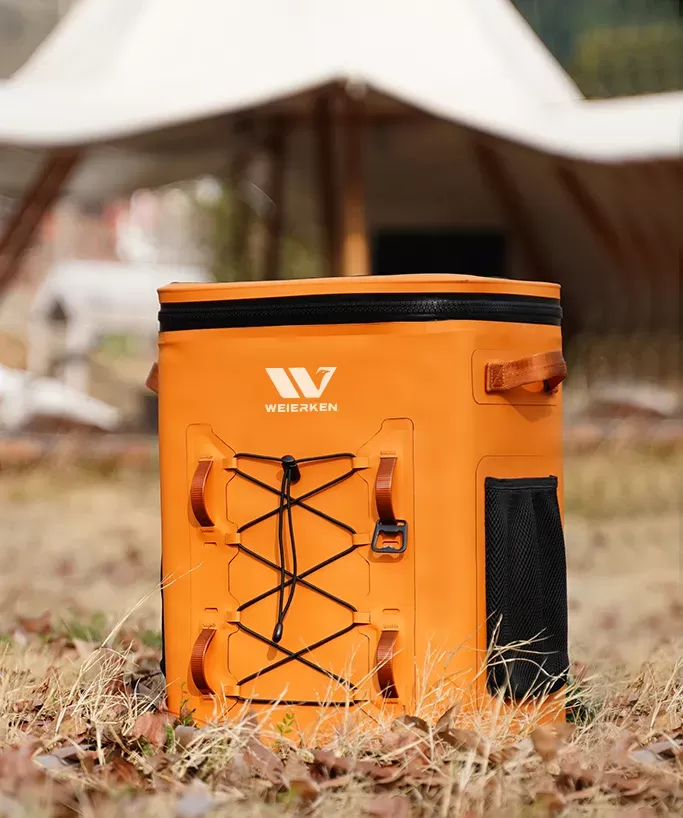


Off-premise dining is no longer a temporary revenue buffer. It is a core pillar of modern hospitality balance sheets. Yet, food quality often drops the moment an order leaves the pass.
When fries turn soggy or hot ramen cools to lukewarm broth, customers blame the brand, not the courier. Temperature drops directly harm customer lifetime value.
Forward-thinking food service groups now treat packaging as critical operational hardware. Working with commercial manufacturers like Weierken, enterprise brands replace flimsy foil sacks with durable, engineered transport systems.
Selecting the right custom insulated bags for restaurant chains safeguards margins, protects product safety, and turns every delivery driver into a mobile brand ambassador.
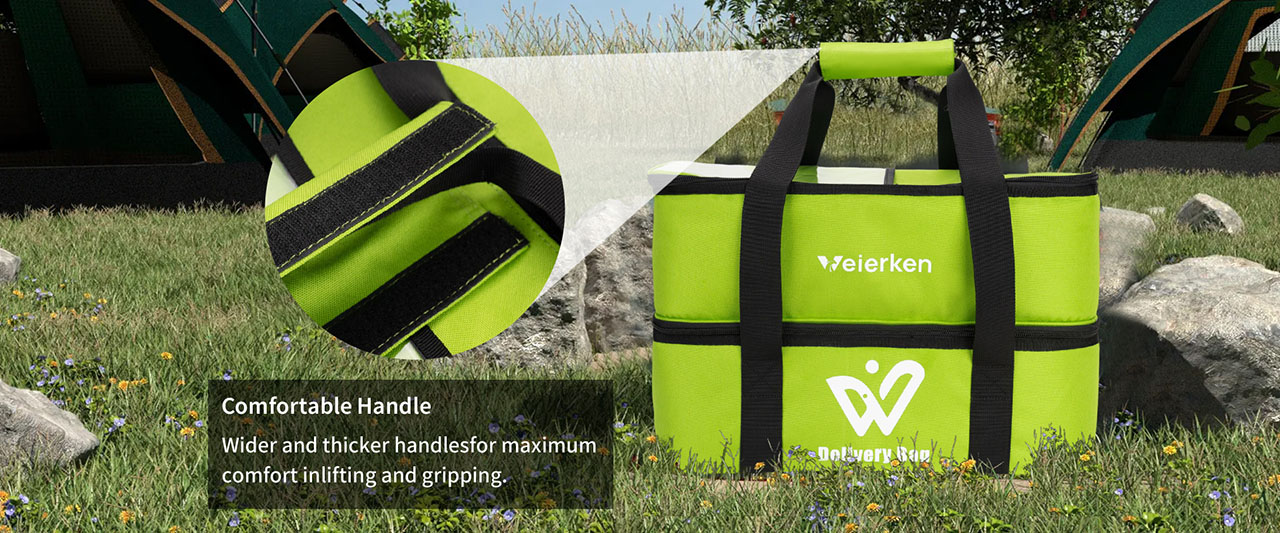
Quick Comparison: Enterprise Food Delivery Bags for 2026
| Bag Architecture | Primary Thermal Material | Holding Window | Best Operational Use Case |
|---|---|---|---|
| Dual-Temp Backpack | Multi-layer EPE + Foil Partition | 45 - 60 Minutes | Mixed hot/cold QSR urban bike delivery |
| Heavy-Duty Catering Bag | High-Density EVA + EPP Foam Board | 90 - 120 Minutes | Large catering drops, corporate luncheons |
| Smart-Heated Thermal Bag | PTC Heating Elements + Aerogel | 120+ Minutes (Active) | Premium pizza networks, steak delivery |
| RPET Curbside Tote | Recycled PET Woven + Closed-Cell Foam | 30 - 45 Minutes | Drive-thru pickup, retail grab-and-go |
| Tamper-Evident Ghost Bag | Reinforced Non-Woven + Metallic Film | 30 - 40 Minutes | Multi-brand virtual kitchens, high-speed pack lines |
Why Chain Operators Must Rethink Food Transport in 2026
Customer patience has worn thin. Data shows that off-temp food ranks as the number one complaint on third-party marketplace apps. This friction directly triggers refund requests and platform penalties.
Stricter HACCP enforcement also pushes brands to act. Delivery transit extending past 35 minutes enters the bacterial danger zone between 4°C (40°F) and 60°C (140°F). Maintaining food safety standards outside the kitchen requires passive or active thermal barriers.
There is also an advertising component. Generic black thermal totes waste valuable visual space. Custom thermal food delivery bags printed with distinct enterprise branding achieve thousands of local impressions daily, lowering customer acquisition costs.
Finally, procurement directors face sharp replacement costs. Flimsy zipper pulls and unreinforced straps break after three weeks of rough courier use. Buying heavy-duty commercial delivery bags that survive 500 industrial wash cycles delivers a far lower total cost of ownership (TCO).
Top 5 Custom Insulated Bags for Restaurant Chains
1. Dual-Temp Zone Delivery Backpacks
Modern fast-casual menus rarely stay in a single temperature lane. Operators routinely pair hot smash burgers with chilled milkshakes or boiling soup with crisp salads. Mixing these items in one chamber ruins both.
Dual-zone backpacks solve this issue with an insulated, airtight internal divider. The top section holds hot items in reflective aluminum compartments, while the bottom section seals cold drinks away from radiant heat.
Independent thermal chambers eliminate internal condensation and steam cross-contamination.
Ergonomic harness systems reduce back strain for bicycle and scooter couriers.
Fully customizable exterior shells support high-visibility reflective printing for nighttime road safety.
Heavy-duty 1680D ballistic polyester resists road grime and resists tears from sharp counter edges.
2. Heavy-Duty Catering & Bulk Drop Bags
Catering operations yield higher margins than standard single-meal tickets, but the operational stakes run higher. A ruined corporate banquet for 80 guests destroys client relationships immediately.
These large-format bags carry full-size metal or foil steam table pans (chafing pans) stacked flat. They feature drop-resistant EPP (Expanded Polypropylene) or EVA internal panels that stop boxes from collapsing under heavy loads.
Rigid internal walls hold over 50 kilograms without buckling or crushing delicate bottom pans.
Internal hook-and-loop straps secure half-pan and quarter-pan layouts to stop contents from shifting during transport.
Removable, leakproof commercial liners trap runaway grease, allowing staff to wipe them clean in seconds.
Reinforced box-stitched carrying handles wrap under the base of the bag to handle high-weight distribution.
3. Smart-Heated Thermal Bags
For high-end pizza chains, rotisserie concepts, and upscale steakhouses, standard passive insulation is not enough. Cold weather routes quickly drain heat from cardboard delivery boxes.
Smart-heated bags feature integrated 12V vehicle plugs or swappable lithium battery systems that power internal PTC heating elements. These pads hold temperatures above 65°C throughout extended delivery corridors without drying out crusts or proteins.
Active heating elements maintain proper serving heat for up to two hours.
Optional external digital temperature gauges give couriers and customers visible proof of food safety.
Integrated RFID or Bluetooth tags help automated distribution centers track fleet inventory and bag locations.
Engineered moisture-release grommets vent excess steam while trapping core heat to prevent soggy fried foods.
4. Sustainable RPET Curbside Totes
Government mandates across North America and the EU continue to ban single-use carrier plastics. At the same time, enterprise brands must fulfill strict annual Corporate Social Responsibility (CSR) and ESG metrics.
Sustainable curbside totes offer an eco-conscious alternative. Constructed from 100% post-consumer recycled plastic bottles (RPET), these bags give eco-minded diners a durable item they can reuse for grocery runs.
Made entirely from certified recycled bottle fabric, diverting ocean-bound plastic waste.
Cost-effective unit rates allow chains to use them for direct app ordering rewards or upscale carryout programs.
High-density stitch points support heavy family-style meal combinations.
Full-bleed rotogravure and water-based screen printing present vivid brand artwork without harsh chemical solvents.
5. Tamper-Evident Ghost Kitchen Bags
Ghost kitchens and virtual food halls operate on speed and high order velocity. Packers manage orders for four to six distinct brands out of a single kitchen footprint, making order mix-ups and packaging delays common risks.
Specialized ghost kitchen transport totes feature flat, broad bottoms to prevent tipping. They use integrated tamper-evident peel-and-seal adhesive flaps. If a courier attempts to open the bag during transit, the seal reveals a visible void warning.
Tamper-evident adhesive tape reassures end-consumers that food remained untouched after leaving the prep table.
Fold-flat geometry saves tight storage space inside compact central prep kitchens.
Thermal metallized interior linings hold heat safely during staging periods under heat lamps.
Clear document windows display printed kitchen order tickets (KOT) for faster, error-free handoffs.
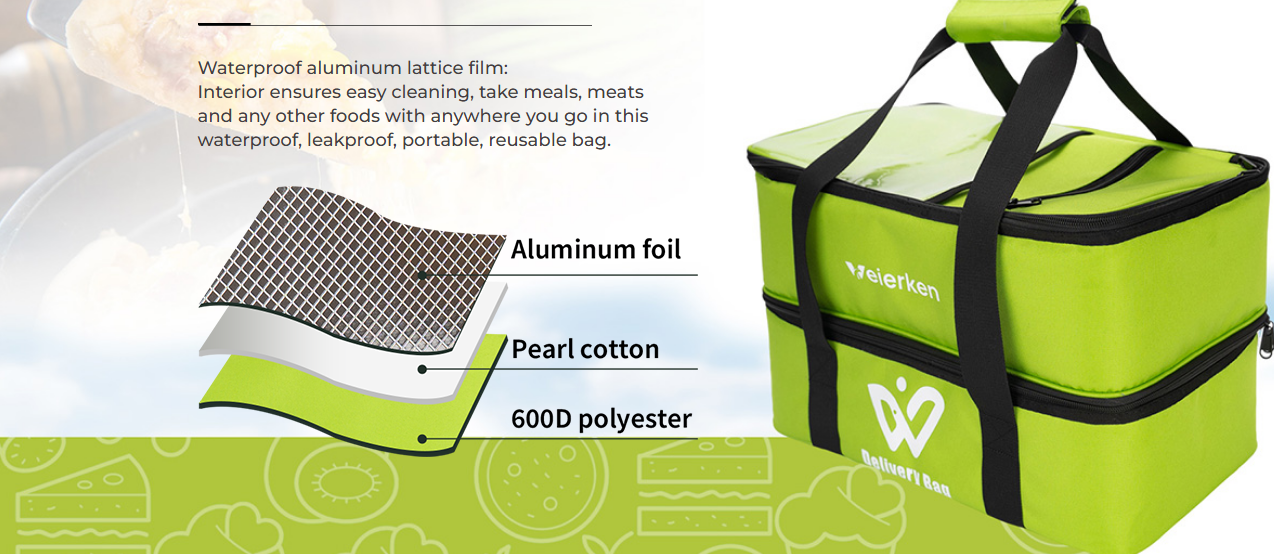
The Chain Sourcing Guide: 4 Technical Metrics to Validate
Procuring wholesale branded insulated catering bags requires thorough technical evaluation. When evaluating commercial manufacturing partners like Weierken, procurement teams should inspect four core build areas.
1. Insulation Core Performance
Avoid cheap open-cell foam. Open-cell structures soak up moisture, harbor mold, and collapse when washed. Insist on closed-cell expanded polyethylene (EPE) or cross-linked polyethylene.
For operations demanding tight temperature windows, evaluate modern aerogel composites or Vacuum Insulation Panels (VIP). These materials provide double the R-value per millimeter compared to standard foam, cutting bag weight and bulk.
2. Liner Certifications and Antimicrobial Linings
Grease, steam, and food juices will inevitably leak onto the interior bottom of any transport container. Uncoated aluminum foil tears easily and traps bacteria within its creases.
Specify heavy-duty, seamless heat-welded TPU (Thermoplastic Polyurethane) or food-grade PVC inner liners. Ensure the manufacturer holds legitimate FDA (US) and LFGB (Europe) food-contact safety testing certificates.
3. Hardware Durability and Reinforcement
The primary point of failure for delivery bags is almost always the closure system. Standard nylon coil zippers strip easily when pulled at off-angles by hurried drivers.
Demand industrial grade waterproof YKK zippers or thick composite teeth.
Check for stress points reinforced with structural box-X cross-stitching on every strap and handle anchor.
Choose abrasion-resistant bottom rubber skids or molded feet to prevent asphalt wear when bags rest on curbs.
4. Factory Scalability and Supply Reliability
Supplying a footprint of 500 franchise locations requires serious factory capacity. Sourcing teams need predictable lead times, rigorous quality assurance, and modular custom manufacturing.
Ensure your chosen heavy-duty insulated bags supplier maintains deep access to raw materials and provides clear sample prototyping lead times. A true enterprise tier manufacturer will stress-test seams, cycle-test zippers, and run thermal validation tests before running mass production.
Frequently Asked Questions
Q1: What thermal retention standard should restaurant chains require
for 45-minute delivery routes?
A1: Commercial specifications should
require bags to limit internal heat loss to no more than 0.5°C to 0.7°C per
minute at an ambient room temperature of 20°C. Hot food packed at 75°C must
remain securely above the 60°C HACCP threshold at the end of a 45-minute
route.
Q2: How do RPET custom insulated bags compare in durability to virgin
nylon?
A2: When woven at identical yarn densities (such as 600D or
900D), high-grade RPET offers tensile and tear strength nearly identical to
virgin polyester. It holds structural color prints well and resists abrasions,
making it an excellent drop-in green replacement.
Q3: Can custom thermal food delivery bags withstand industrial
dishwashing?
A3: Standard bags cannot be washed in a dishwasher due
to water penetration risks into internal foam panels. However, commercial-grade
bags designed with sealed TPU linings and water-sealed seams can be sanitized
using high-pressure sprayers, chlorine wipe-downs, or commercial sanitizing wash
bays without warping.
Q4: What is the typical MOQ and lead time for large-scale custom
insulated bags?
A4: Custom OEM production runs typically require a
Minimum Order Quantity (MOQ) between 500 and 1,000 units depending on colorways
and proprietary mold designs. Prototyping takes roughly 7 to 12 days, while mass
manufacturing and sea transit generally run 35 to 55 days.
Q5: How do dual-temp bags stop condensation from softening fried
foods?
A5: Dual-temp systems use thick closed-cell foam partitions
to stop heat from radiating toward chilled items. In addition, hot chambers use
passive brass eyelet grommets or breathable membrane vents that release excess
steam pressure while keeping core heat locked inside.
Secure Your Last-Mile Food Quality Today
Off-premise food quality directly shapes brand loyalty. Every dropped degree during transit harms your guest experience and cuts into repeat store sales.
Upgrading to engineered custom insulated bags for restaurant chains protects plate presentation, satisfies health inspectors, and shows off your logo across the city.
Weierken engineers commercial-grade, heavy-duty insulated transport solutions for world-class restaurant chains, franchisees, and delivery fleets. Whether you need modular dual-temp courier backpacks, heated pizza carriers, or certified sustainable RPET carryout totes, our production lines build to your exact operational requirements.
Ready to protect your off-premise food quality? Contact our engineering and procurement team today to request a quote or order an evaluation sample kit for your operations.