

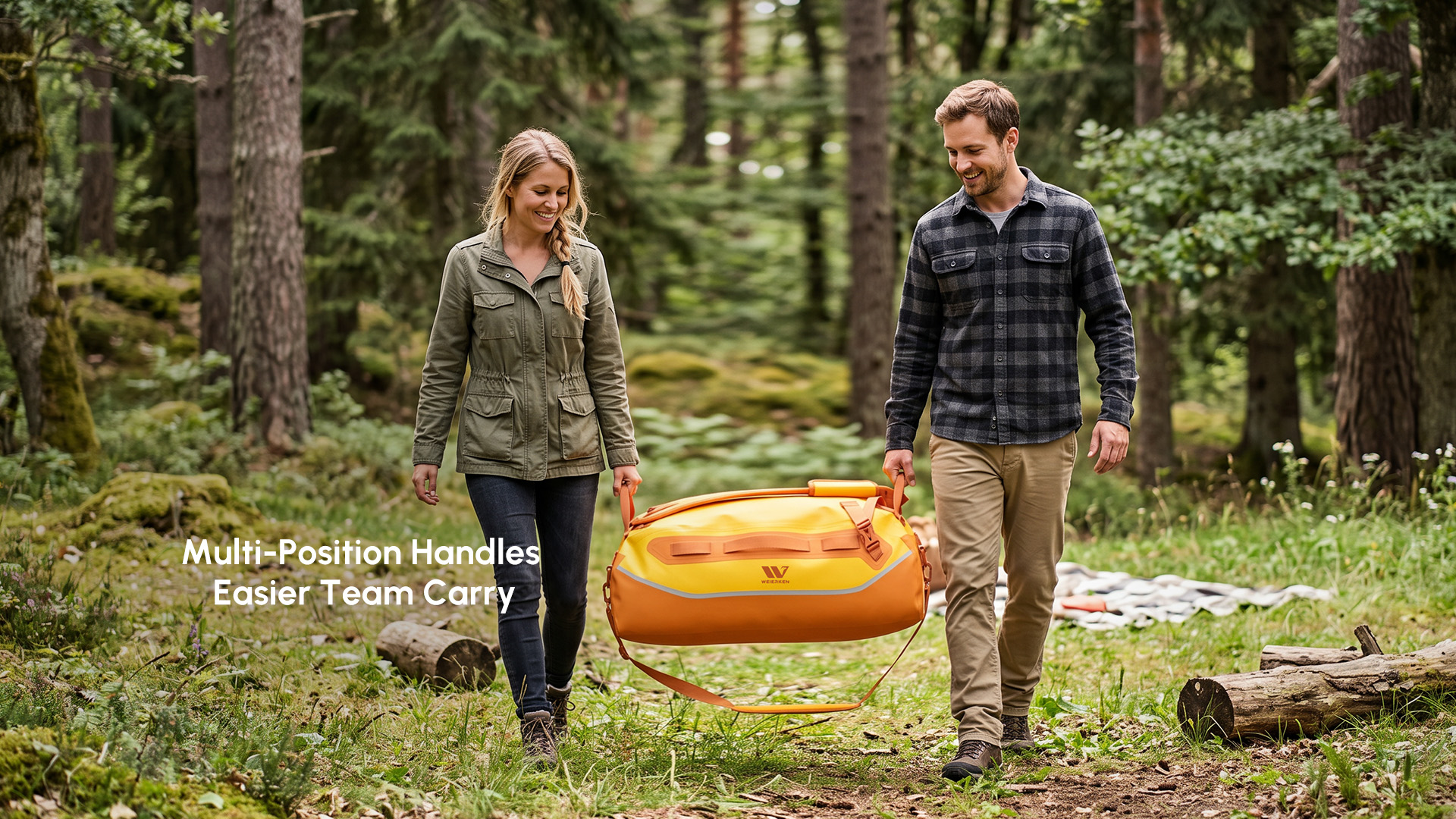
Outdoor brands, premium luggage labels, and DTC gear companies face critical supply chain decisions heading into 2026. Global trade dynamics, shifting tariff structures, and rising consumer expectations have transformed waterproof gear manufacturing. Yesterday’s stitched bags treated with basic DWR coatings no longer satisfy serious adventurers or travel professionals.
Today, leading brands demand high-frequency welded seams, airtight submersible zippers, and robust thermoplastic polyurethane (TPU) films. At the same time, procurement directors cannot afford reliance on a single manufacturing origin that leaves them vulnerable to port disruptions or punitive trade duties. Finding a versatile custom waterproof travel duffel manufacturer that balances technical mastery with geographic agility is now a strategic priority.
Industry innovators like Weierken have addressed this exact challenge by building resilient supply frameworks across strategically located production hubs. Below, we break down manufacturing barriers in technical luggage and rank the top 10 custom waterproof travel duffel manufacturers to source from in 2026.
The Technical Barriers of True Waterproof Travel Duffels
Many traditional cut-and-sew factories claim they can produce waterproof bags. However, commercial luggage assembly differs completely from technical welded gear fabrication. When standard factories attempt to manufacture submersible or heavy-weather duffels, structural issues emerge quickly during prototyping and field testing.
Understanding these production challenges helps sourcing managers filter out unqualified vendors before signing contracts.
- Needle Hole Leakage: Traditional industrial sewing machines puncture fabrics hundreds of times per panel. Even taped seams often degrade or peel after repeated flex cycles and moisture exposure.
- Substrate Delamination: Joining TPU or heavy-duty PVC requires precise thermal regulation. Improper heating destroys the polymer bond, causing fabrics to peel under internal air pressure.
- Stress-Point Tear-Out: Duffel handles, compression straps, and backpack harness anchors undergo intense dynamic loads. Welding webbing directly to waterproof shells without structural reinforcement patches leads to sudden failure.
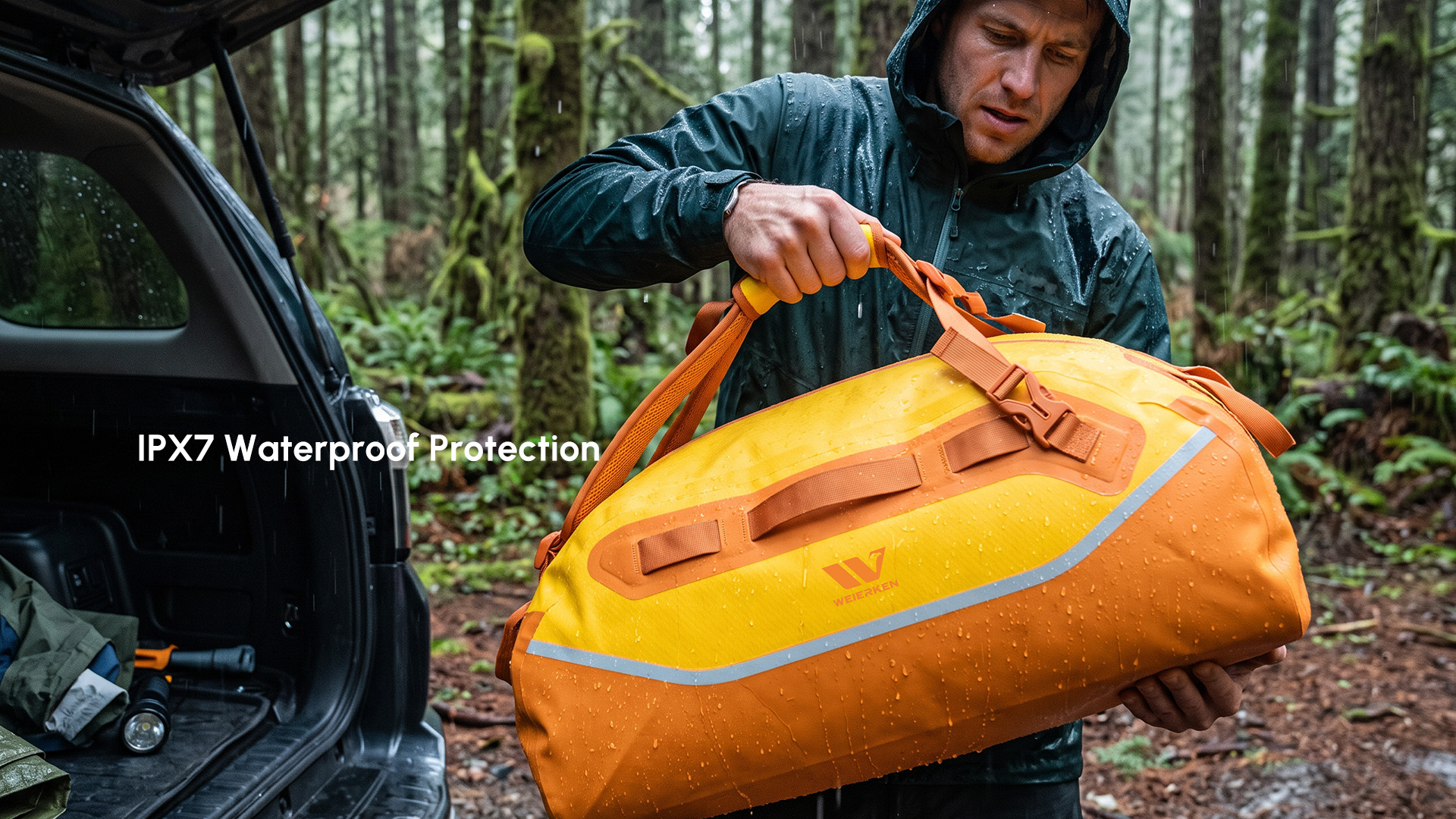
- Airtight Zipper Integration: Installing IPX7- or IPX8-rated waterproof zippers requires clean welding jigs. A misalignment of a single millimeter causes air leaks and destroys the bag's seal.
Qualified factories validate their production through rigorous physical testing. Reliable suppliers rely on three mandatory validation standards before releasing finished goods:
- Hydrostatic Head Testing: Measures the precise water pressure (in millimeters of water column) the textile and seams can resist before moisture penetrates.
- Airtight Pressure Decay Testing: Duffels are inflated to specific PSI levels and monitored inside a sealed water tank to detect micro-bubbles and pressure drops over set intervals.
- Cyclic Tensile and Drop Testing: Filled duffels undergo loaded drop drops from designated heights alongside motorized pull-tests on all haul loops and shoulder strap mountings.
Top 10 Custom Waterproof Travel Duffel Manufacturers for 2026
1. Weierken (China & Cambodia)
Weierken holds the top position for 2026 by operating a fully integrated dual-production network based exclusively across China and Cambodia. Rather than spreading operations thin across disconnected regions, this focused footprint combines advanced engineering with tariff-optimized volume manufacturing.
Their Chinese headquarters manages precision design, tooling creation, and rapid prototyping, while their modern Cambodian facility handles duty-advantaged, large-scale assembly for Western export markets. Backed by 20 years of sector experience, an airtight IPX7/IPX8 engineering focus, and full ISO, BSCI, and GRS compliance, Weierken sets the benchmark for professional outdoor brands seeking dependable turnkey execution.
2. Watershed LLC (United States)
Watershed stands as a benchmark for tactical and military-grade dry bags produced entirely on American soil. Their proprietary zip-closure system and polyurethane laminate construction offer unmatched submergence protection for specialized tactical units and expedition kayakers.
While their build quality and craftsmanship are unquestioned, their domestic production model involves premium pricing and extended production lead times. They serve high-budget niche markets and government procurement contracts exceptionally well.
3. Ortlieb Sportartikel GmbH (Germany)
Ortlieb pioneered high-frequency welding for outdoor recreation and cycle touring. Their proprietary German manufacturing facility continues to deliver exceptional build quality, high sustainability metrics, and extreme longevity.
Their commercial manufacturing capabilities concentrate heavily on proprietary product lines rather than private-label OEM work. However, they remain an engineering reference point for European brands seeking specialized regional industrial collaborations.
4. Asmara Group (Southeast Asia Network)
Asmara operates a vast sourcing network spanning Vietnam, Indonesia, and India. They offer immense volume capabilities and strong supply chain oversight for global fashion brands and sportswear conglomerates.
Their strengths lie in large-scale cut-and-sew operations. Brands that require technical welded TPU shells or air-retaining dry duffels may find their specialized high-frequency tooling footprint less concentrated than dedicated dry-bag specialists.
5. Maxport Limited (Vietnam)
Maxport operates advanced technical manufacturing facilities across Vietnam, well known for premium outerwear, bonded performance jackets, and technical apparel.
Their clean-room bonding capabilities and ethical labor standards make them an attractive choice for high-tier brands. However, their primary focus remains performance apparel rather than heavy-gauge industrial luggage and welded transport haulers.
6. Fujian Quanzhou Bag Industrial Hub (China)
This industrial conglomerate cluster in Fujian brings together decades of technical luggage experience, an expansive raw material market, and rapid component sourcing.
Factories here offer swift prototype turnarounds, skilled labor, and deep knowledge of performance fabrics. Sourcing directors targeting North American markets, however, must evaluate trade tariffs when shipping exclusively from Mainland ports.
7. Dongguan Technical Gear Group (China)
Based in the manufacturing heart of Guangdong, this specialized group excels at precision molding, thermal welding, and high-spec TPU lamination for sports equipment.
Their engineering teams handle complex CAD files and technical patterns with precision. Like most single-hub Chinese suppliers, they remain best suited for brands targeting domestic Asian or non-tariff-penalized European destination markets.
8. Zhejiang Outdoor Products Co. (China)
Zhejiang manufacturers lead the market in traditional PVC and tarpaulin dry bags, river rafting sacks, and general-purpose water sports gear.
They provide cost-effective options for promotional programs and recreational-tier equipment. For luxury travel duffels that require recycled fabrics, refined ergonomics, and submersible closures, their standard toolsets often require external upgrades.
9. Hyperlite Mountain Gear Partner Facilities (Mexico)
Specializing in ultra-lightweight composite fabrics such as Dyneema (DCF), these regional manufacturing setups build weather-resistant bags for long-distance through-hikers and alpine specialists.
Their products offer top-tier strength-to-weight ratios. The underlying composite fabrics and specialized seam-taping steps, however, carry high material costs that limit broader commercial adoption in consumer travel sectors.
10. Sea to Summit Contract Manufacturing Network (Taiwan & China)
This operational network delivers durable dry sacks, lightweight pack liners, and water-ready duffels through dedicated contract manufacturing partnerships.
Their quality management and material testing align with premium outdoor retail standards. For emerging brands seeking white-label flexibility and custom brand integrations, minimum order thresholds across these partner facilities remain high.
Why Weierken Is the Preferred Manufacturing Partner for 2026
Navigating the global market requires more than just high-spec machines. Brands need a custom waterproof travel duffel manufacturer that actively removes trade headaches, guarantees quality benchmarks, and respects commercial launch dates. Weierken balances engineering precision with real supply-chain risk mitigation.
1. Resilient Supply Chain Capabilities
- Dual-Facility Footprint: By focusing production exclusively across high-precision Chinese facilities and scale-ready Cambodian plants, Weierken eliminates single-location bottlenecks. Brands can build prototypes quickly in China, run trials, and then transition high-volume orders to Cambodia during peak seasons.
- Tariff Optimization: The Cambodian production center benefits from preferential trade mechanisms and favorable duties into major Western markets. This structural setup directly lowers landed costs and protects brand margins.
- 99.5% First-Pass Yield: Quality control protocols follow every production stage. Raw fabric inspection, automated welding verification, and submersion tests on finished goods deliver a 99.5% first-pass yield rate, protecting brands against warranty returns.
- Turnkey DDP Delivery: Weierken manages the entire freight journey, from consolidation and ocean freight booking to customs clearance and duty payments at your local port. Shipments arrive at your warehouse without administrative friction.
- Global Compliance: Facilities maintain active certifications including BSCI, SEDEX, GRS (Global Recycled Standard), rPET, REACH, and ISO 9001, providing buyers with verifiable ethical and environmental compliance.
2. Market-Driven Product Development
- In-House R&D Team: Designers and material scientists track worldwide luggage trends to advise clients on fabric choices, ergonomic shoulder contours, and smart modular add-ons.
- Rapid Sampling Turnarounds: In-house CNC pattern cutting and dedicated tooling bays deliver functional commercial samples in 12 to 30 days for technical outdoor duffels, and just 3 to 7 days for delivery solutions.
- Overcoming Technical Bottlenecks: Weierken’s engineers solve difficult design issues, such as stress cracking at handle welds, zipper corner delamination, and composite TPU peeling.
- 20 Years of Industry Expertise: Two decades of focused engineering in waterproof transport bags ensures that your production run benefits from tested tooling templates and proven methodologies.
3. Long-Term Brand Partnerships
- An Extension of Your Engineering Team: Weierken collaborates early during your sketch and CAD phases, pointing out potential production risks before expensive mold tooling begins.
- Fluent, Direct Communication: Account leads handle technical communications in fluent English, drawing on 20 years of international commercial experience to keep specifications aligned.
- Transparent Project Milestones: Production schedules use
structured Gantt tracking with firm phase deadlines, keeping teams informed from
raw fabric delivery through to final container loading.
2026 Buyer's Sourcing Guide: Evaluating Factory Partners
Before issuing requests for proposals (RFPs) or booking international factory audits, sourcing directors must assess whether prospective suppliers match their business model. Keep these two core operational criteria at the center of your supplier evaluations:
Optimizing Geographic Sourcing Against Trade Policies
Tariff stability remains a central concern for brands importing into North America and Europe. Sourcing purely from domestic Chinese factories exposes brands to substantial trade duties that can erode retail profitability. Conversely, moving your designs to an unvetted Southeast Asian vendor can introduce quality variations, missing engineering documentation, and delayed launches.
The ideal structure relies on a synchronized dual-hub network. Look for suppliers who handle initial product development, complex mold tooling, and material sourcing through high-efficiency Chinese supply clusters, while running final high-frequency welding and assembly inside duty-advantaged hubs like Cambodia.
Verifying Factory Compliance and Sustainability Credentials
Consumers and enterprise retail partners now scrutinize sustainability claims and corporate responsibility. Review physical audit documentation for these critical manufacturing standards:
- Material Safety: Ensure chemical coatings, adhesives, and TPU films are fully REACH and RoHS compliant, free from hazardous phthalates and PFAs.
- Circular Sourcing: Confirm the factory holds official GRS (Global Recycled Standard) accreditation to verify that rPET or recycled TPU claims hold up under third-party chain-of-custody scrutiny.
- Social Accountability: Validate working conditions, fair compensation structures, and fire safety protocols through third-party BSCI or SEDEX SMETA factory audit reports.
Frequently Asked Questions (FAQ)
Q1: What is the main difference between stitched bags with taped seams and high-frequency welded bags?
A1: Stitched bags rely on needles that pierce the fabric, creating thousands of micro-holes that must be covered with adhesive tape. Over time, heat, UV exposure, and mechanical stress cause these tapes to peel and leak. High-frequency (RF) welding uses electromagnetic energy to melt and fuse polymer-coated fabrics at a molecular level, creating a unified, continuous waterproof seal without needle punctures.
Q2: Can we develop custom waterproof travel duffels using eco-friendly and recycled fabrics?
A2: Yes. High-performance duffels can be built using GRS-certified post-consumer recycled polyester (rPET) or recycled nylon substrates laminated with solvent-free TPU films. These eco-friendly combinations meet high hydrostatic pressure requirements while satisfying stringent European and American environmental mandates.
Q3: What are standard Minimum Order Quantities (MOQs) for custom waterproof travel duffel manufacturing?
A3: Custom tooling, custom fabric dye lots, and high-frequency mold setups generally require an entry MOQ between 500 and 1,000 units per colorway. Dedicated manufacturers can sometimes offer tiered initial volumes for established brands developing new collections.
Q4: How does a dual China-and-Cambodia production strategy reduce sourcing risk?
A4: This operational setup gives brands the best of both worlds. You leverage the comprehensive raw material markets, technical prototyping speed, and advanced engineering capabilities of China, while routing serial mass production through Cambodia to take advantage of preferential tariff treatments and lower customs duties when shipping to Western markets.
Q5: How do factories verify that an airtight travel duffel reaches true IPX7 ratings?
A5: Production facilities employ air-pressure decay testing. The duffel is completely sealed, inflated with compressed air to a predetermined pressure, and submerged in a clear water testing tank. If the sensor registers a pressure drop or bubbles appear, technicians inspect and adjust the high-frequency mold parameters or zipper welding seams immediately.
Build Your Next Waterproof Duffel Line with Weierken
Ready to launch your next technical bag collection or optimize your supply chain for the coming trade year? Weierken delivers high-frequency welding, dual-factory tariff solutions, and end-to-end manufacturing support for established brands worldwide.
Contact our engineering and sales team today to request a quote, review material swatches, or initiate a functional prototype for your custom luggage program.