
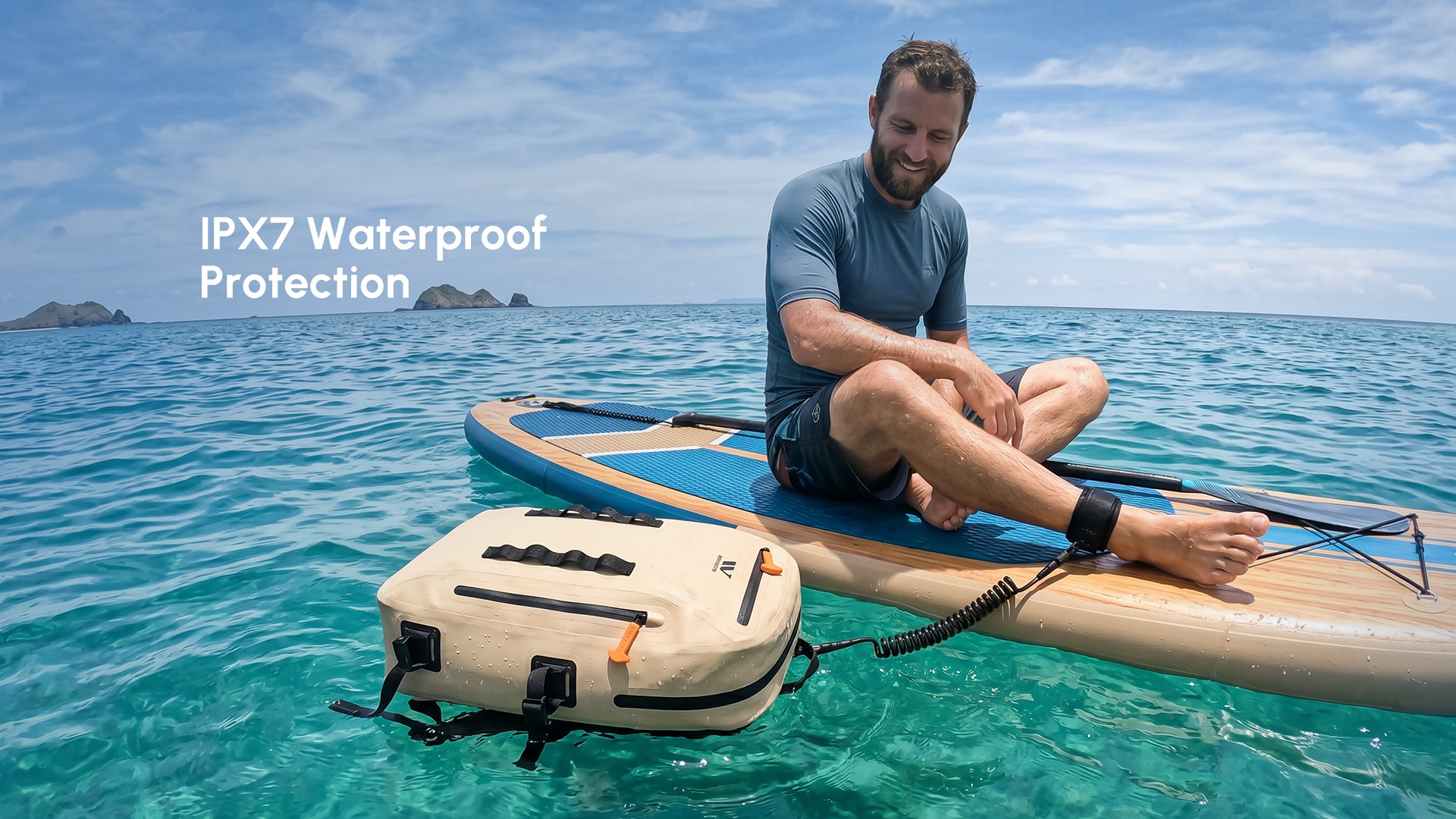
Kayaking pushes gear to its absolute limits. A kayak backpack endures continuous saltwater spray, prolonged deck immersion, intense UV exposure, and heavy loads during portage. Standard stitched-and-taped bag constructions fail rapidly under these grueling conditions.
For outdoor brand owners and sourcing managers, developing a market-leading OEM waterproof kayak backpack requires technical precision. You need more than an attractive exterior. You require advanced bonding technology, structural reinforcement, and rigorous factory quality control.
A single batch of leaking bags can destroy your brand reputation and cause severe financial loss through warranty returns. Choosing a factory with proven engineering expertise is your best defense against these risks.
This guide analyzes the material science, manufacturing technologies, and quality control audit protocols necessary to build high-performance waterproof bags. We also demonstrate how Weierken combines advanced radio-frequency welding with strict testing protocols to protect your investment.
Durable Engineering: Material Science and Bonding Technologies
To manufacture a truly submersion-proof backpack, factories must replace traditional sewing machines with molecular-bonding technologies. Here is how advanced technical engineering creates a leak-proof product.
Materials Science: TPU vs PVC Waterproof Backpack OEM Selection
Selecting the correct composite fabric dictates the backpack's durability, weight, and environmental performance:
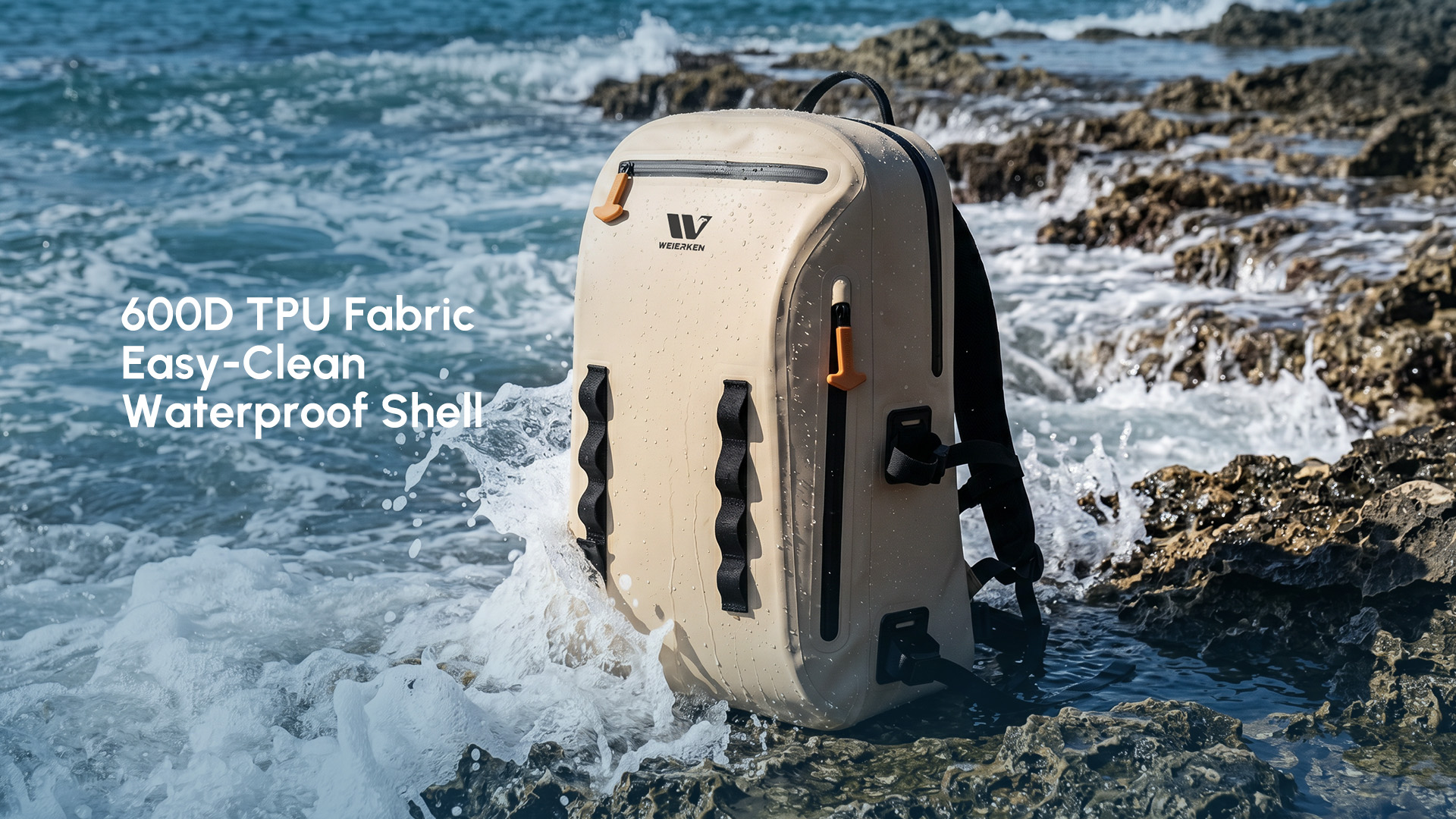
TPU (Thermoplastic Polyurethane): The premium choice for high-end technical outdoor gear. TPU offers outstanding low-temperature flexibility (it does not crack in freezing water), high tensile strength, and superior abrasion resistance. It is non-toxic and complies fully with REACH and GRS standards.
PVC (Polyvinyl Chloride): A cost-effective material with high durability and resistance to oil and grease. It works well for commercial kayak rental fleets and entry-level gear lines where unit cost is the primary metric.
Recycled TPU (rPET + TPU): A growing trend for 2026. Lighter weight composite fabrics combine recycled polyester (rPET) with a TPU laminate. This pairing lets brands offer sustainable products without sacrificing waterproof performance.
RF Welded Kayak Dry Backpack Manufacturer Techniques
Needle holes create leaks. Therefore, a specialized RF welded kayak dry backpack manufacturer relies on Radio-Frequency (RF) welding or Hot Air Welding instead of thread stitching.
RF welding passes high-frequency electromagnetic energy through the fabric layers. This process agitates the molecules within the TPU or PVC coating, fusing the materials together into a single, seamless layer under mechanical pressure.
The resulting welded seam is often stronger than the surrounding fabric itself. This molecular bond enables the pack to achieve IPX7 (temporary submersion) or IPX8 (continuous deep submersion) waterproof ratings.
Closure Systems and Airtight Zippers
Waterproof integrity depends heavily on how the main compartment opens and seals:
Roll-Top Closure: Integrates embedded EVA or PE stiffening strips along the collar. Rolling the top 3 to 4 times creates a mechanical barrier that completely blocks water spray and rain.
IPX8 Watertight Zipper Kayak Pack: Uses airtight, toothless or interlocking waterproof zippers for main compartment access or front storage pockets. These heavy-duty zippers prevent water ingress even when submerged under high water pressure.
Ergonomic Suspension and Kayak Attachment Systems
A technical kayak backpack must carry heavy loads comfortably across portages and secure easily to kayak decks:
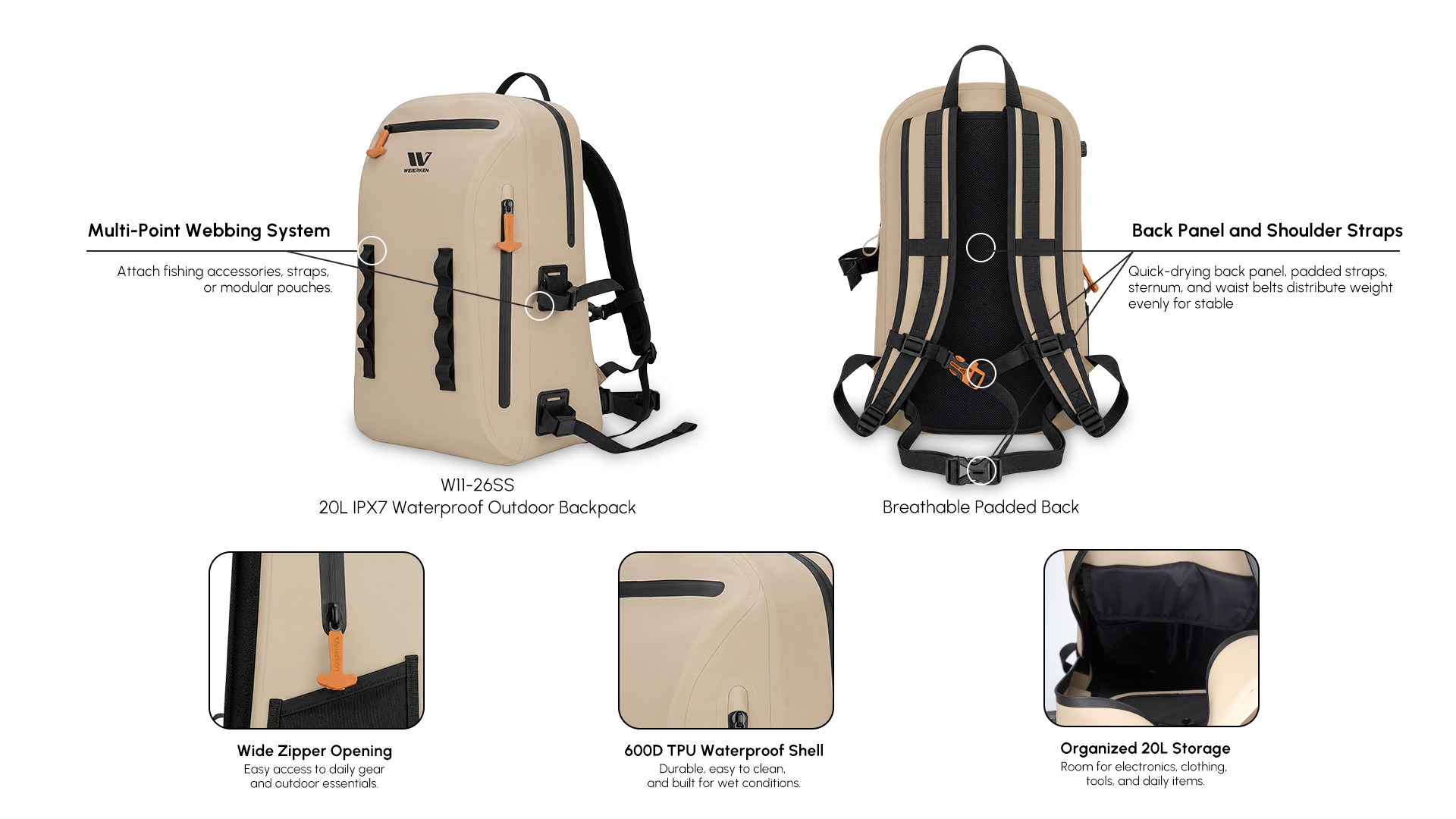
Stress Point Reinforcement: Heavy loads strain shoulder strap attachment points. Factories weld high-frequency TPU reinforcement patches or perform RF bar-tack welding at these critical junctions to prevent fabric tearing.
Non-Absorbent EVA Molded Back Panels: Closed-cell EVA foam panels support the back without absorbing water. This design ensures the backpack stays lightweight even after prolonged exposure to waves.
Deck Attachment Anchors: Reinforced D-rings and side compression straps allow paddlers to lash the pack tightly to kayak deck rigging or paddleboard bungee systems.
Quality Control Audits and Leak-Testing Protocols
Consistent quality control separates premier manufacturers from low-cost workshops. To deliver flawless gear, your manufacturing partner must enforce a comprehensive dry bag backpack quality control audit across every production stage. At Weierken, our auditing procedures maintain an industry-leading 99.5% First-Pass Yield Rate.
1. Incoming Quality Control (IQC)
Defect prevention begins before cutting raw materials. Quality control engineers subject every batch of fabric and hardware to strict lab testing:
Tensile & Tear Strength Test: Pulling fabric swatches to destruction to ensure they meet minimum Newton-meter force requirements.
Hydrostatic Head Test: Applying continuous water pressure to raw fabric samples. Fabrics must resist water column pressure exceeding 10,000mm+ before passing inspection.
2. In-Line QC: Leak-Testing Process for Waterproof Bags
Checking finished bags after packing is too late. In-line testing catches micro-defects during assembly:
Air Inflation Pressure Test: Technicians inflate welded main compartments to a specific PSI rating and monitor internal pressure for 24 hours. Factories discard any batch showing a pressure drop greater than 3%.
Water Immersion Squeeze Test: Workers submerge fully inflated backpacks in water testing tanks and apply mechanical pressure to check for pinhole leaks or bubbles.
3. Final Quality Control (FQC/OQC) and Lab Inspections
Before shipment packing, completed bags undergo destructive and environmental testing:
Load-Bearing Drop Test: Testing facilities load backpacks with 15kg to 20kg weights and drop them from heights onto hard surfaces to verify strap joint integrity.
Salt Spray Corrosion Test: Hardware, zippers, and plastic buckles undergo salt spray chamber testing to ensure they will not rust or corrode in marine environments.
4. Factory Compliance and Ethical Audits
International outdoor brands must protect their corporate social responsibility standing. Overseas buyers require supply partners to maintain active compliance audits, including BSCI, ISO 9001, and SEDEX certifications.
Sourcing Insights: Evaluating OEM Partners and Mitigating Risk
Navigating global supply chain challenges requires a practical sourcing strategy. When evaluating potential vendors for your OEM waterproof kayak backpack line, review these operational factors.
Prototyping Speed in the Sampling Room
Complex technical bags require multiple design iterations. A qualified factory should operate a specialized sample development room capable of producing functional prototypes in 12 to 30 days.
Rapid sampling allows your team to field-test prototypes in real water conditions before paying for mass-production tooling.
China + Cambodia Dual-Factory Strategy
Relying on a single manufacturing location leaves your brand vulnerable to shifting tariffs and geopolitical trade friction.
Weierken addresses this risk by operating production facilities in both China and Cambodia:
China Base: Focuses on advanced technical R&D, specialized material sourcing, and fast sample turnaround.
Cambodia Base: Provides large-scale production runs with lower export tariffs for US and European markets, reducing overall landed costs.
Additionally, offering full DDP (Delivered Duty Paid) shipment services allows you to avoid logistics management entirely. Weierken handles ocean transport, customs filing, and local delivery direct to your facility doors.
Build Your Next Waterproof Kayak Backpack with Weierken
Manufacturing a rugged, submersion-proof OEM waterproof kayak backpack requires premium technical fabrics, precise RF welding, and rigorous leak-testing protocols. Shortcutting any stage in this process leads to product failures in the field.
Weierken brings over 20 years of technical outdoor bag manufacturing experience to your brand. We protect your product line through dual-factory cost advantages, transparent factory auditing, and complete engineering support.
Looking for a reliable OEM manufacturer for your next-gen waterproof kayak backpack? Partner with Weierken. Contact our engineering team today to request a technical consultation, factory audit report, or sample development schedule.
Frequently Asked Questions (FAQ)
1. What is the difference between TPU and PVC for an OEM waterproof kayak backpack?
TPU (Thermoplastic Polyurethane) is lighter, remains flexible in cold temperatures, offers higher tear resistance, and is environmentally compliant (REACH/GRS). PVC (Polyvinyl Chloride) is heavier and less eco-friendly, but it offers high abrasion resistance at a lower price point. Premium outdoor brands typically specify TPU for technical kayak gear.
2. How does an IPX8 watertight zipper compare to a roll-top closure?
A roll-top closure relies on folding stiffened fabric 3 to 4 times to prevent water spray ingress, making it cost-effective and reliable. An IPX8 watertight zipper uses an airtight, pressurized seal that allows direct, quick access to compartments while maintaining full submersion protection under deeper water pressure.
3. What is the standard leak-testing process for waterproof bags at Weierken?
Weierken applies a two-part leak-testing protocol. First, we inflate welded main compartments and monitor air pressure retention for 24 hours (rejecting any unit with over 3% pressure loss). Second, we perform a 100% water tank immersion squeeze test on production lines to catch pinhole leaks before final assembly.
4. What is the typical lead time for custom sample development?
Our dedicated R&D sample workshop produces simple welded bag samples in 3 to 7 days. Complex, multi-compartment technical kayak backpacks with custom molded back panels and watertight zippers take between 12 and 30 days.
5. How does Weierken's Cambodia facility help lower import tariffs?
Goods exported from Cambodia benefit from preferential duty rates in various Western countries. Producing high-volume orders at our Cambodia base lowers your landed costs compared to direct exports from China, helping protect your profit margins.
6. How are shoulder straps reinforced to prevent tearing under heavy load?
We reinforce shoulder strap connections using high-frequency TPU patches or RF bar-tack welding instead of simple thread stitching. This molecular fusion distributes weight across a wider surface area, preventing strap separation even when carrying 15kg to 20kg of equipment.