

Managing cold chain logistics across a multi-unit food service franchise is an unforgiving task. Whether supplying secondary store locations from a central production kitchen or fulfilling massive catering orders, moving bulk frozen desserts presents severe operational risks.
Ice cream does not wait. If temperatures rise above -15°C, micro-melting begins instantly. Once the product softens and refreezes, large ice crystals ruin the texture. What should have been a smooth, creamy dessert turns into an icy, unmarketable batch.
For chain operations, the traditional equipment choices are flawed. Bulky rotomolded hard coolers offer good insulation, but they are heavy, take up massive warehouse floor space, and make reverse logistics expensive. On the other hand, generic off-the-shelf delivery bags are too fragile for daily commercial rotation.
Food service enterprises solve this through OEM/ODM partnerships. By co-developing custom returnable cold chain packaging with an experienced manufacturing partner like Weierken, restaurant chains achieve strict thermal control and lower packaging costs across their networks.
This guide explains how procurement directors and cold chain managers can customize high-performance bulk ice cream delivery bags built for commercial distribution.
1. Geometric Optimization for Commercial Containers
A major design flaw in standard delivery bags is poor spatial fit. When containers do not fit snugly, dead air pockets form around the cargo. This trapped air accelerates convective heat transfer, melting the product faster.
A dedicated OEM insulated bag factory designs your bulk commercial thermal carrier around the exact containers your network uses every day:
Standard Gastronorm (GN) Pans: Dimensions engineered to support GN 1/1, GN 1/2, or deep 150mm stainless steel or polycarbonate pans without lateral shifting.
Commercial Napoli Gelato Tubs: Custom cavities built to nest standard 5-liter Italian gelato pans securely.
Industrial Round Buckets: Precision interior sleeves that secure 2.5-gallon or 5-gallon cylindrical plastic tubs, preventing tipping during abrupt vehicle stops.
Eliminating excess internal air space keeps temperatures uniform and stops heavy dessert tubs from sliding and crushing adjacent orders.
2. Collapsible Engineering for Efficient Reverse Logistics
Transporting empty hard coolers back to a distribution hub wastes money. You end up paying drivers to haul empty boxes that consume valuable cubic feet of truck space.
High-performance bulk ice cream delivery bags solve this problem with collapsible semi-rigid engineering. By integrating segmented structural wall panels, your manufacturer creates a bag that stays completely rigid when loaded, yet folds down effortlessly when empty.
Volume Compression: The empty bag collapses down to 25% of its expanded volume, allowing couriers to stack dozens of bags in a single vehicle on return trips.
Integrated Storage Straps: Heavy-duty elastic loops or hook-and-loop straps keep the folded bag flat and compact inside regional storage hubs.
Internal Stiffeners: Lightweight, hollow-core polypropylene (PP) structural boards provide box-like rigidity during transport without the dead weight of solid plastic chests.
This hybrid approach combines the thermal protection of a rigid cooler with the storage efficiency of a soft-sided bag, cutting reverse distribution expenses.
3. HACCP Compliance and Sanitization Engineering
Food service chains operate under rigorous public health scrutiny. Sweet, sticky dairy spills create bacterial breeding grounds if liquids penetrate the insulation layers.
Standard sewn bags absorb spilled ice cream into their thread lines and open-cell foam padding, causing foul odors and failing food safety inspections. A commercial bulk thermal carrier must be built for continuous industrial sanitization:
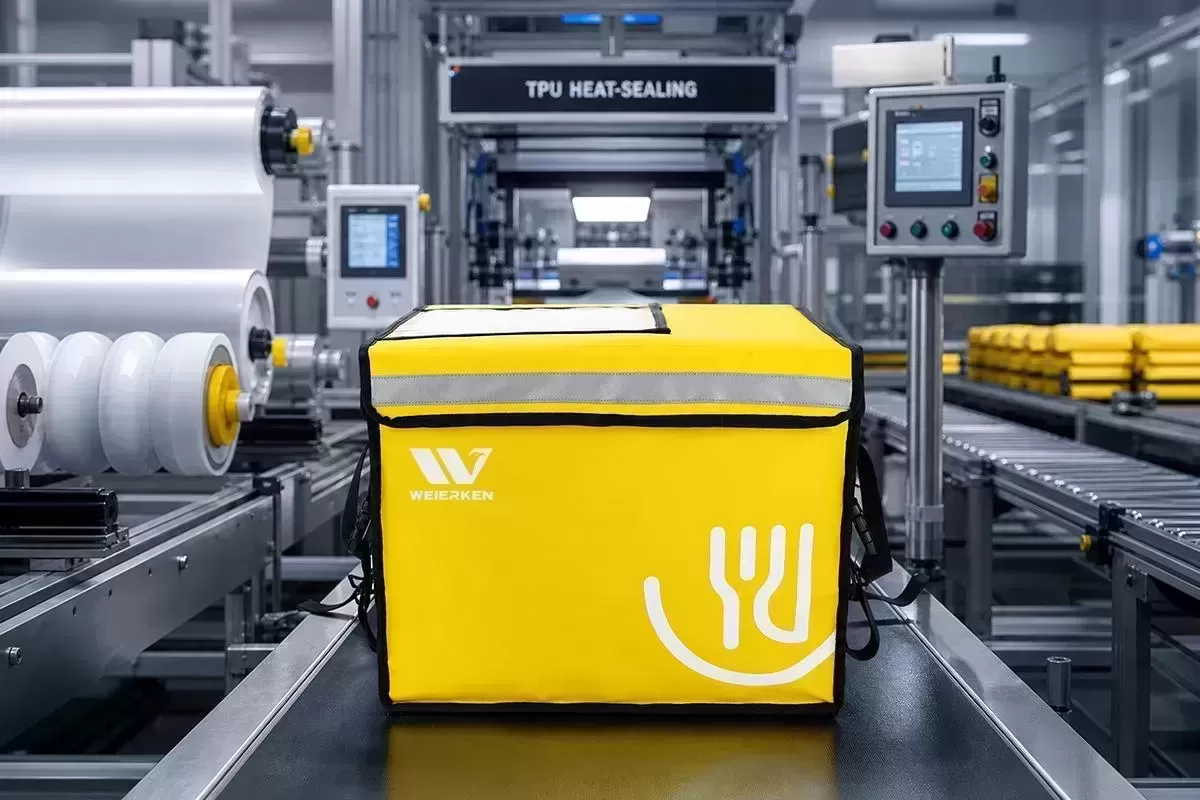
Radio-Frequency (RF) Welded Liners: High-frequency welding fuses the interior thermoplastic polyurethane (TPU) lining into a single leakproof basin with zero needle punctures.
Chemical Resistance: The lining material must withstand daily exposure to multi-quat sanitizers, high-percentage isopropyl alcohol, and mild bleach solutions without clouding or peeling.
Removable Liners: Removable inner compartments secured with industrial hook-and-loop fasteners can be pulled out, pressure-washed, and air-dried away from the main exterior shell.
Engineers at Weierken utilize non-porous, food-grade materials certified to FDA and European LFGB standards to make sure daily sanitation routines remain fast and reliable.
4. Secondary Thermal Baffles for Multi-Drop Delivery Runs
Central kitchen couriers rarely make single-drop trips. A typical route involves stopping at multiple franchise stores or business catering clients. Opening the bag at each stop introduces a rush of hot, humid air into the main chamber.
An experienced wholesale ice cream transport bags manufacturer integrates multi-drop air-control features directly into the build:
Magnetic Sub-Lids: A secondary insulated flap equipped with high-strength neodymium magnets snaps shut immediately after a driver pulls a single tub. This traps the cold air pocket around the remaining payload.
Modular Thermal Curtains: Flexible, insulated internal dividers isolate individual drops from one another. Unloading the front compartment leaves the rear compartments sealed in their own sub-zero zones.
Zipper-Free Fast Access: Magnetic or heavy-duty overlapping compression flaps give drivers quick access, cutting the open-air exposure window from thirty seconds down to three.
These convective barriers protect against temperature degradation during multi-stop delivery routes, keeping every order in spec from the first stop to the last.
5. Standardized Eutectic PCM and Dry Ice Enclosures
Holding products below -18°C (-0.4°F) for four to six hours requires external thermal mass. However, simply throwing loose dry ice bricks or cold packs on top of dessert tubs is dangerous and inefficient.
Your custom heavy-duty delivery bags should feature purpose-built cooling reservoirs designed around heat transfer dynamics:
Overhead Cold Pockets: Because dense cold air falls, eutectic phase change material (PCM) packs freeze best from the top down. Ceiling sleeves position -21°C or -26°C PCM plates directly above the dessert tubs to create a downward convective column.
Dry Ice Venting Systems: As solid dry ice warms, it expands into carbon dioxide gas. Dedicated dry ice sleeves feature micro-perforated escape valves that safely vent pressure while containing the cold block.
Reinforced Contact Linings: The contact sleeves must use cold-crack resistant TPU formulations that will not turn brittle or fracture when exposed to dry ice temperatures (-78.5°C).
6. Total Cost of Ownership (TCO): The Business Case for Reusables
When procurement managers look at unit prices alone, single-use expanded polystyrene (EPS) foam boxes seem cheap. But when you examine your annual operations, disposable packaging becomes a recurring drain on working capital.
Consider the total cost of ownership (TCO) over a typical operating year across 50 franchise locations:
The Disposable Trap: Buying single-use EPS foam boxes and corrugated cartons adds up to substantial ongoing packaging waste and recurring replenishment costs.
The Reusable Advantage: A commercial-grade, custom-built bulk ice cream carrier costs more up front, but easily withstands more than 500 delivery cycles.
Operational Savings: Food service chains that switch to reusable, collapsible bulk delivery bags typically cut their annual packaging material expenses by over 40% while lowering warehouse disposal overhead.
Well-built equipment also provides brand exposure. Adding custom Pantone matching, reflective trim, and crisp screen printing turns your delivery network into a clean, mobile advertisement for your brand.
7. Manufacturing Scalability, Audits, and Production Run Times
Designing the ideal bag is only half the battle. Your supplier must be able to scale manufacturing reliably to support retail expansions and summer demand spikes.
When selecting your OEM/ODM factory partner, verify these production and quality milestones:
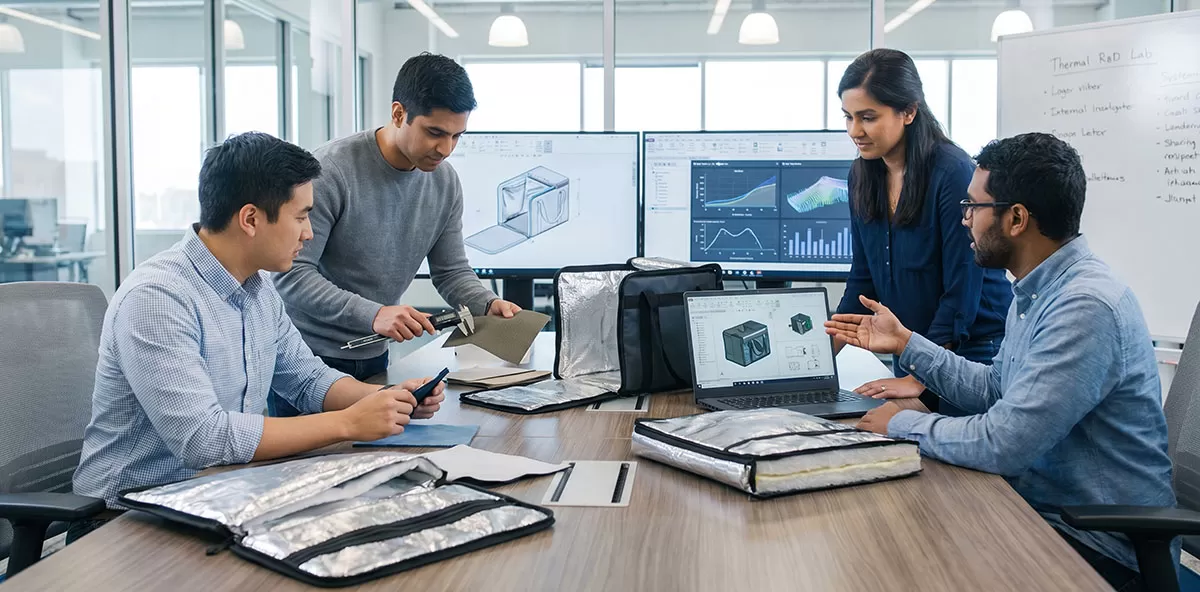
Prototyping Speed: The OEM should turn around production-ready physical prototypes within 7 to 10 business days based on your digital CAD container files.
Production Scalability: Ensure the factory operates dedicated automated cutting and high-frequency welding lines capable of producing 50,000 to 100,000 units monthly during peak demand.
Verified Compliance: Protect your brand reputation by verifying social compliance audits, such as BSCI or Sedex, alongside ISO 9001 certified quality control systems.
Frequently Asked Questions
Q1: Can bulk ice cream delivery bags hold product below -18°C for over 5 hours without electric refrigeration?
A1: Yes. When built with high-density polyurethane (PU) or vacuum insulation panels (VIP) and supported by -21°C eutectic phase change materials (PCMs), our custom bulk bags maintain internal temperatures below -18°C for 4 to 6 hours, even in ambient summer temperatures reaching 35°C.
Q2: How do soft-sided bulk delivery bags protect ice cream containers from crushing during transport?
A2: Professional bags are semi-rigid rather than soft. High-density polypropylene (PP) structural plates are sewn or welded inside the side walls and lid. This construction allows the bags to support heavy top loads without transferring downward pressure onto the dessert containers inside.
Q3: What is the lifespan of an OEM commercial bulk delivery bag in a high-frequency franchise network?
A3: A bag manufactured with 1680D TPU-coated Oxford polyester or 500D commercial PVC tarpaulin typically delivers 500 to 800 operational cycles. That lifespan translates to roughly 1.5 to 3 years of daily store-to-store service under normal working conditions.
Q4: How do we clean and sanitize these bags between multi-store delivery runs?
A4: Seamless, RF-welded interior liners can be sprayed with food-safe quaternary ammonium or alcohol-based sanitizing solutions and wiped dry with microfiber cloths. Removable liners can be taken out completely for deep sanitization and pressure-washing.
Q5: What is the typical minimum order quantity (MOQ) for custom-engineered bulk thermal carriers?
A5: Custom production runs that involve specific container tooling, custom fabric colors, and specialized PCM compartments usually carry an MOQ of 500 to 1,000 units. For large franchise systems rolling out to hundreds of locations, production can easily scale to thousands of units per week.
Equip Your Fleet with Engineered Cold Chain Packaging
Bulk frozen dessert transport does not have to mean high product loss, bulky plastic boxes, or endless waste from disposable packaging. Standardizing your supply chain with purpose-built, returnable equipment protects your product, reduces operating overhead, and supports brand consistency across every market you serve.
Weierken engineers and manufactures commercial cold chain delivery bags for international restaurant chains, food service distributors, and ghost kitchens. Our manufacturing facilities combine clean RF seamless welding with advanced thermal insulation engineering to create delivery gear that handles demanding daily transit routes.
Managing cold chain logistics for 50 or more store locations? Contact the OEM engineering team at Weierken today. Provide your container dimensions and transport routes to receive 3D design renderings, thermal hold profiles, and a complete bulk quotation within 72 hours.