

White-water rafting is one of the most punishing environments for technical gear. When a raft flips in a Class IV rapid, the gear inside the boat faces violent hydrostatic pressure, continuous submersion, and rough abrasion against river boulders.
For outdoor brands and commercial outfitters, product failure here is catastrophic. If river water leaks into a dry pack, sensitive electronics ruin, hypothermia kits soak through, and brand reputation craters. Yet, many commercial buyers discover that bags labeled "waterproof" fail the moment they take a prolonged swim.
The failure rarely stems from the fabric itself. It stems from the construction method. This brings us to the core manufacturing debate: traditional stitching with seam tape versus seamless high-frequency welding. At Weierken, our engineering teams spend hundreds of hours testing both methods to solve one fundamental problem: building gear that stays bone dry under real river pressure.
Here is an inside look at how a specialized waterproof rafting backpack OEM builds, tests, and validates packs that withstand total submersion.
The Core Dilemma: Stitched & Seam-Taped vs. Seamless Welded Technology
Every commercial buyer wants to balance production cost against functional performance. To make an informed sourcing decision, you must understand how both construction methods behave under water pressure.
Stitched & Seam-Taped Bags: The Traditional Approach
Traditional bag manufacturing relies on industrial sewing machines. A needle punches through multiple layers of heavy fabric, running a bonded nylon or polyester thread through the joint. To waterproof this seam, a hot-air sealing machine applies a thermo-adhesive polyurethane (PU) tape over the puncture holes inside the pack.
- The Advantage: Lower barrier to entry. Factory tooling costs are minimal because standard sewing lines handle complex geometric shapes, curves, and pocket layouts with ease.
- The Structural Flaw: Sewing punctures thousands of microscopic holes into an otherwise impermeable membrane. The entire integrity of the pack relies on a thin strip of tape glued over those holes.
- Failure Modes in Rafting: White-water conditions exert dynamic hydraulic shock. As water repeatedly slams into the bag, the fabric flexes. Over time, moisture, heat, and mechanical shear cause the seam tape to lift at the edges. Once the tape delaminates, water shoots straight through the stitch holes.
High-Frequency (HF) / RF Welded Bags: The Marine-Grade Solution
High-Frequency (HF) welding—also known as Radio Frequency (RF) welding—does not use needles, thread, or surface glue. Instead, it directs electromagnetic energy (typically 27.12 MHz) through specialized aluminum tooling dies pressing onto two overlapping pieces of thermoplastic-coated fabric.
The high-frequency energy excites the molecular structure of the plastic coating, causing the polymers to melt and intermingle under high mechanical pressure. Once the cycle cools, the two pieces have fused into a single monolithic sheet.
- Zero Needle Holes: Because the fabric is never punctured, there is no physical pathway for water or pressurized air to enter.
- Molecular-Level Strength: The welded seam is often stronger than the surrounding base fabric. In tensile pull tests, the material coating will tear before the welded seam separates.
- Tooling Investment: HF welding requires custom CNC-milled brass or aluminum dies for every single joint and seam angle. It requires significant capital upfront, making it ideal for scalable, professional production runs.
For true white-water rafting, where a bag might spend twenty minutes trapped underwater beneath an overturned raft, seamless HF welding is the only reliable choice.
Material Selection: What Fabrics Do Top OEMs Use for 100% Watertight Rafting Packs?
Welding machines cannot fuse materials unless the outer layers are compatible thermoplastics. A professional waterproof rafting backpack OEM must carefully balance base fabric density with coating chemistry.
TPU vs. PVC: Choosing the Polymer Base
The two dominant coatings used in marine bags are Polyvinyl Chloride (PVC) and Thermoplastic Polyurethane (TPU).
- PVC (Vinyl): Traditionally popular due to low material costs. It welds easily and offers decent water resistance. However, PVC stiffens and cracks in cold mountain rivers. It also contains plasticizers that leach over time and faces growing environmental restrictions across North America and the EU.
- TPU (Thermoplastic Polyurethane): The gold standard for modern technical expedition packs. TPU remains soft and flexible down to -30°C, features superior tear resistance, and contains zero harmful plasticizers. It is lighter than PVC and resists long-term UV degradation.
Denier Ratings and Substrate Strength
The internal fabric scrim provides structural tensile strength, while the coating provides air- and watertight integrity. Most professional white-water dry bags utilize:
- 420D Nylon/Polyester with Double-Sided TPU: Ideal for lightweight expedition dry bags where weight matters but puncture resistance remains necessary.
- 840D to 1000D High-Tenacity Nylon with TPU: The industry standard for heavy-duty commercial rafting backpacks. This base handles gravel, sharp branches, and constant deck friction without puncturing.
Engineering parameters must match material thickness precisely. If an OEM runs an HF machine with too much power, the die burns through the substrate, weakening the seam. If power or dwell time is too low, the bond remains superficial and peels apart under load.
Beyond the Seams: The Engineering Behind a True Submersible Rafting Backpack
A waterproof fabric with welded seams will still flood if the rest of the backpack is poorly engineered. An elite waterproof rafting backpack OEM applies precise mechanical engineering to every opening and contact point.
1. Closure Systems: Roll-Top vs. Airtight Submersible Zippers
Water enters through the easiest path available. OEMs design two primary closure methods for white-water use:
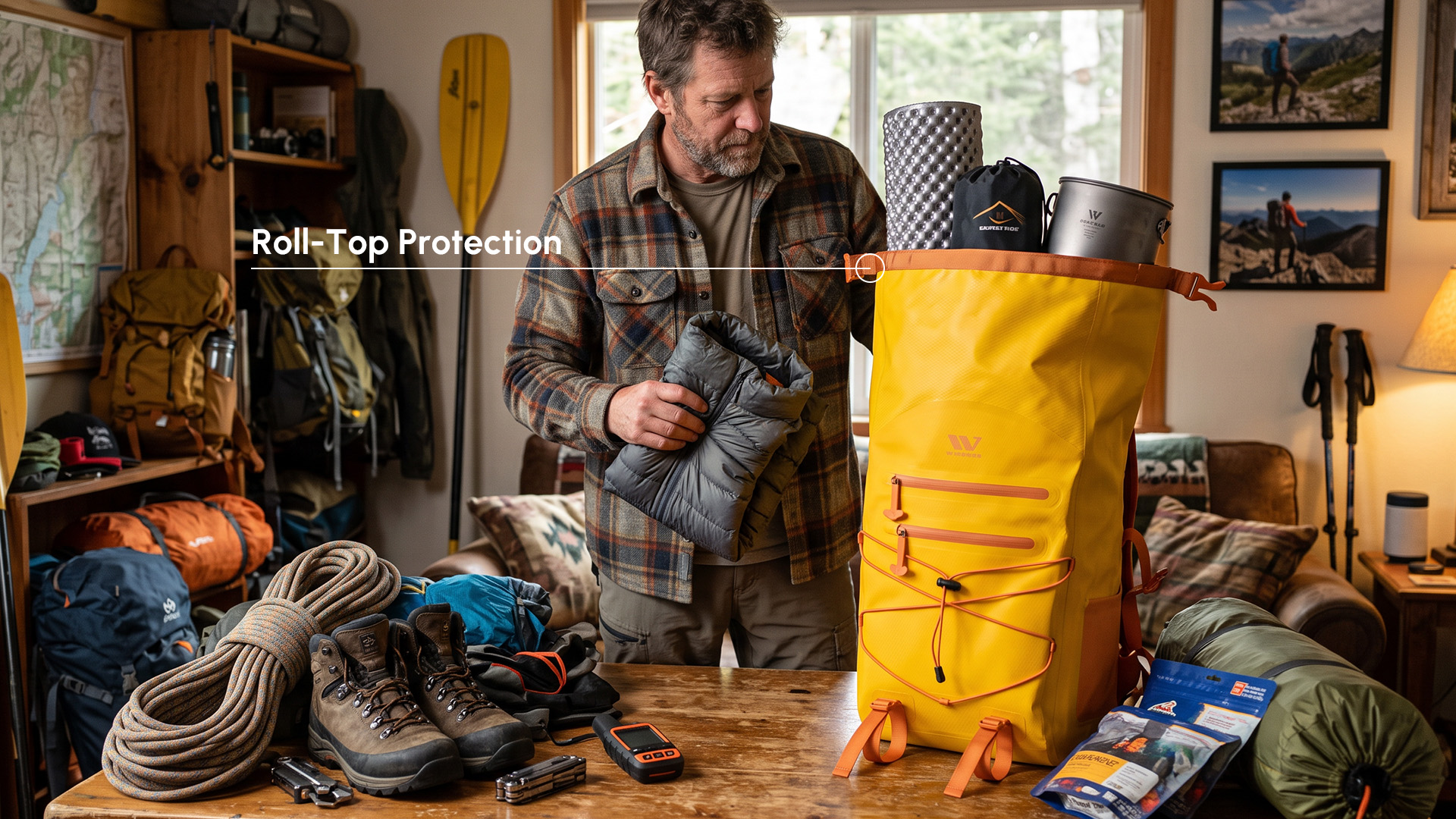
- Classic Roll-Top: Relies on mechanical folding. A reinforced Hypalon or polypropylene stiffener strip sits at the opening. Rolling the collar tightly a minimum of three to four times creates a compression barrier against water ingress. It handles quick submersion well and never jams with sand.
- Airtight/Pressure-Proof Zippers: For absolute submersion (IPX7 and above), top-tier packs use mechanical waterproof zippers like TIZIP MasterSeal. These feature interlocking polyurethane teeth that clamp rubber sealing lips together under pressure, creating a true gas-tight seal.
2. Welded Load-Bearing Anchor Points
How do you attach heavy shoulder straps to a dry bag without sewing through the main waterproof compartment?
Amateur factories stitch the straps directly to the bag and try to tape over the seam inside. This always leaks over time due to shoulder leverage pulling the tape loose. At Weierken, our engineering team eliminates this vulnerability by RF-welding high-strength Hypalon or reinforced TPU anchor patches to the bag's exterior.
The harness is then stitched solely to these secondary exterior patches. The primary waterproof chamber remains 100% untouched and puncture-free, allowing the backpack to carry 25+ kilograms without threatening watertight integrity.
3. Hydrophobic and Non-Absorbent Harness Materials
A true rafting pack must not gain water weight. Standard open-cell backpack foam acts like a sponge, soaking up liters of river water and adding unnecessary weight to the paddler.
Top OEMs use closed-cell EVA foam molded directly into ergonomic back panels. Closed-cell EVA cannot absorb water. Paired with non-absorbent monofilament mesh and hydrophobic webbing, the pack drains instantly upon exiting the river, drying rapidly in camp.
Quality Control: How an Elite Waterproof Rafting Backpack OEM Tests for 100% Watertightness
Marketing claims mean nothing without empirical factory testing. Top-tier factories test against established Ingress Protection (IP) standards rather than relying on visual inspections.
Understanding Ingress Protection (IPX) Ratings
- IPX5: Protected against low-pressure water streams from any angle. (Rainproof only).
- IPX6: Protected against high-pressure heavy seas and powerful water jets. (Acceptable for flatwater splash decks).
- IPX7: Protected against complete water immersion up to 1 meter deep for 30 minutes. (The baseline requirement for white-water rafting packs).
- IPX8: Protected against continuous submersion under deeper pressurized water.
The Three Internal Lab Tests
To guarantee every batch meets IPX7 standards, a dedicated waterproof rafting backpack OEM enforces stringent inline quality controls:
- Positive Pressure Bubble Leak Testing: The factory seals the backpack, inflates it through a temporary pneumatic valve to 2.5 to 3.5 PSI, and completely submerges the pack in an illuminated water tank. Technicians monitor the seams for escaping air bubbles. If zero bubbles appear within two minutes, the seam is certified airtight.
- Tensile Seam Peel Strength Testing (ASTM D751): Technicians cut sample weld swatches from each production roll. A calibrated universal testing machine pulls the seam apart at a fixed velocity. The welded bond must meet or exceed factory shear strength metrics (typically >150 N / 50mm) before assembly line release.
- Cold-Crack and Flex-Fatigue Testing: Material swatches
endure sub-zero temperatures inside a climate chamber, followed by rapid
mechanical folding cycles. This ensures the TPU-welded seams will not crack when
a rafter folds the pack in freezing glacial runoff.
Key Considerations When Choosing a Waterproof Rafting Backpack OEM Partner
If you are developing a technical pack for your brand, catalog, or crowdfunding campaign, choosing the wrong manufacturing partner can cost you tens of thousands of dollars in product returns. Keep these critical requirements in mind during your supplier audit:
- In-House Tooling and Welding Capacity: Does the factory operate their own high-frequency welding machines and tooling workshop, or do they outsource welding to third-party subcontractors? Working with a direct manufacturer speeds up prototyping adjustments and maintains tight quality control.
- Mastery of Complex Curves: Welding flat dry sacks is easy; welding an ergonomic, three-dimensional backpack with contoured lumbar supports and roll-top collars requires multi-axis custom dies and precise operator skill. Ask potential suppliers for samples of curved-welded structures.
- Global Regulatory Compliance: Ensure the factory sources raw materials compliant with international standards, such as REACH, RoHS, and Prop 65. Chemical compliance protects your brand from severe import penalties.
Frequently Asked Questions (FAQ)
Q1: Why do seam-taped waterproof backpacks fail in white-water conditions?
A1: Seam-taped packs fail because traditional sewing punches thousands of structural holes through the fabric. Under dynamic hydraulic pressure and repeated flexing during river running, the polyurethane tape adhesive fatigues and peels back. Once the tape delaminates, water penetrates directly through the thread holes.
Q2: What is the minimum IPX rating required for a commercial rafting backpack?
A2: A commercial rafting backpack should achieve an IPX7 rating at minimum. This certification ensures that if a raft capsizes or the bag falls overboard into turbulent current, gear inside remains completely dry during immersion up to 1 meter for 30 minutes.
Q3: Is TPU significantly better than PVC for technical rafting packs?
A3: Yes. TPU is substantially lighter, far more abrasion-resistant, and maintains its flexibility in near-freezing river water without cracking. Additionally, TPU does not require toxic plasticizers to stay supple, making it environmentally compliant and longer-lasting than PVC.
Q4: What is the typical MOQ for custom high-frequency welded backpacks?
A4: Because HF welding requires custom-engineered aluminum dies for each component, minimum order quantities (MOQs) typically range between 500 and 1,000 units per colorway. This volume absorbs the initial tooling costs and allows for automated production efficiency.
Q5: Can an OEM integrate ergonomic padded straps without punching stitch holes through the dry compartment?
A5: Yes. An experienced OEM will RF-weld dedicated mounting patches (typically made from Hypalon or heavy-duty TPU) to the outside of the main dry shell. The shoulder straps, hip belts, and load lifters are stitched exclusively to these welded patches, keeping the inner chamber completely hole-free.
Build Expedition-Grade Packs with Weierken
White-water rafting allows no room for manufacturing compromises. If your brand wants to launch a durable, submersible backpack that conquers rough waters without leaking, seamless high-frequency welding is the only industrial choice.
At Weierken, we operate advanced high-frequency welding lines, precision CNC tooling facilities, and clean assembly lines. We engineer customized waterproof packs for outdoor brands worldwide, meeting rigorous IPX7 and IPX8 standards.
Ready to engineer your next high-performance outdoor pack? Contact our engineering team today to review your tech pack, explore material options, and request a detailed production quote.