
A failed cold chain in the human food sector causes customer disappointment. In the raw and fresh pet food sector, it causes bacterial blooms. Pathogens like Salmonella and Listeria monocytogenes multiply quickly once frozen raw meat climbs above 4°C (40°F), creating health risks for pets and liability for brands.
While the outer fabric of a delivery bag handles abrasion and weather, the hidden insulation layer determines your holding time. Packaging engineers at Weierken help direct-to-consumer (DTC) fresh food companies evaluate how different core thermal insulation materials for cooler bags impact thermal drift, freight costs, and customer retention.
Selecting the wrong insulation drives up dry ice consumption, increases volumetric freight charges, and ruins margins. Below, we break down the four most common commercial cold chain thermal layers used in pet food home delivery cooler bags, analyzing their technical properties, performance profiles, and commercial trade-offs.
1. EPE Foam with Metalized Radiant Foil (Expanded Polyethylene)
Expanded Polyethylene (EPE) foam laminated with reflective aluminum or metalized PET film represents the standard entry-level solution across the food logistics sector. It features a closed-cell structure that traps air inside tiny plastic bubbles, slowing conductive heat transfer.
In standard configurations, manufacturers laminate a 4mm to 8mm sheet of low-density EPE foam between two reflective metalized layers. The shiny aluminum film reflects up to 95% of radiant heat, while the closed-cell foam resists conductive heat movement through the bag walls.
Thermal Efficiency (R-Value): R-1.2 to R-1.8 per inch of thickness. Moderate thermal performance that drops quickly if the foam compresses under heavy loads.
Cost Profile: Low initial cost. Tooling, cutting, and stitching EPE panels require minimal specialized factory machinery.
Weight & Flexibility: Extremely lightweight. It adds almost zero dead weight to the final parcel.
Durability Concerns: Poor compression recovery. Once a heavy frozen block of pet food crushes the cells, the foam loses structural elasticity and cannot regain its original thickness.
Best Use Cases: Same-day local delivery, on-demand courier routes (2 to 6 hours), and low-cost disposable thermal liners. If you run a high-turnover local hub where packaging is not recovered, EPE foam delivers acceptable performance at a low price point.
2. High-Density Closed-Cell PU / EVA Foam
For brands operating a closed-loop subscription model, cross-linked high-density Polyurethane (PU) and Ethylene-Vinyl Acetate (EVA) foams offer substantial engineering upgrades over basic EPE. These resilient foams range from 8mm to 15mm in thickness.
Closed-cell PU and EVA feature dense microcellular structures that resist moisture absorption and physical crushing. Even when stacked under 15 kilograms of frozen food portions and heavy gel packs, these materials spring back to their intended thickness cycle after cycle.
Thermal Efficiency (R-Value): R-3.5 to R-4.2 per inch. Excellent thermal resistance that maintains frozen products below 0°C for 24 to 36 hours when properly packed.
Structural Memory: Outstanding rebound resilience. High-density EVA survives 50 or more delivery and wash cycles without thinning out or developing cold spots.
Cushioning & Impact Protection: Rigid enough to protect vacuum-sealed plastic pet food tubs and sausages from rupture during parcel sortation and transit.
Cost & Bulk: Moderate to high material cost. The added wall thickness increases the exterior dimensions of the bag, which can slightly raise shipping volumes.
Best Use Cases: DTC pet food subscriptions, weekly scheduled drop-offs, and multi-trip reverse logistics networks. When designing durable pet food home delivery cooler bags, this core material provides the sweet spot between thermal retention and operational life expectancy.
3. Recycled Cotton and Plant-Fiber Felt with Vapor Barriers
Consumer demand for eco-friendly packaging has pushed recycled natural fibers into mainstream cold-chain shipping. These insulated liners use post-consumer denim, textile offcuts, or jute fibers processed into a dense needle-punched felt.
Because open natural fibers absorb ambient moisture and trap dirt, manufacturers seal them inside an impermeable poly-barrier film or metalized pouch. The fiber matrix traps air while providing high specific heat capacity, slowing down external temperature spikes.
Thermal Efficiency (R-Value): R-3.0 to R-3.8 per inch. Comparable to rigid polyurethane foams when completely dry.
ESG & Brand Optics: Strong sustainability appeal. Using recycled materials directly addresses customer resistance to single-use plastics and petroleum-based foams.
Thermal Inertia: Dense natural fibers absorb heat energy slowly, buffering frozen cargo against short-term porch exposure in direct summer sunlight.
Failure Risks: High vulnerability to moisture. If a meat pouch punctures or condensation compromises the exterior barrier film, the inner cotton felt absorbs water like a sponge. Saturated felt loses its insulating ability entirely and becomes a breeding ground for mold.
Best Use Cases: Organic, eco-certified pet food brands shipping 24-hour regional parcels. It works best in dry logistics workflows where the courier retrieves packaging quickly and packaging sanitation is carefully managed.
4. Advanced Aerogel Insulation Composites
Derived from aerospace engineering, aerogel represents the cutting edge of thermal barrier technology. Often referred to as "frozen smoke," aerogel is an open-celled mesoporous solid where air makes up over 90% of the volume, bound by a silica matrix.
In thermal packaging, silica aerogels are embedded into flexible non-woven textile blankets. At just 2mm to 4mm in thickness, an aerogel composite matches or outperforms traditional foam layers that are four times thicker.
Thermal Efficiency (R-Value): R-8.0 to R-10.0+ per inch. Unmatched thermal resistance. It stops conductive, convective, and radiant heat transfer with remarkable efficiency.
Extreme Space Savings: Ultra-thin profile. Because the wall thickness drops from 15mm to 3mm, you gain internal storage volume without expanding the bag's exterior footprint. This drastically cuts volumetric dimensional weight (DIM weight) surcharges.
Hydrophobic Performance: Modern aerogel blankets repel liquid water while allowing vapor permeability, preventing water-logging from melted ice.
Cost Barrier: Highest upfront unit price. Aerogel composites require significant upfront investment, making them practical only for high-margin products or strictly tracked closed-loop systems.
Best Use Cases: Long-distance transcontinental raw pet food shipping (48 to 72 hours), high-value customized veterinary nutrition diets, and extreme summer shipping lanes where standard bags fail.
Technical Comparison: Evaluating Insulation Core Materials
To help supply chain managers specify the right material for their operational model, Weierken tests every core layer under controlled ambient temperatures. The table below compares the four insulation layers across standard packaging metrics:
| Insulation Material | Thermal R-Value | Durability (Trips) | Moisture Resistance | Volumetric Efficiency | Cost Tier |
|---|---|---|---|---|---|
| EPE Foam + Foil | Low (R-1.2 to 1.8) | 1 - 5 Trips | High (Surface Sealed) | Moderate | Budget |
| High-Density PU/EVA | High (R-3.5 to 4.2) | 30 - 50+ Trips | Very High (Closed-Cell) | Moderate | Mid-Tier |
| Recycled Cotton Felt | Medium (R-3.0 to 3.8) | 1 - 10 Trips | Poor (If Film Punctured) | Low (Bulky) | Mid-Tier |
| Aerogel Composites | Ultra-High (R-8.0+) | 50+ Trips | High (Hydrophobic) | Maximum (Ultra-Thin) | Premium |
Preventing Thermal Bridging in Bag Construction
A high-performance insulated liner for pet meal delivery means nothing if your overall bag design allows heat to leak through the joints. Cold air is dense and escapes through needle holes, loose corners, and unsealed zippers.
Packaging engineers eliminate thermal bridging through three key structural details:
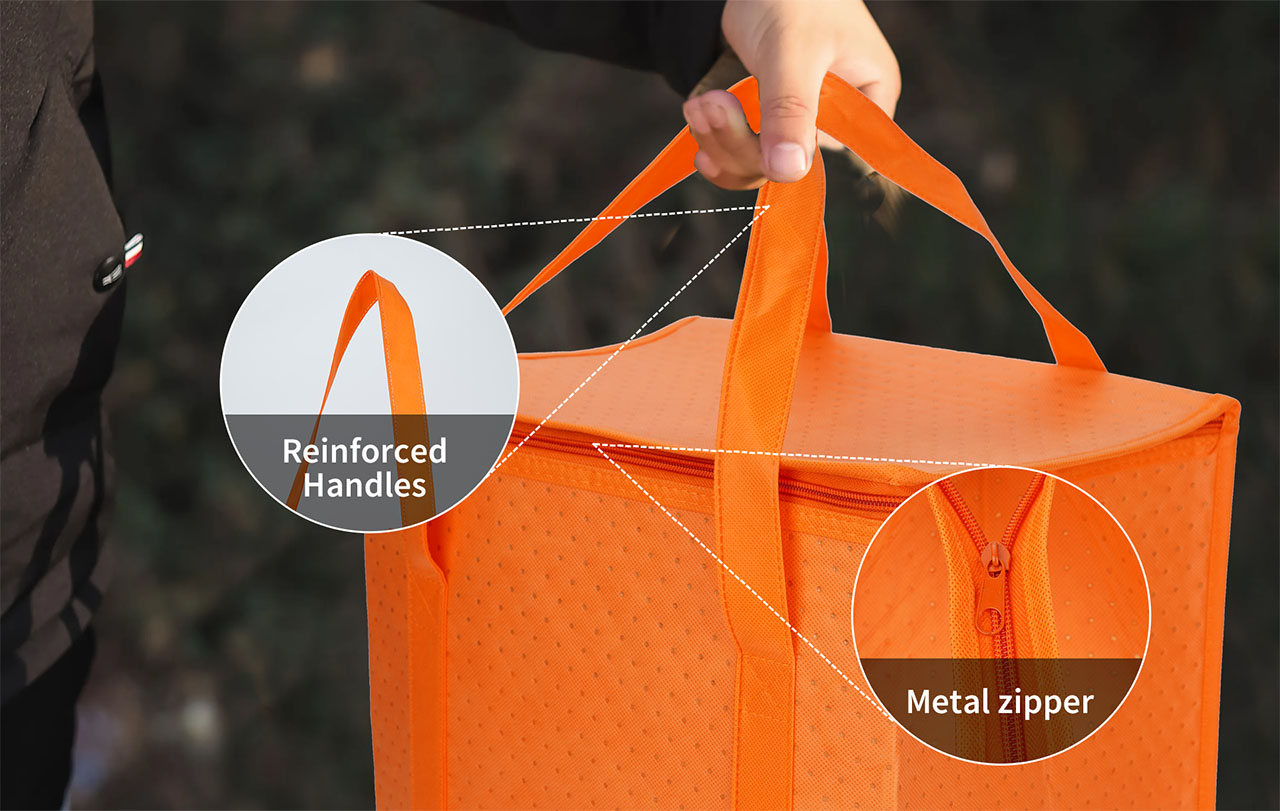
Insulated Gasket Flaps: Zippers cannot insulate. An overlapping, foam-filled thermal flap must sit directly beneath the zipper track. When closed, this gasket seals the perimeter, preventing warm air infiltration.
Airtight and Water-Repellent Hardware: Standard coil zippers breathe. Selecting PU-coated water-resistant zippers or airtight closures keeps humidity and ambient summer heat from entering the payload chamber.
Seamless Welded Interior Linings: Never use stitched inner seams for raw pet food cold chain packaging. High-frequency welded PEVA or TPU liners create a leakproof, tub-style basin. This prevents ice melt from seeping into the insulation layer, protecting hygiene and preserving thermal performance.
Frequently Asked Questions
Q1: What is the minimum R-value required for shipping frozen raw pet
food?
A1: For a 24-hour transit window in temperate conditions,
target an overall packaging R-value of at least R-3.0 to R-4.0. For 48-hour
delivery windows during hot summer months, your packaging should reach an
R-value of R-6.0 or higher, paired with adequate phase-change materials (PCMs)
or dry ice.
Q2: How does foam compression affect the thermal performance of
delivery bags?
A2: When low-density foam compresses under heavy
loads, it squeezes out trapped air. Because still air provides the actual
insulation, compressed foam loses up to 50% of its thermal efficiency. This is
why high-density PU and EVA foams are necessary for reusable delivery
networks.
Q3: Can we machine-wash cooler bags that contain recycled cotton
insulation?
A3: Generally, no. Washing machines often tear the outer
vapor-barrier film of cotton inserts. If water reaches the natural fiber core,
it will clump, take days to dry, and develop mold. Bags using closed-cell PU
foam or removable inner liners are much better suited for commercial
washdowns.
Q4: Why does raw meat require higher insulation specifications than
human meal kits?
A4: Human meal kits typically contain pre-cooked
ingredients or produce held at refrigerated temperatures (0°C to 4°C). Raw pet
diets contain uncooked animal proteins that must stay completely frozen (below
-18°C preferred, -2°C absolute maximum) to stop enzymatic breakdown and
microbial activity.
Q5: How does insulation thickness impact dimensional weight (DIM
weight) shipping costs?
A5: Couriers charge by package volume if the
dimensional weight exceeds actual weight. Adding 20mm of bulky, low-efficiency
foam around a box increases total volume significantly. Upgrading to
higher-efficiency, thinner materials like aerogel or high-density EVA reduces
the bag's exterior dimensions, often saving more in shipping costs than the
material upgrade costs.
Source Engineered Cold-Chain Packaging for Your Brand
Choosing the right thermal insulation layer for your pet food home delivery cooler bags directly impacts your operating margins, product safety, and brand reputation. Balancing thermal holding time against material cost and reverse-logistics durability requires experienced engineering.
Weierken manufactures industrial-grade thermal delivery bags, custom liners, and reusable cold-chain soft goods built specifically for raw and fresh pet food logistics. We test every design in environmental chambers to match your exact delivery lanes and temperature requirements.
Contact our technical packaging team today to review your cold-chain parameters, request thermal test reports, and order custom prototypes for field trials.