
Running a food delivery business or a central kitchen involves more than just cooking great food. You have to ensure that the meal reaches the customer in the same condition it left the stove. Standard thermal insulation bags often fail to meet the rigorous demands of professional catering. That is where a specialized meal delivery bag factory becomes an essential partner in your supply chain.
A reliable manufacturer does not just sell off-the-shelf products. They offer comprehensive OEM services that align with your brand's specific logistical needs and aesthetic identity. Companies like weierken focus on delivering high-performance gear that balances durability with thermal efficiency. This article outlines the top-tier services you should expect when auditing a factory for your next big project.
1. Customized Dimensions and Structural Design
Every food item has a unique footprint. A pizza box requires a flat, wide surface, while a gourmet soup order needs vertical stability. A professional meal delivery bag factory provides flexible structural engineering to accommodate these differences. They don't force you into a "standard" size that leaves your food sliding around during transit.
Multi-Size Series: You can request a range of volumes, such as 5L for single meals, 15L for family packs, and 30L for large-scale catering.
Adjustable Internal Dividers: Factories can design removable partitions or cup holders to keep hot rice and cold drinks separated within the same unit.
Dual-Purpose Orientation: Some bags need to stand upright to prevent spills but must also fold flat for easy storage when the shift ends.
Opening Mechanisms: Choose from top-loading, side-zipper, roll-top, or magnetic flip-top designs based on how your couriers actually work.
By customizing the structure, you minimize "dead space" inside the bag. Less empty space means better heat retention, as there is less air to warm up or cool down.
2. Brand Visual Integration and Customization
Your delivery bag is a moving billboard. It is often the only physical touchpoint a customer has with your brand besides the food itself. A high-quality meal delivery bag factory supports a variety of branding techniques to make your logo pop.
Professional factories offer silk-screen printing, heat transfer, and digital printing for high-resolution graphics. These methods ensure that your brand identity remains intact even after months of exposure to rain, sun, and frequent cleaning. weierken excels in these visual integrations, ensuring that every stitch aligns with the client's corporate colors.
High-Visibility Features: Add reflective strips or fluorescent prints to ensure courier safety during night-time deliveries.
Premium Labeling: Use 3D silicone patches, embroidery, or woven labels to give the bag a high-end feel.
Custom Hardware: You can even have your logo engraved on zipper pullers or molded into plastic buckles for a fully bespoke look.
3. Professional Thermal and Cold Zone Management
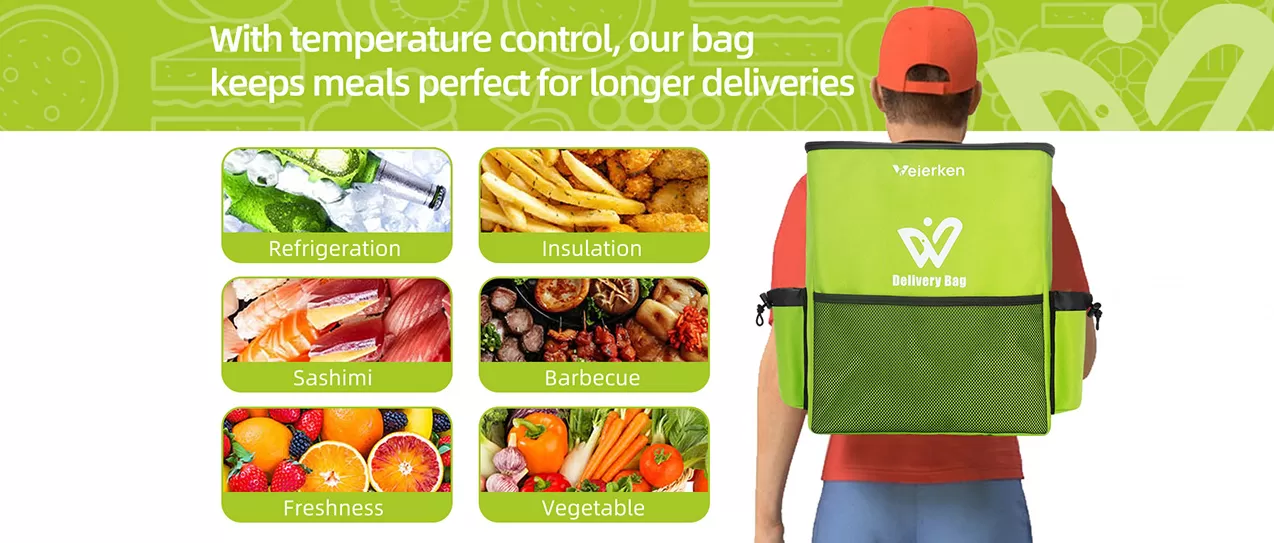
The biggest challenge in last-mile delivery is maintaining different temperatures in one trip. Customers often order a piping hot pasta dish alongside a freezing cold soda. A generic bag will turn both into a lukewarm disappointment. A top meal delivery bag factory solves this through thermal zoning.
Factories use internal thermal walls to create "hot zones" (keeping food above 65°C) and "cold zones" (keeping drinks below 8°C). This prevents thermal migration between items. Furthermore, they can design internal pockets specifically for PCM (Phase Change Material) plates or gel packs to extend the holding time during long-distance routes.
Don't just take their word for it. A professional manufacturer should provide thermal test reports. These reports show how the internal temperature fluctuates over 2, 4, or 6 hours in varying ambient conditions. This data-driven approach is a hallmark of a serious industrial meal bag manufacturer.
4. Food-Grade Materials and Safety Certifications
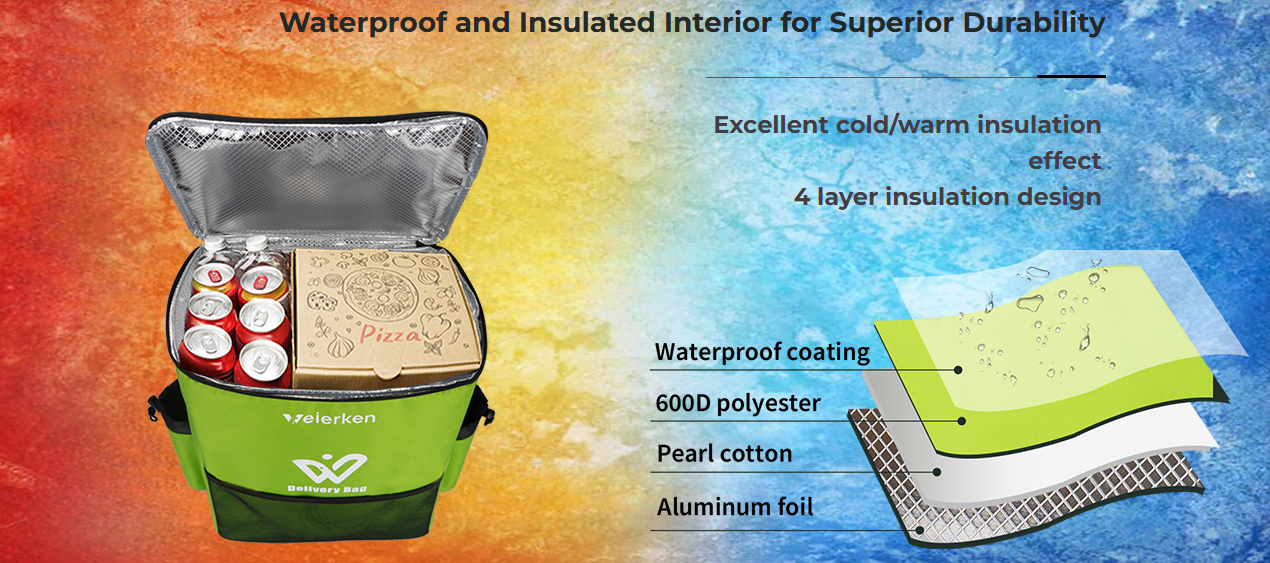
Safety is the baseline in the food industry. The interior lining of the bag must be non-toxic and easy to sanitize. A reputable meal delivery bag factory will use food-grade PEVA, TPU, or FDA-approved aluminum foil composites. These materials do not omit odors and are resistant to bacterial growth.
Leak-proofing is equally critical. If a soup container cracks, the liquid should stay contained within the lining, not soak into the insulation foam. Factories utilize heat-sealing technology to create seamless interiors. This allows the courier to simply wipe the bag clean with a damp cloth at the end of the day.
Oil-Resistant Coatings: Specialized coatings prevent grease from staining the inner fabric.
Compliance: Ensure the factory provides LFGB, FDA, or REACH test reports to meet international import standards.
BPA-Free Construction: Guaranteeing that no harmful chemicals leach into the food packaging environment.
5. Ergonomics and Courier-Friendly Features
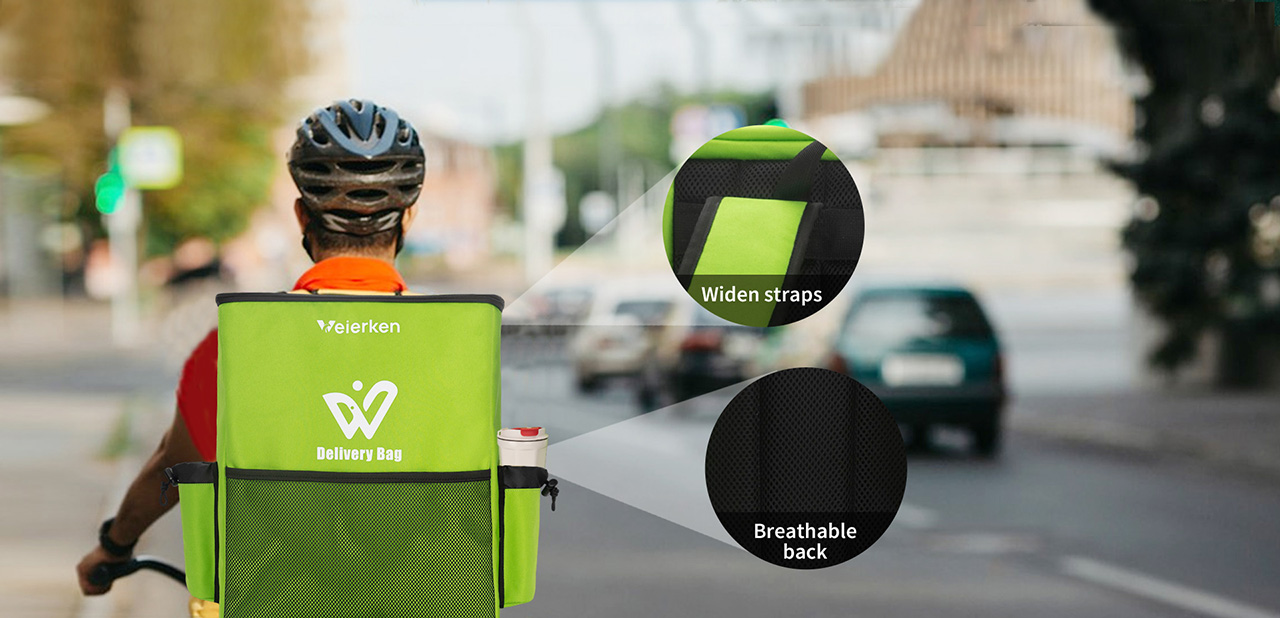
If a bag is difficult to carry, delivery efficiency drops. Couriers face fatigue when using poorly designed gear. A smart meal delivery bag factory focuses on ergonomic design to support the rider. This includes padded shoulder straps, breathable back panels, and balanced weight distribution.
In many urban environments, couriers switch between walking, biking, and riding scooters. The bag should adapt to all these modes. weierken incorporates feedback from real-world riders to refine their handle placements and strap adjustments. This attention to detail reduces the physical strain on the delivery team and speeds up the "drop-off" process.
Quick-Access Openings: Magnetic flaps allow riders to grab an order without fully unzipping the bag, preserving the internal temperature.
Anti-Slip Bases: Adding rubber feet or silicone pads prevents the bag from sliding off a scooter floorboard or a car seat.
Integrated Tool Pockets: Transparent slots for smartphones, receipt clips, and power bank pouches keep the courier organized.
6. Durability and Heavy-Duty Construction
Delivery bags take a beating. They are tossed into trucks, scraped against doors, and left out in the rain. A budget bag will fall apart in weeks. A high-end meal delivery bag factory uses reinforced stitching at all stress points, such as handle attachments and shoulder strap junctions.
The choice of outer fabric is vital. Most professional bags use 600D to 1680D Nylon or Polyester with a heavy PVC or PU backing. These fabrics are abrasion-resistant and waterproof. Additionally, water-resistant zippers with storm flaps provide an extra layer of protection during heavy downpours, ensuring the customer's meal stays dry and presentable.
Factories also offer UV-resistant treatments. This prevents the fabric from fading or becoming brittle after months of sun exposure on the back of a delivery bike. Long-lasting gear represents a lower total cost of ownership for your business.
7. Flexible MOQ and Rapid Prototyping
Not every brand needs 10,000 bags on day one. A flexible meal delivery bag factory understands the needs of startups and regional chains. They offer Low MOQ (Minimum Order Quantity) options, often ranging from 200 to 500 units for trial runs or limited-edition collaborations.
Speed to market is another competitive advantage. You should look for a factory that can produce a standard sample within 7 days and a complex custom prototype within 15 days. Many modern factories now offer 3D design renders before physical production begins. This allows you to visualize the final product and make adjustments without wasting material or time.
8. Value-Added Packaging and Logistics Services
The relationship doesn't end when the bags are sewn. Shipping large, bulky delivery bags can be expensive. A savvy meal delivery bag factory offers vacuum compression packaging. By removing the air from the bags and folding them strategically, they can reduce the shipping volume by up to 50%, saving you a fortune in ocean freight costs.
Some manufacturers go even further by offering drop-shipping services or fulfillment. They can ship directly to your individual franchisees or regional hubs. They can even provide custom retail packaging or "maintenance kits" that include spare buckles and cleaning cloths to enhance the end-user experience.
By partnering with a full-service provider like weierken, you streamline your entire procurement process. You get more than a bag; you get a logistics solution designed to grow with your brand.
Frequently Asked Questions (FAQ)
1. What is the standard MOQ for a custom meal delivery bag?
Most meal delivery bag factory partners set their MOQ between 300 and 500 pieces for fully customized orders. However, for simpler branding on existing designs, some factories may accept smaller batches of 100 units.
2. How do you ensure the bag is actually waterproof?
We use high-denier fabrics with a waterproof coating (PVC or PU) and employ heat-sealed liners. Additionally, selecting waterproof zippers and adding protective flaps over the seams prevents water ingress during rain.
3. Can the factory help with the actual design of the bag?
Yes. A professional meal delivery bag factory provides ODM services where their in-house design team creates blueprints based on your specific food containers. You just provide the dimensions, and they handle the engineering.
4. What kind of insulation is best for keeping food hot?
For hot food, high-density EPE foam or XPE foam (8mm to 10mm thickness) combined with a reflective aluminum foil lining is standard. For extreme heat retention, vacuum insulation panels can be used, though they increase the cost significantly.
5. How long does the thermal effect last?
In a standard environment (25°C), a professional bag can keep hot food above the safety threshold of 60°C for 2 to 4 hours. With the addition of heating elements or high-end insulation, this can be extended to 6+ hours.
6. Do you provide samples before mass production?
Yes, sampling is a standard part of the OEM process. It allows you to test the size, the thermal performance, and the durability of the materials before committing to a full production run.
Start Your Custom Project Today
Choosing the right meal delivery bag factory is a strategic move for any food service brand. From structural innovation to brand integration, the right partner helps you maintain food quality and courier satisfaction. weierken is committed to providing these top-tier OEM services to clients worldwide, ensuring every delivery is a success.
Don't let poor equipment hold your brand back. Our team is ready to help you design a bag that meets your exact thermal and aesthetic requirements. Whether you are a small local kitchen or a global delivery platform, we have the manufacturing capacity to support your growth.
Ready to see the difference quality manufacturing makes? Contact us today to request a quote or order a custom sample for your business.
Inquiry Now for Custom Solutions
Expert meal delivery bag factory services are just one click away. Let's build your perfect bag.
SEND AN INQUIRY