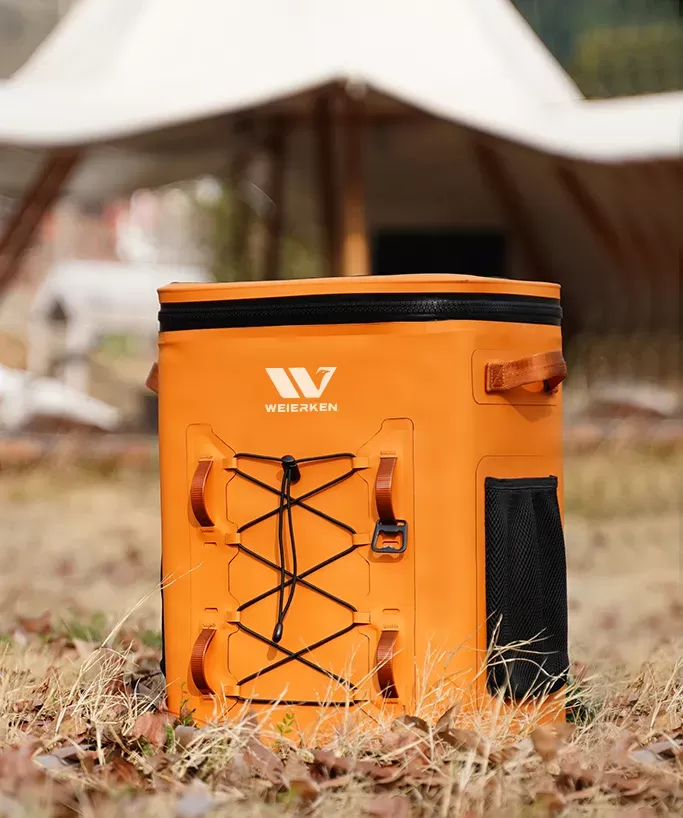

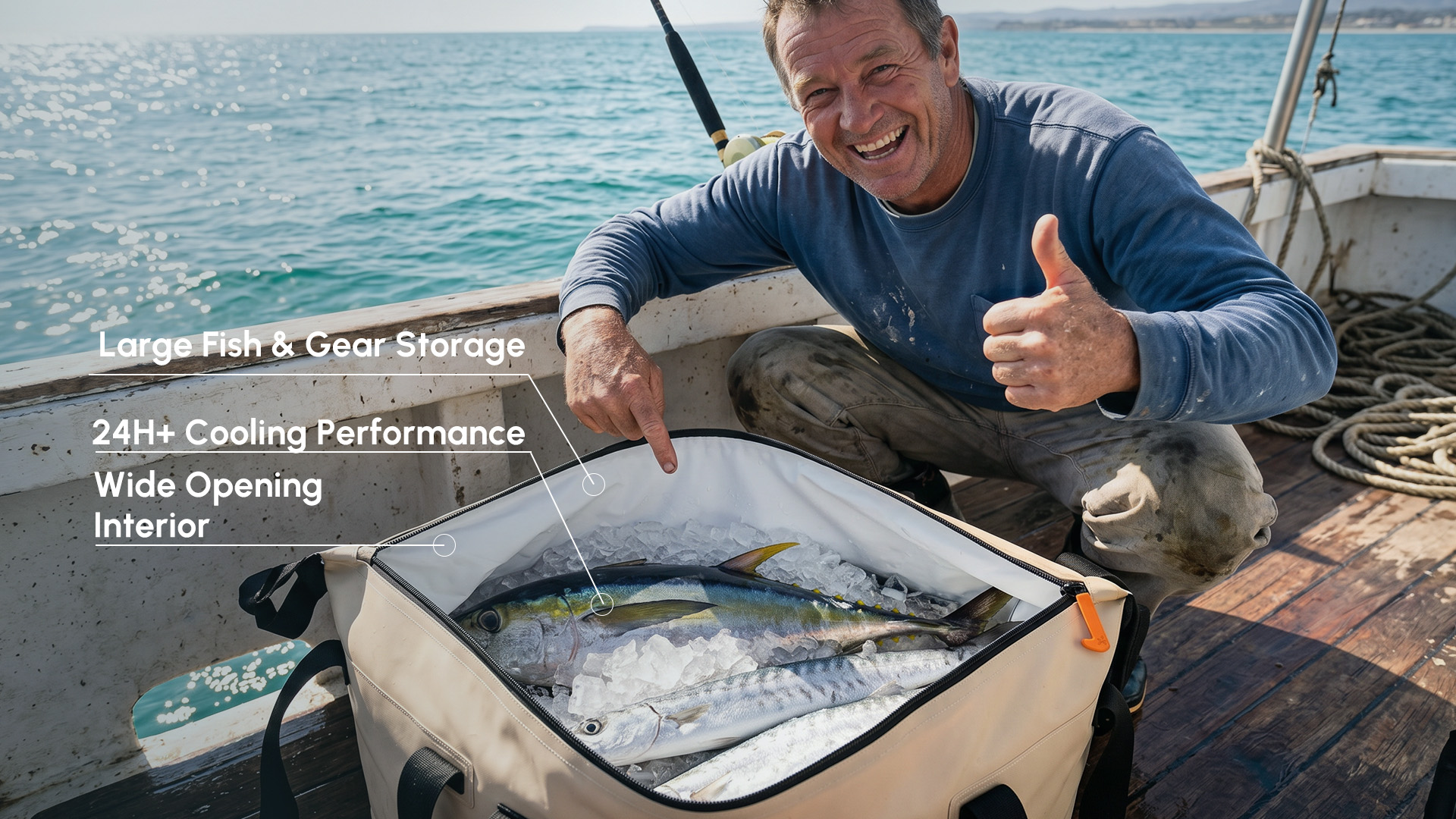
Offshore angling exposes gear to brutal punishment. Between thrashing pelagic fish, razor-sharp fins, saltwater corrosion, intense UV radiation, and heavy ice loads, a standard soft cooler fails quickly. Marine brands and commercial fishing outfits require rugged, leakproof gear that keeps catches fresh across multi-day expeditions.
If you plan to launch or upgrade an insulated fish storage bag OEM product line, your primary engineering decision centers on the shell material: Thermoplastic Polyurethane (TPU) or Heavy-Duty Polyvinyl Chloride (PVC). This choice dictates your Bill of Materials (BOM) cost, factory tooling parameters, international regulatory compliance, and market pricing tier.
At Weierken, we engineer and manufacture technical marine soft goods for global brands. This guide analyzes TPU and PVC across material mechanics, manufacturing processes, and total return on investment to help you specify the right textile for your product line.
[Request a Custom OEM Quote & Fabric Swatch Pack]
Heavy-Duty PVC: Industrial Strength and Cost-Effective Manufacturing
Heavy-duty PVC tarpaulin remains the traditional workhorse for commercial marine gear and high-capacity kill bags. Built by sandwiching a high-tenacity polyester scrim between two layers of plasticized polyvinyl chloride, this composite delivers exceptional tear resistance at a practical factory cost.
Material Specifications and Densities
Most commercial fish kill bags use PVC tarpaulin ranging from 500D to 1000D, with material weights spanning 600 GSM to 900 GSM (approximately 0.55mm to 0.90mm total thickness). The internal polyester base fabric provides structural tensile strength, while the PVC coating seals out water, blood, and slime.
Core Manufacturing Advantages
Puncture and Abrasion Defense: The sheer mass of 1000D PVC resists sharp dorsal spines from tuna, wahoo, and grouper. It withstands dragging across non-skid fiberglass boat decks without tearing.
Mature RF Welding Integration: PVC bonds easily under standard Radio Frequency (RF) and High-Frequency (HF) welding. The polymer chains melt quickly and fuse completely, producing a 100% watertight seam with high factory yields.
Lower Production Costs: PVC raw materials cost significantly less than TPU. For brands targeting mid-range price points or building large 100-quart-plus tournament bags, PVC keeps FOB prices competitive.
Engineering Trade-offs and Constraints
Despite its structural benefits, PVC presents specific engineering challenges for high-end retail brands:
Excess Weight: A 1000D PVC kill bag is heavy before adding ice or fish. This increases shipping costs per unit and creates handling fatigue for the end-user.
Cold-Cracking Tendencies: Standard PVC uses liquid plasticizers to achieve flexibility. Under freezing temperatures or long contact with dry ice, cheap PVC stiffens and risks micro-cracking along folded edges.
Environmental and Compliance Barriers: Traditional PVC contains phthalates and heavy metals. To sell in North America and the European Union, your OEM factory must use 6P-free or 17P-free formulations to comply with California Proposition 65 and REACH regulations.
Target OEM Applications
Heavy-duty PVC works best for commercial charter boat bags, high-volume fishing cooler bag factory runs, and high-capacity offshore kill bags where structural toughness and price per quart matter more than minimal weight.
High-Performance TPU: Lightweight Durability and Premium Retail Positioning
Thermoplastic Polyurethane (TPU) laminated onto high-density nylon represents the modern benchmark for premium outdoor gear. TPU combines the elasticity of rubber with the mechanical strength of engineered thermoplastics, making it the preferred choice for direct-to-consumer (DTC) marine brands targeting premium retail tiers.
Material Specifications and Architecture
Premium TPU bags typically employ a 420D, 600D, or 840D High-Density Nylon 6/6 woven fabric laminated with an Ether-based TPU film. Ether-based TPU provides hydrolytic stability, preventing the material from breaking down when continuously exposed to saltwater and organic matter.
Core Manufacturing Advantages
Food-Grade Safety and Regulatory Compliance: TPU is non-toxic, odorless, and free of plasticizers. It meets FDA standards for direct food contact and passes California Prop 65, REACH, and RoHS audits without specialty additives. Anglers can place edible fillets directly against the inner liner.
All-Weather Flexibility: TPU maintains its elasticity from -30°C to 70°C. It will not crack when packed with crushed ice, salt brine, or ice packs, nor will it become greasy or tacky on hot boat decks.
30% to 40% Weight Reduction: TPU-laminated nylon achieves higher tensile and burst strength than PVC at a fraction of the mass. A lighter bag significantly cuts dimensional weight (CBM) for ocean freight, air express, and domestic e-commerce fulfillment.
UV and Hydrolysis Resistance: High-grade Ether TPU resists UV oxidation and solar yellowing 2 to 3 times longer than standard PVC tarpaulin, extending product lifespan in equatorial marine settings.
Engineering Trade-offs and Constraints
Specifying TPU introduces specific manufacturing and pricing requirements:
Higher Raw Material Cost: Raw TPU fabric costs two to three times more than standard PVC tarpaulin, shifting the bill of materials upward.
Precise Welding Tooling: TPU requires narrow temperature windows, precise dwell times, and clean welding dies during high-frequency assembly to avoid thinning the laminated barrier film.
Target OEM Applications
TPU serves premium direct-to-consumer marine brands, portable kayak and paddleboard fishing cooler bags, and performance tournament gear where sleek aesthetics, lightweight portability, and food-grade compliance drive purchase decisions.
TPU vs. Heavy-Duty PVC: Direct Technical Comparison
The matrix below outlines key mechanical, chemical, and commercial metrics to help you assess materials for your insulated fish storage bag OEM program.
| Performance Metric | Heavy-Duty PVC (500D - 1000D) | High-Performance TPU (420D - 840D Nylon) |
|---|---|---|
| Raw Material Cost | Low to Moderate (Cost-efficient baseline) | High (2x to 3x PVC raw fabric cost) |
| Weight / Density | Heavy (650 - 900 GSM) | Lightweight (380 - 600 GSM; ~35% lighter) |
| Puncture & Tear Resistance | Excellent (Thick structural wall) | Superior Tensile & Puncture per mm |
| Cold Flexibility | Moderate to Poor (Stiffens below 0°C) | Superior (Maintains flex to -30°C) |
| Direct Food Contact (FDA) | Requires specialized non-phthalate formula | Inherently compliant, food-grade safe |
| Environmental Compliance | Requires strict testing for Prop 65 / REACH | BPA-free, Phthalate-free, fully compliant |
| RF Seam Weldability | Extremely forgiving; high processing window | Requires precise thermal & HF pressure control |
| UV Aging Resistance | Moderate (Degrades over prolonged exposure) | High (Ether-grade resists long-term solar damage) |
| Foldability & CBM Storage | Bulky; higher shipping footprint | Highly compact; reduces e-commerce freight |
| Target Retail MSRP Range | $80 - $220 (Mid-tier to commercial focus) | $200 - $450+ (Premium & DTC technical focus) |
Beyond the Shell: Critical OEM Engineering and Construction Details
Material selection represents only the first layer of performance. An exceptional custom insulated marine cooler bag relies on thermal insulation, perimeter hardware, and reinforced load points.
1. Insulation Core: Closed-Cell EVA vs. NBR/PE Foam
Never specify open-cell sponge or low-density polyurethane foam for a marine kill bag. Open-cell foam absorbs melted ice water like a sponge, breeding bacteria, creating foul odors, and ruining thermal efficiency.
At Weierken, our engineering team utilizes high-density Closed-Cell EVA or NBR/PVC blend foam in thicknesses from 12mm to 25mm:
Zero Water Absorption: The closed micro-cell matrix prevents moisture penetration even if an interior skin suffers a puncture.
48 to 72-Hour Ice Retention: Paired with airtight zippers and dense insulation, these bags hold ice across multi-day offshore trips.
Impact Cushioning: Dense foam protects both the catch and the boat's gelcoat from heavy impacts during rough sea transits.
2. Watertight Perimeter Hardware and Drainage Ports
Leaking fish blood and melted ice inside an SUV trunk or boat cabin destroys brand reputation instantly. Professional OEM engineering incorporates true commercial-grade hardware:
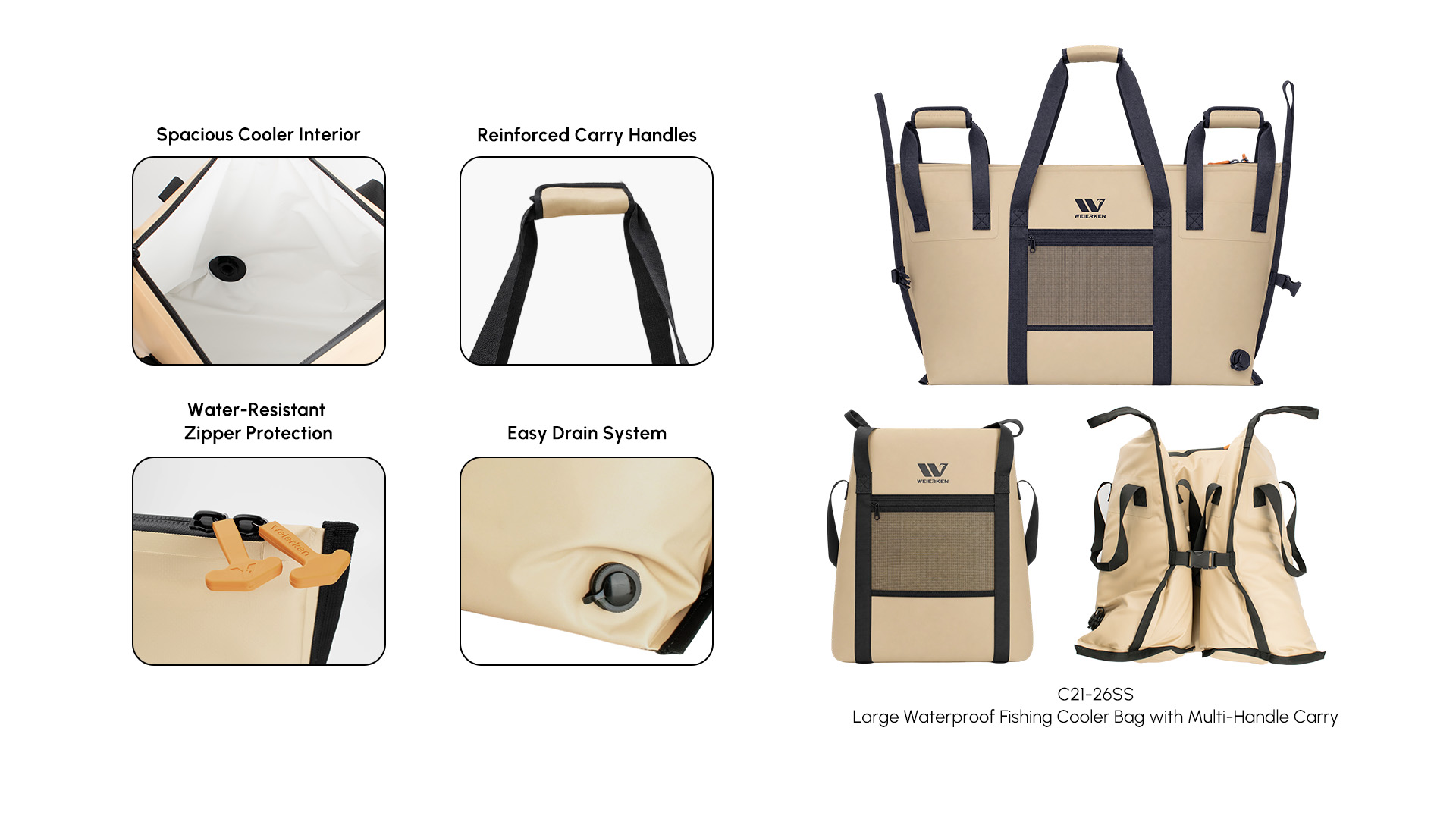
Airtight Hydro-Lock Zippers: We use pressure-tested, tooth-free airtight zippers that seal water in and keep hot air out.
Welded Drain Valves: Marine kill bags need heavy-duty drainage spigots. We ultrasonically weld the valve flange directly to the bag skin to eliminate mechanical puncture leaks around the screw cap.
3. Structural Reinforcements for Heavy Loads
A 150-quart fish kill bag filled with ice, water, and large pelagics can easily exceed 60 kilograms. Standard stitching will rip right through a waterproof membrane under that weight.
Load-Bearing Anchor Plates: We RF-weld reinforced TPU/PVC mounting patches directly onto the bag shell before attaching handles.
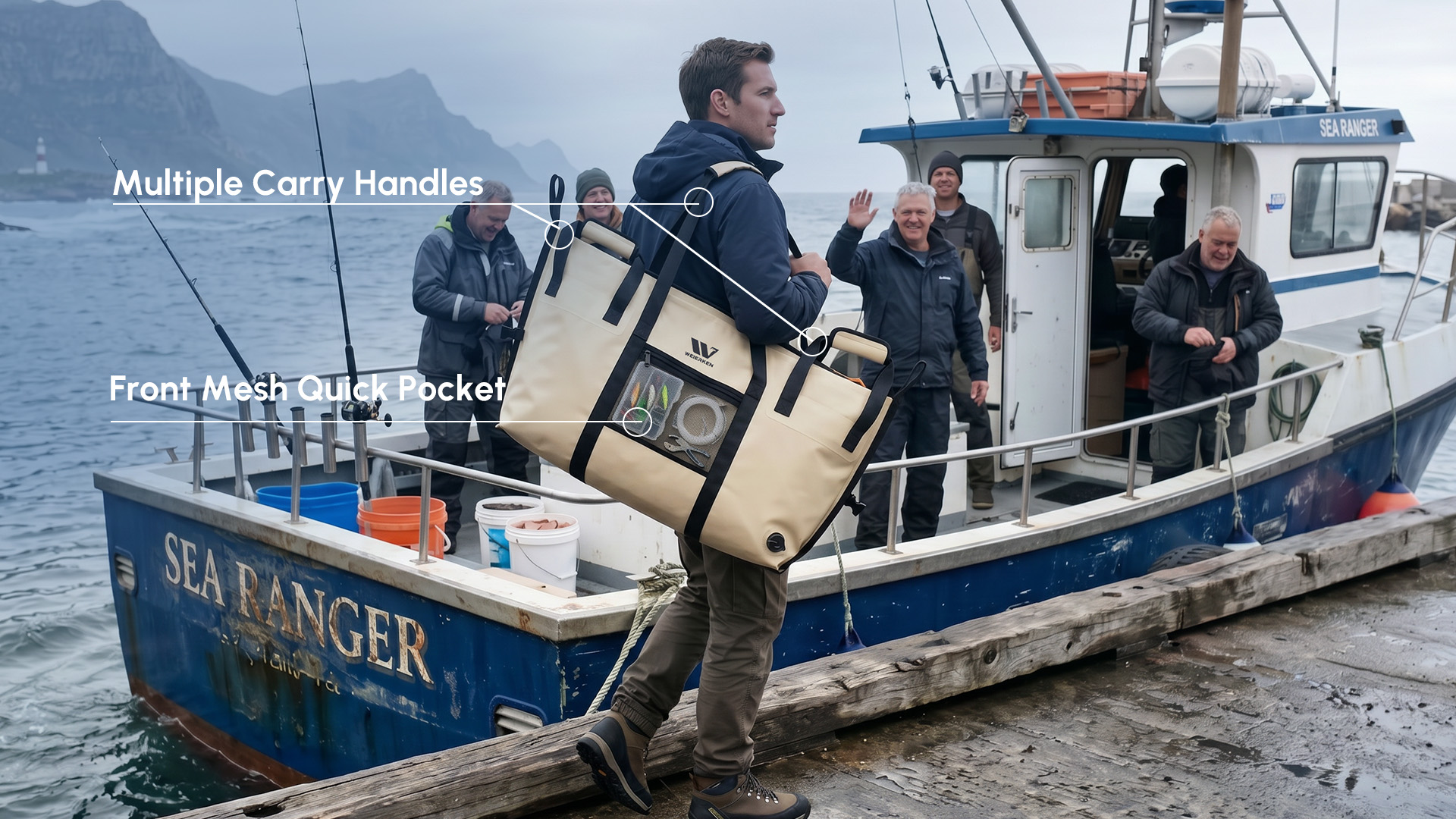
Box-X Reinforced Webbing: Heavy-duty, UV-treated polyester webbing wraps completely around the base of the bag, distributing load across the bottom rather than hanging solely from the top seam.
Double-Layer Bottom Skin: We apply a textured 1000D abrasion layer to the bottom panel to protect against rough boat decks and gravel shorelines.
Strategic Selection Guide: Aligning Materials with Your Business Model
When finalizing your project brief, match your choice of shell material to your commercial goals, sales channels, and customer profile.
Select Heavy-Duty PVC If:
Your primary channel involves commercial fishing outposts, charter boat fleets, or tournament gear where extreme durability per dollar is the key value proposition.
You require oversized kill bags (120QT to 250QT+) where TPU fabric costs would make the final product pricing impractical for your audience.
You target traditional wholesale distribution and volume retail where competitive factory pricing drives shelf turnover.
Select High-Performance TPU If:
You run a direct-to-consumer (DTC) or premium specialty outdoor brand competing alongside market leaders like YETI or Toadfish.
Your primary marketing claims highlight food-grade hygiene, easy cleaning, zero chemical odor, and eco-conscious compliance.
You ship units individually via e-commerce fulfillment networks, where TPU's lightweight and tight folding radius lower storage and courier fees.
You produce smaller, highly mobile products such as kayak cooler bags, paddleboard storage, or soft-sided tackle bags.
Frequently Asked Questions (FAQ)
Q1: Can Weierken manufacture a hybrid fish bag using a PVC exterior and a TPU interior?
Yes. A hybrid construction pairs a heavy-duty 1000D PVC exterior for puncture and abrasion resistance on boat decks with a food-grade, easy-to-clean white TPU interior liner. This combination balances durability, direct food contact safety, and BOM cost control.
Q2: What is the typical MOQ for custom insulated marine cooler bag projects?
Our standard Minimum Order Quantity (MOQ) starts at 300 to 500 units per colorway for custom designs. For standardized factory silhouettes using stock fabric colors, we can accommodate lower pilot batch quantities to support emerging brands during initial product launches.
Q3: How do TPU and PVC fish kill bags perform under California Proposition 65 testing?
Ether-based TPU passes California Prop 65 screening without special formulation because it uses no ortho-phthalate plasticizers. PVC requires certified eco-friendly, non-phthalate plasticizers (such as DOTP or DINCH) to pass heavy metal and chemical migration tests. Weierken tests and certifies materials to ensure your products clear customs cleanly.
Q4: What thickness of closed-cell foam is ideal for 48-hour ice retention?
For reliable 48-hour ice retention in direct sunlight, we recommend at least 15mm to 20mm of high-density closed-cell NBR/EVA foam paired with an airtight, water-sealed zipper. For ultra-compact or smaller kayak bags, 10mm to 12mm foam balances packability with solid single-day cooling.
Q5: Which material yields better shipping container utilization (CBM)?
TPU offers substantial logistical advantages. Because TPU-laminated nylon is thinner and more pliable than heavy PVC tarpaulin, an empty TPU bag folds down much flatter. This allows you to fit 25% to 35% more units onto a standard 40ft High Cube container, reducing freight costs per bag.
Q6: How does RF welding ensure 100% leakproof performance compared to traditional stitching?
Traditional sewing punches thousands of needle holes through the fabric, allowing melted ice and fish blood to seep into the insulation core over time. RF welding uses high-frequency electromagnetic energy to melt and fuse polymer edges together at the molecular level, creating a permanent, continuous waterproof barrier.
Partner with Weierken for Your Next Marine Soft Goods Line
Choosing between TPU and PVC requires balancing your target customer's field demands against your brand's financial model. As an experienced insulated fish storage bag OEM manufacturer, Weierken supports your team through every phase of the development cycle.
From initial CAD modeling and Design for Manufacturability (DFM) reviews to precision RF tooling, thermal insulation testing, and strict quality control, we build marine-grade soft coolers that stand up to harsh saltwater environments.
Ready to Build Your Custom Insulated Fish Bag Line?
Speak with our marine gear engineering team to review technical specs, request fabric swatch cards, and receive a competitive OEM manufacturing quote.