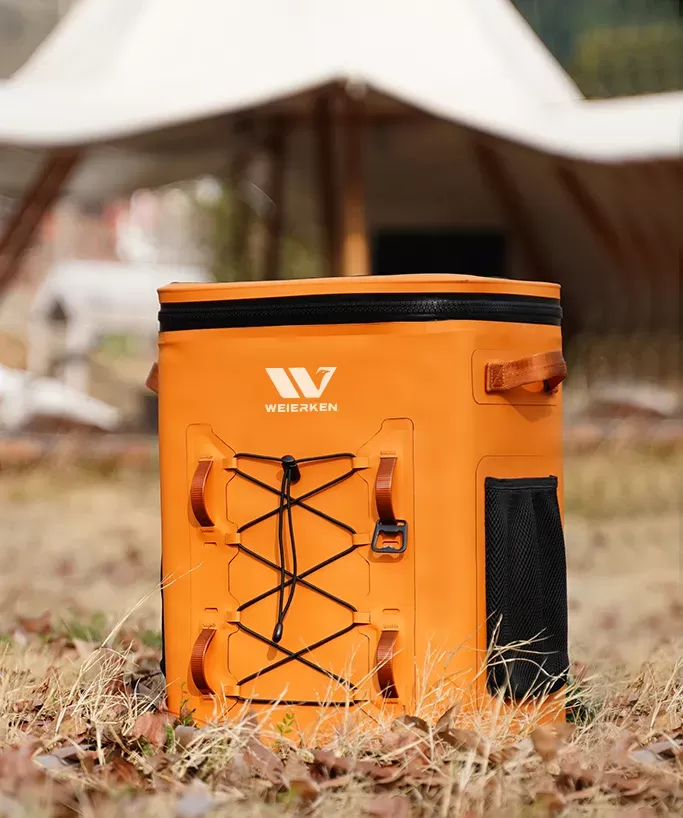

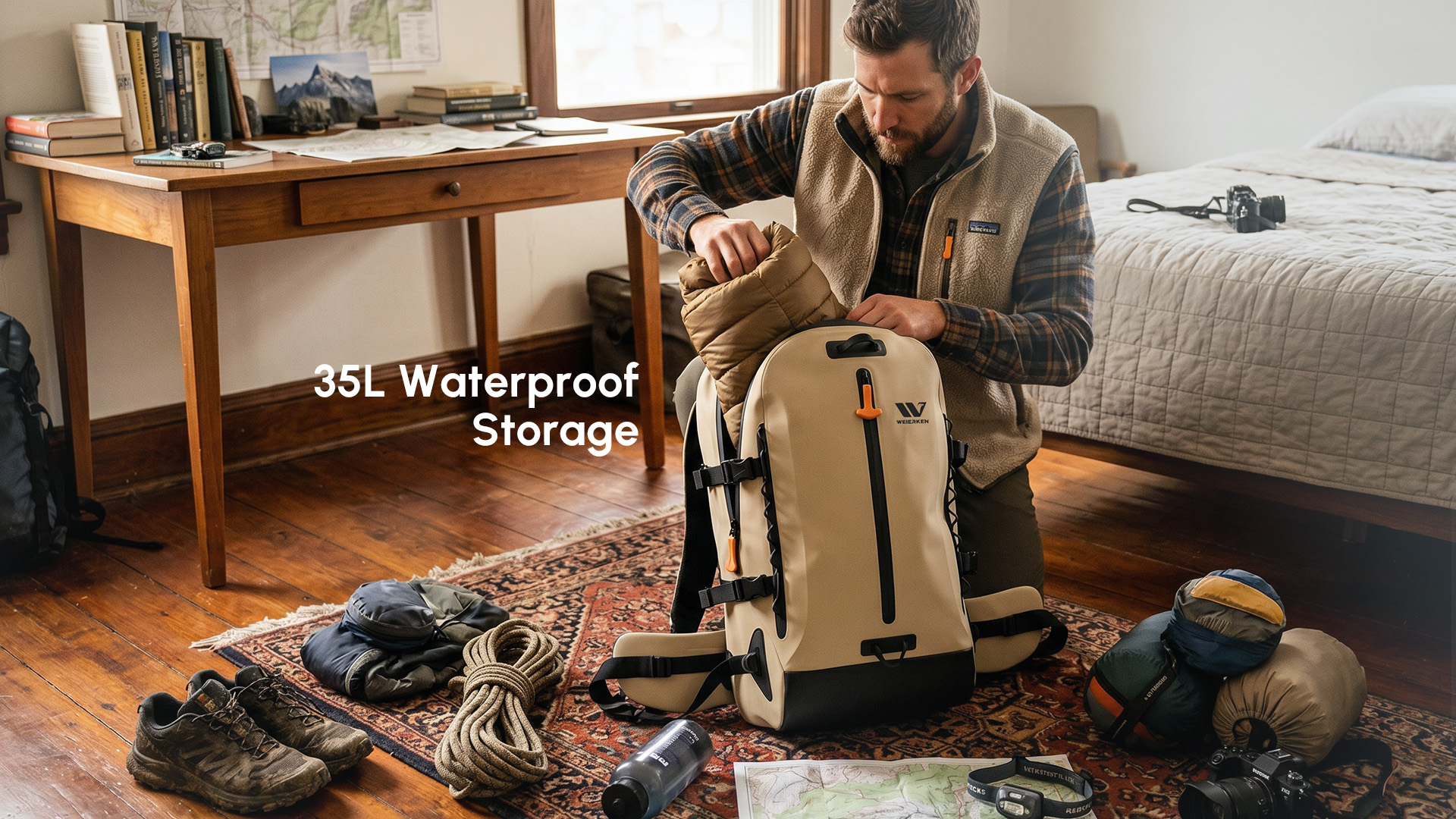
Anglers are pushing further into extreme environments. Whether wading deep flats for tarpon, hiking remote coastal rivers for steelhead, or kayak fishing in heavy surf, standard water-resistant gear no longer makes the cut. A single rogue wave or an accidental slip can ruin expensive tackle trays, electronics, and spare apparel.
Because of this shift, fully submersible, IPX7-rated tackle backpacks have become one of the fastest-growing, high-margin categories in the fishing industry. However, building these technical packs presents a unique manufacturing hurdle. Traditional cut-and-sew factories do not have the high-frequency welding technology required to make a pack 100% waterproof. At the same time, standard dry bag suppliers often lack an understanding of tackle box geometry, weight distribution, and tool placement.
This guide breaks down the engineering, material selection, and manufacturing roadmap required to build a market-ready product with a dedicated waterproof tackle backpack OEM partner like Weierken.
[Request a Free Feasibility & Tooling Review for Your Project]
1. Water-Resistant vs. Truly Waterproof: What Outdoor Brands Must Know
Before issuing a tech pack, product managers must define the target waterproof threshold. Confusion between water resistance and true submersion leads to customer returns and brand damage.
Fabric Mastery: TPU vs. Traditional PVC
Material choice dictates pack durability, environmental compliance, weight, and feel.
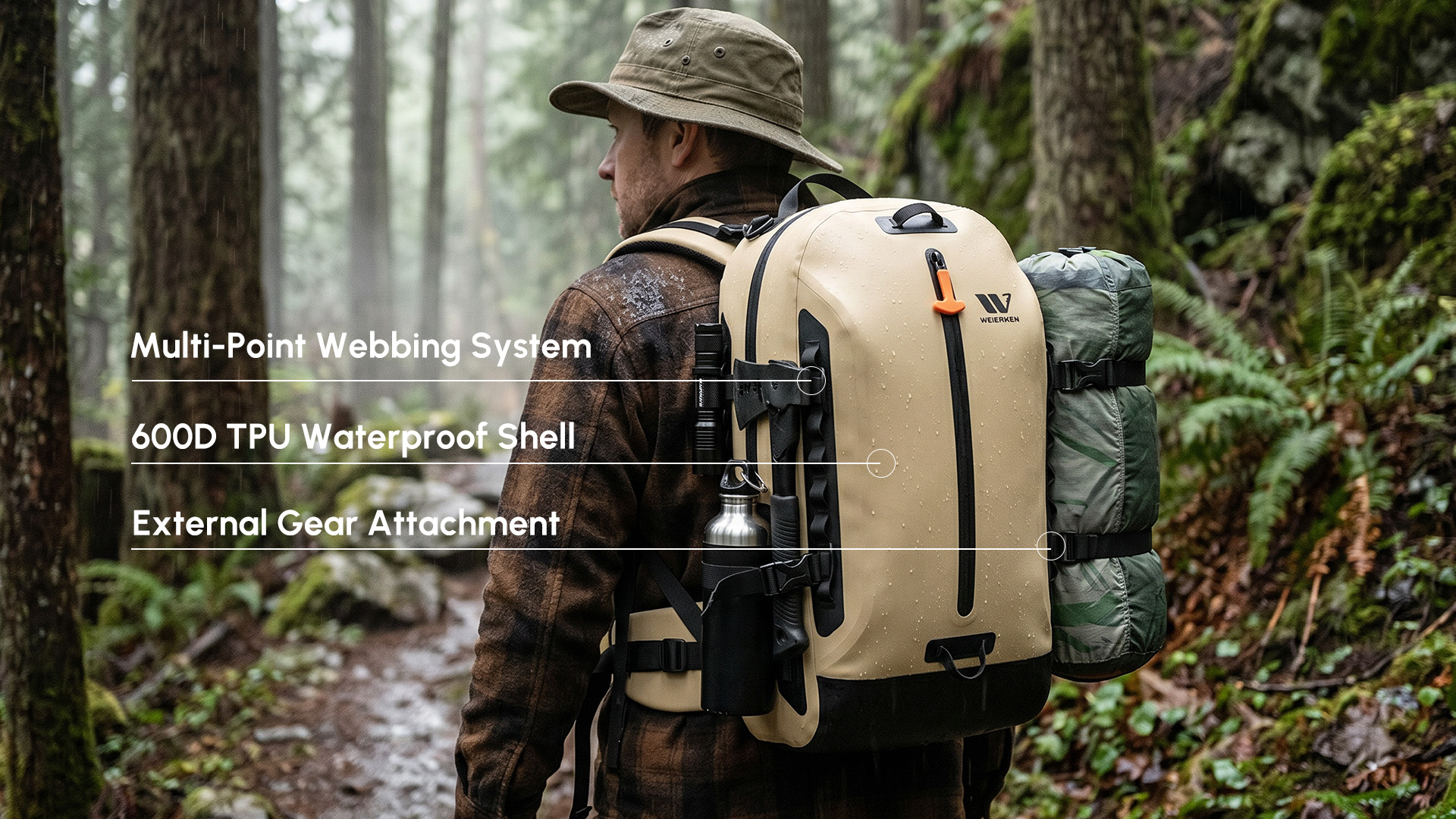
TPU (Thermoplastic Polyurethane) Coated Nylon/Polyester: The industry standard for high-end technical gear. Typically specified in 420D to 840D densities. TPU offers superior abrasion resistance, remains flexible in sub-zero conditions, and does not crack. It is lighter than PVC and free from toxic plasticizers.
PVC (Polyvinyl Chloride) Tarpaulin: A cost-effective, heavy-duty alternative. While durable, it adds noticeable weight to the pack and stiffens in cold weather.
Sustainable rPET TPU: For brands targeting strict ESG goals, Weierken supports GRS-certified (Global Recycled Standard) recycled polyester or nylon fabrics laminated with eco-friendly TPU films. This provides full waterproof performance while meeting European and North American environmental standards.
Construction: High-Frequency (HF) Welding vs. Stitched & Taped Seams
Stitched seams create needle holes. While factory taping can temporarily seal these punctures, constant flexing, saltwater exposure, and internal pressure from heavy lure boxes eventually cause seam tape to delaminate.
True submersible backpacks rely on High-Frequency (Radio Frequency / RF) or Hot Air Welding. This process applies electromagnetic energy and pressure to fuse TPU-coated fabrics at a molecular level. The resulting bond is as strong as the raw fabric itself, creating a permanent, continuous barrier that easily earns an IPX7 waterproof rating (submersion up to 1 meter for 30 minutes).
The Critical Hardware: Airtight Waterproof Zippers vs. Water-Repellent Zippers
Your zipper selection dictates the true capability of the pack:
Airtight/Submersible Zippers: Feature interlocking elastomeric teeth or continuous vulcanized rubber tracks that seal completely under internal pressure. Essential for main gear compartments that must survive direct submersion.
Water-Repellent (PU Coated) Coil Zippers: Suitable only for external accessory pockets where quick access is needed and exposure is limited to rain or light spray.
Saltwater Corrosion Resistance: Marine environments quickly ruin standard metal sliders. High-grade OEM designs require injection-molded polymer sliders, marine-grade 316 stainless steel pulls, and salt-tolerant protective coatings.
2. Ergonomics & Tackle Organization: Designing for the Modern Angler
A waterproof shell is useless if an angler cannot efficiently access their gear on the water. A successful design balances technical dry protection with specialized fishing features.
Universal Tackle Box Compatibility
Tackle backpacks must fit standardized utility trays. The main compartment profile should be engineered around standard footprints, such as Plano 3600 or 3700 series boxes:
Plano 3600 Sizing: Compact footprint (approx. 10.75" x 7.25"). Best for mobile river anglers and wading packs.
Plano 3700 Sizing: Larger footprint (approx. 14" x 9.13"). Ideal for boat, kayak, and offshore anglers carrying heavy payloads.
Structural Cavity Support: Internal EVA molded base panels or internal frame sheets help maintain structure, preventing the bag from sagging when loaded with heavy lead sinkers and jigs.
Specialized Fishing Functional Modules
Modern anglers demand purpose-built storage points that keep tools accessible without breaking the pack's waterproof seal:
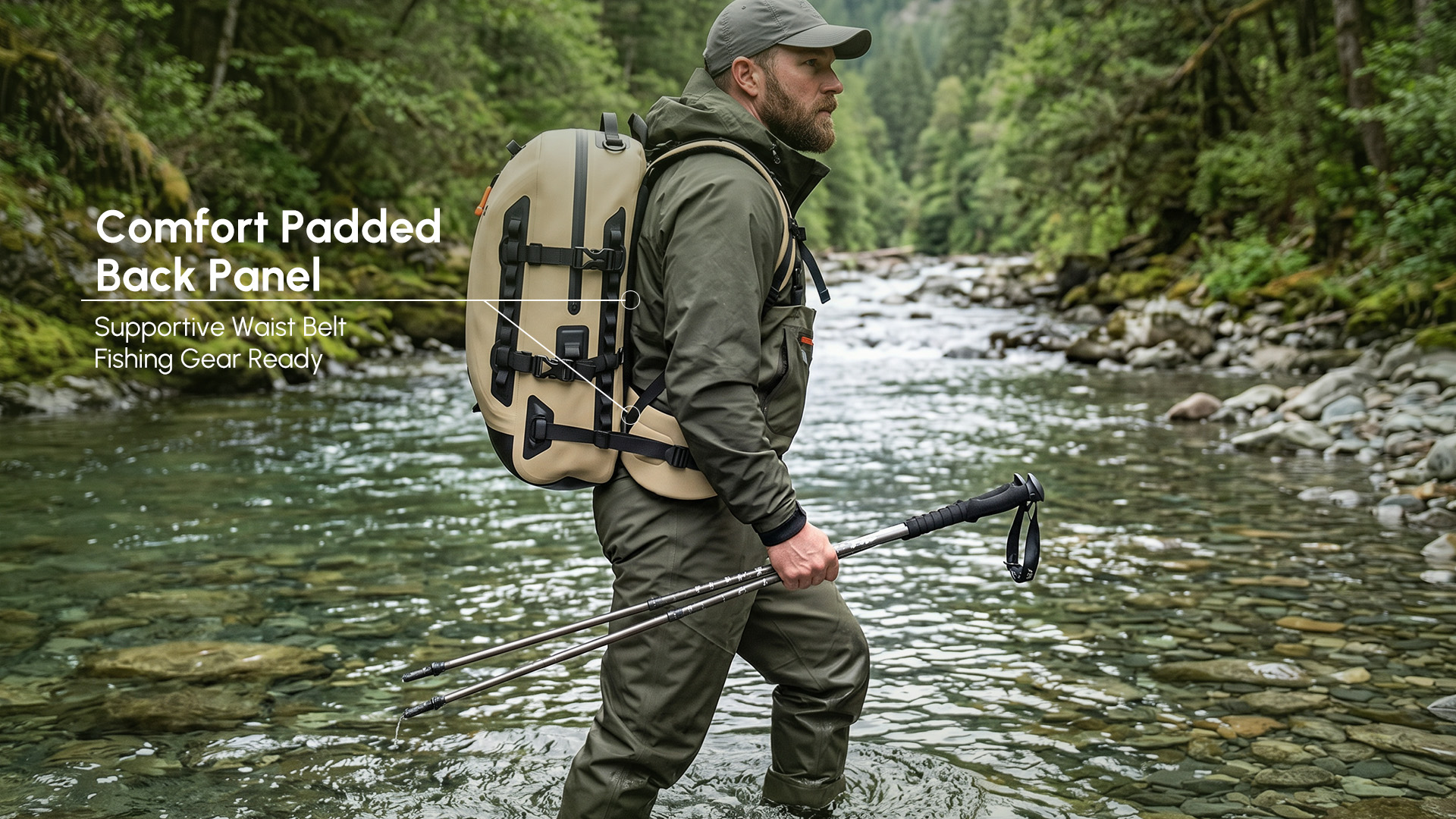
Quick-Draw Plier Holster: Molded exterior Hypalon or reinforced TPU holsters with dedicated drainage ports and lanyard D-rings.
Dual Rod Tube Systems: Heavy-duty side retention straps combined with reinforced stretch mesh or fold-away base pockets to secure travel rods or spare setups.
Laser-Cut Molle Arrays: Welded, non-stitched Hypalon utility patches for clipping retractors, tippet holders, and line cutters.
Wet/Dry Compartment Separation: External splash-proof pockets or expandable bottom compartments to isolate wet wading socks, rain gear, or live bait scents from dry interior gear.
3. The OEM Prototyping & Development Roadmap
Developing a welded waterproof pack requires a different approach than conventional cut-and-sew soft goods. The tooling and design validation stages demand precise engineering from the start.
Converting Concepts and Tech Packs into Precision Welding Tooling
Every welded seam, curved contour, and bonded structural patch requires dedicated CNC aluminum or copper high-frequency welding molds. A reliable factory engineering team must review your 2D drawings and 3D CAD models to optimize:
Draft angles and seam radiuses to prevent micro-punctures during the RF welding stroke.
Fabric overlap widths to guarantee consistent burst strength under pressure.
Component sequencing to ensure complex three-dimensional gussets can be sealed on standard machine anvils.
Fast Prototyping Timelines
Speed to market matters. Working with Weierken provides brands with direct access to an in-house engineering and sampling team. The typical sample development cycle runs between 12 and 30 days, covering initial mold fabrication, fabric laser cutting, assembly, and hydrostatic testing. This quick turnaround allows brands to finalize their field testing and open pre-orders well ahead of peak buying seasons.
4. Mitigating Risks: Quality Control, Tariffs, and Supply Chain Stability
Scaling production of technical waterproof gear introduces production and regulatory risks that require a clear mitigation plan.
Zero-Leak Quality Control: The 99.5% First-Pass Yield Standard
A single defective seal can cause an entire pack to flood, leading to negative reviews and high return rates. High-reliability OEM manufacturing requires strict quality control throughout production:
100% Inflation Testing: Every finished airtight compartment is inflated to 2.5–3.0 PSI and monitored over a set dwell time to check for pressure drops.
Water Immersion Verification: Submersion water tank testing to inspect for escaping micro-bubbles along welded seams and zipper terminal docks.
Hardware Pull & Dynamic Drop Tests: Stress testing shoulder harness anchor points, top grab handles, and zipper tracks to ensure they hold up under heavy field loads.
99.5% Yield Target: Continuous incoming material inspection (raw TPU coating adhesion and denier consistency) ensures our first-pass production yield reaches 99.5%, preventing defective units from reaching retail channels.
The Dual-Facility Advantage: China + Cambodia Operations
Trade policies and changing import tariffs present ongoing challenges for outdoor gear margins. Utilizing a dual-facility strategy provides supply chain stability and cost optimization:
China Facility: Serves as the central hub for advanced R&D, rapid mold tooling, material sourcing, and specialized quick-turn runs.
Cambodia Facility: Delivers large-scale production volume with zero or reduced tariff access to key Western markets (such as the United States and the EU), significantly lowering landed unit costs.
5. Factory Compliance & Global Fulfillment
Your manufacturing partner must meet the compliance standards set by major retail buyers and outdoor conglomerates.
International Factory Audits and Material Safety
Reputable production facilities operate with transparent, audited workplace conditions and strict chemical management systems:
Social Audits: BSCI, SEDEX (SMETA), and ISO 9001 certifications to verify ethical labor, safety, and consistent quality systems.
Chemical & Environmental Compliance: All raw fabrics, foams, coatings, and polymers comply with REACH (EU), CA Prop 65 (US), and utilize PFAS-free / C0 DWR water-repellent treatments.
Door-to-Door (DDP) Fulfillment
Navigating ocean freight, customs clearance, and inland trucking adds friction for growing brands. A professional OEM supplier offers complete DDP (Delivered Duty Paid) shipping services, managing everything from factory floor export to final delivery at your central warehouse or Amazon FBA distribution hubs.
Frequently Asked Questions
Q1: What is the minimum waterproof rating required for a true
waterproof tackle backpack?
A1: A pack intended for wading, boating,
and marine environments should achieve at least an IPX6 (resistance to
high-pressure heavy water jets) or IPX7 rating (submersion up to 1 meter in
water for 30 minutes without leaking). IPX7 requires high-frequency welded seams
and a pressure-rated airtight zipper.
Q2: What is the typical MOQ for custom waterproof tackle backpack OEM
manufacturing?
A2: Standard Minimum Order Quantities (MOQ) generally
range from 500 to 1,000 units per colorway. This minimum is driven by custom TPU
fabric mill dyeing runs and dedicated high-frequency welding tooling setups.
Flexible scaling options are often available for brands starting new product
lines.
Q3: How do you prevent zipper failure and corrosion in harsh
saltwater conditions?
A3: We specify self-lubricating,
salt-resistant polymer zipper sliders and heavy-duty polyurethane-sealed zipper
tracks. Avoiding corrosive metal alloys in coastal contact zones ensures
long-term reliability without binding or oxidation.
Q4: Can we produce custom waterproof fishing bags using recycled and
eco-friendly materials?
A4: Yes. We offer GRS-certified rPET
(recycled polyethylene terephthalate) face fabrics bonded with non-toxic TPU
films. These fabrics match the tensile and burst strength of virgin nylon while
meeting sustainable sourcing standards.
Q5: What are the main differences between single-sided TPU and
double-sided TPU in fishing backpacks?
A5: Single-sided TPU coats
the interior or exterior of the base fabric, leaving one side textured. This is
lighter and ideal for main pack bodies. Double-sided TPU covers both faces,
creating a smooth, non-absorbent surface that is completely wipe-clean, ideal
for high-wear areas and internal wet-storage compartments.
Q6: How does the dual-facility manufacturing setup in China and
Cambodia reduce tariff costs?
A6: Developing tooling and prototypes
in China allows for rapid engineering and material sourcing. Transitioning
high-volume assembly to a Cambodia facility allows North American and European
brands to take advantage of favorable duty rates and trade agreements,
protecting bottom-line margins.
Build Your Next Fishing Bag Line with Weierken
Launching a high-performance waterproof tackle backpack requires the right mix of radio-frequency welding engineering, practical tackle organization, and reliable global manufacturing. Weierken brings over two decades of technical OEM and ODM expertise to help outdoor brands develop reliable, high-end waterproof gear.
Whether you need to refine an existing tech pack, develop custom high-frequency molds, or diversify your supply chain through our dual-facility network, our engineering team is ready to assist.
[Submit Your Tech Pack for a Free Feasibility & Cost Review]