
Delivering chilled beverages or fresh produce is relatively forgiving. Maintaining a steady 2°C to 4°C window allows for basic insulation and standard gel ice packs. Frozen desserts do not offer that luxury.
Ice cream, gelato, and frozen yogurt demand an uncompromising thermal envelope. These products require temperatures at or below -15°C to -18°C throughout the last-mile route. A minor temperature spike triggers surface melting.
When softened ice cream refreezes in a customer's freezer, the water molecules reform into jagged, coarse ice crystals. The creamy texture disappears, replaced by a gritty, unpalatable mouthfeel. This defect leads directly to refunds, customer churn, and brand erosion.
Protecting frozen inventory requires more than just an off-the-shelf cooler bag. B2B delivery platforms, ghost kitchens, and dessert franchises must partner with a specialized frozen dessert delivery bag OEM like Weierken that understands industrial thermodynamics.
If you want to protect margins and safeguard product quality, look for these four core thermal engineering standards during your OEM factory evaluations.
Standard 1: Multi-Layer Sub-Zero Insulation Architecture
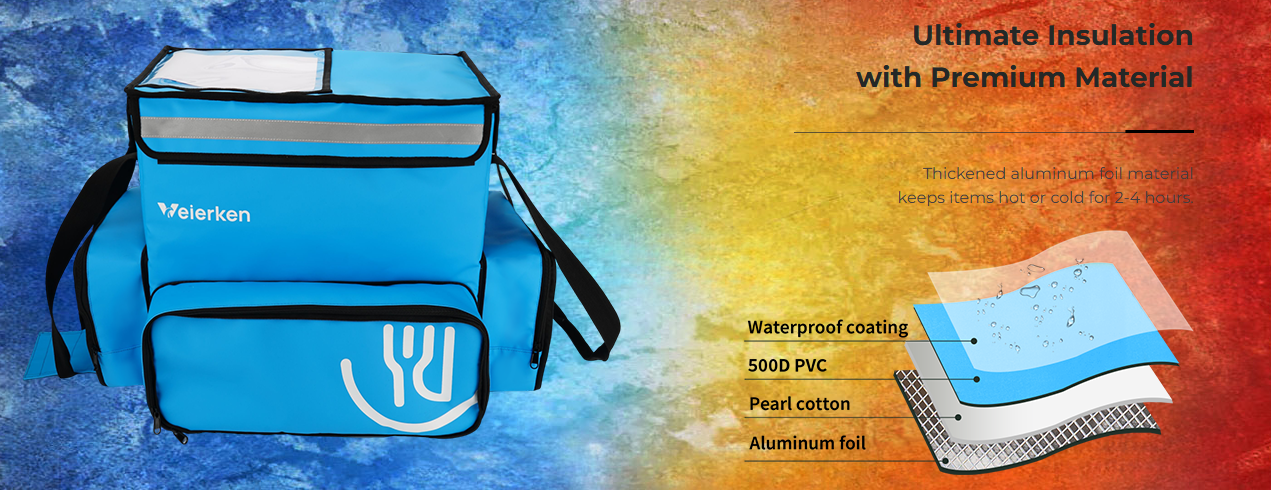
Standard delivery coolers rely on low-density expanded polyethylene (EPE) foam. While EPE foam works for lukewarm meals, it fails rapidly against ambient summer heat when tasked with keeping cargo below zero.
A capable insulated delivery bag manufacturer designs a layered insulation matrix based on thermal conductivity ($k$-value) ratings and transit windows. Different dispatch windows—30 minutes versus 90 minutes—require completely different material densities.
High-Density Closed-Cell Foams: Leading manufacturers use cross-linked polyethylene (XPE) or dense polyurethane (PU) foam cores. The micro-cellular structure traps inert air, stopping conductive heat transfer from the outside world.
Nanotechnology Aerogel Blankets: For high-end, extended-duration routes, cutting-edge OEMs incorporate thin silica aerogel layers. Aerogel offers the lowest thermal conductivity of any known solid, delivering extreme thermal resistance without excessive bulk.
Vacuum Insulation Panels (VIPs): Premium delivery boxes integrate VIP inserts. VIPs provide up to seven times the thermal resistance of conventional foam of the same thickness, making them ideal for high-heat metropolitan environments.
Radiant Heat Barriers: The outer insulation boundary must feature an industrial-grade reflective film. Aluminum-coated poly films reflect radiant infrared energy away from the bag exterior rather than absorbing it.
A reliable OEM will never offer a one-size-fits-all foam layer. They engineer the stack based on your operational run times and geographic climate profiles.
Standard 2: Zero Thermal Bridging and Airtight Engineering
Even the thickest insulation core fails if the container leaks air. In cold chain logistics, this vulnerability is known as a thermal bridge—a direct pathway for heat to bypass the insulation.
Traditional cut-and-sew manufacturing creates thousands of needle punctures along every structural seam. Each needle hole allows chilled air to escape and hot, humid air to pour inside via atmospheric convection. Moisture ingress also saturates internal padding, permanently ruining its insulation capacity.
An experienced custom thermal delivery bag partner solves this through specialized mechanical joining processes:
High-Frequency (HF) Welding: Premium factories utilize high-frequency radio waves or ultrasonic welding to fuse thermoplastic polyurethane (TPU) or PVC linings. This creates continuous, hermetic seams without a single needle hole.
Airtight and Waterproof Zippers: Standard coil zippers allow steady air exchange. High-performance bags implement rubber-sealed, airtight tooth zippers or wide-overlap magnetic compression gaskets.
Thermal Baffles (Draft Walls): When zippers must be used, professional designs place an insulated interior flap directly behind the zipper track. When closed, this baffle compresses against the zipper line, choking off convective air leakage.
Engineering teams at Weierken utilize high-frequency welding lines to construct seamless, drop-tested interiors that eliminate convective leakage entirely.
Standard 3: Integration with Phase Change Materials (PCMs) and Dry Ice
An insulated bag does not generate cold; it merely slows heat absorption. Keeping products below -18°C requires dedicated active or passive cooling mediums. An OEM must engineer internal geometry specifically around Phase Change Materials (PCMs) and dry ice.
Cold air is denser than warm air and sinks naturally. Placing cooling packs flat on the bottom of a container creates a severe thermal gradient: the bottom stays frozen, while the top products melt. An engineered frozen dessert delivery bag solves this through deliberate load planning:
Suspended Roof Pockets: Overhead mesh or conductive pockets hold -21°C or -26°C eutectic PCM plates. As cold air sinks through the dessert stack, it maintains an even thermal column.
Sub-Zero Liner Embrittlement Resistance: Dry ice sublimes at -78.5°C. At this extreme temperature, cheap plastic linings (like low-grade PVC or vinyl) turn brittle and shatter upon impact. Industrial OEMs specify cold-crack resistant polyether TPU liners that remain pliable down to -40°C or lower.
Food Contact Approvals: Condensation can transfer chemicals from packaging fabrics onto food containers. Inner liners must meet direct food safety mandates, including FDA compliance and LFGB testing.
Without engineered compartments for your refrigerants, couriers end up tossing dry ice blocks directly onto retail boxes, resulting in uneven cooling and crushed consumer packaging.
Standard 4: Standardized Thermal Decay Testing & Validation
Never rely on factory promises that say a bag "holds ice for 4 hours." Ambient humidity, solar radiation, bag opening frequency, and internal payload volume completely change real-world performance.
A professional ice cream cold chain packaging manufacturer validates performance through environmental chamber testing. The OEM should provide empirical thermal decay curves demonstrating how the interior behaves under controlled, elevated stress.
Climate Chamber Stress Tests: The OEM places data-logger probes inside the payload core, seals the bag, and sets the testing chamber to 38°C (100°F) with 75% relative humidity to simulate punishing summer routes.
Variable Payload Profiling: Thermal decay happens much faster in a half-empty bag due to the dead air space. Professional OEMs run comparative tests across 100%, 50%, and 25% volumetric loads.
Drop and Vibration Profiles: Road vibrations can compress cheap fibrous insulation over time, creating cold voids. Proper testing evaluates the bag's insulation stability after simulated transit stress.
If an OEM cannot provide a time-temperature graph with sensor-tracked test points, they are designing based on guesswork rather than thermal engineering.
Beyond the Cold: Commercial Durability and Sourcing Realities
Thermal stability is your primary metric, but a delivery bag must also withstand punishing commercial usage. Delivery couriers drop bags on asphalt, squeeze them into tight motorcycle boxes, and spill sticky sugar syrups inside them every single day.
Heavy-Duty Exterior Fabrics
Look for tear-resistant 900D to 1680D Oxford polyester or heavy-duty tarpaulin coated with water-repellent TPU. These exterior textiles resist punctures, shed rain, and protect the internal insulation from crushing forces.
Sanitation and Spill Containment
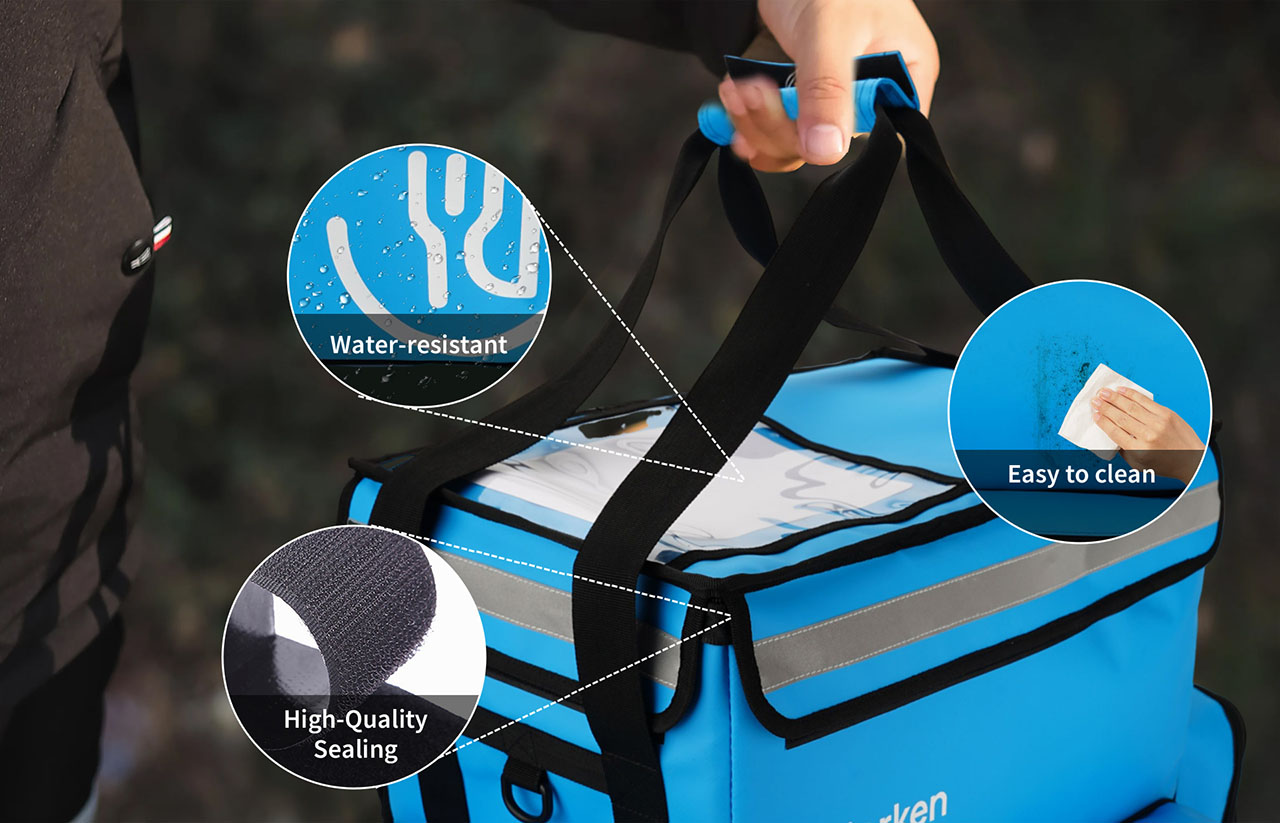
Dairy-based melt spills harbor bacteria and generate odors if liquids seep into the foam layers. The interior must feature a smooth, non-porous, wipe-clean finish. Removable, replaceable interior liners extend the operational lifespan of the delivery fleet significantly.
Fleet Form Factors and Ergonomics
A dependable OEM provides bespoke structural design options suited to your specific fleet:
Reinforced strap anchor points distributed across heavy-gauge box stitches.
Integrated base plates and D-ring tie-down slots for secure mounting to scooter racks.
Ergonomic backpack harnesses with padded lumbar supports for high-rise pedestrian deliveries.
Modular hook-and-loop internal dividers to prevent smaller orders from tipping over during transit.
Factory Certifications and Volume Scaling
Verify that your manufacturing partner operates under verifiable management and social compliance standards. Insist on ISO 9001 certified facilities for consistent quality control, alongside BSCI or Sedex factory audits for ethical labor compliance. Ensure the facility maintains sufficient raw material access to scale production quickly ahead of peak spring and summer sales periods.
Frequently Asked Questions
Q1: What is the target internal temperature for last-mile ice cream delivery?
A1: Ice cream and gelato should remain at or below -15°C to -18°C. If the core temperature rises above -12°C, ice crystals begin to destabilize. Once crystal destabilization occurs, product texture degrades permanently, even if the ice cream is immediately re-frozen upon arrival.
Q2: Why does standard bubble wrap or foil-lined EPE fail for frozen deliveries?
A2: Thin foil-lined bubble wrap and low-density EPE foam lack sufficient thermal mass and thermal resistance. While they slow down radiant heat, they do not adequately stop conductive or convective heat transfer over routes longer than 15 minutes in warm weather. Sub-zero applications demand thick closed-cell structures or advanced vacuum/aerogel barriers.
Q3: How do Phase Change Materials (PCMs) perform compared to dry ice?
A3: Dry ice reaches -78.5°C, providing exceptional cooling power, but it sublimates into carbon dioxide gas, requiring careful ventilation and safety handling. Dry ice is also a recurring operational expense. Sub-zero PCMs (engineered to freeze at -21°C or -26°C) can be reused thousands of times, do not emit gas, and eliminate the risk of cold-contact burns for couriers.
Q4: Can a frozen dessert delivery bag crack when used with dry ice?
A4: Yes, if the OEM uses cheap PVC or low-grade vinyl liners. Those materials suffer from severe low-temperature embrittlement and will shatter under stress. You must specify cold-crack resistant polyether TPU or industrial cold-rated tarpaulins engineered to withstand continuous sub-zero contact.
Q5: What is the typical development timeline for a custom thermal delivery bag?
A5: Initial concept refinement and structural CAD prototyping generally require 1 to 2 weeks. Fabric sourcing, tooling development, and sample fabrication typically take another 10 to 15 business days. Once prototypes pass climate chamber validation, mass production runs usually range from 30 to 45 days, depending on seasonal volume demands.
Secure Your Sub-Zero Chain with an Engineering-First OEM
Choosing a frozen dessert delivery bag OEM is not an ordinary textile procurement task. You are investing in a mobile, micro-cold-storage asset that directly impacts your brand reputation and operational bottom line.
Every dropped degree protects your dessert's flavor profile, limits customer refund claims, and builds customer loyalty. Partnering with a manufacturer that calculates thermal resistance, builds airtight seams, and optimizes coolant placement prevents costly trial-and-error in the field.
Weierken engineers sub-zero delivery bags, industrial cold chain packs, and custom food transport systems for global restaurant chains and delivery platforms. Our production lines combine high-frequency welding, advanced insulation composites, and certified thermal validation testing to keep your products completely frozen right to the doorstep.
Are melted deliveries cutting into your bottom line? Contact the thermal packaging engineers at Weierken today to discuss your route requirements, review climate decay data, and request an engineered prototype tailored to your delivery fleet.