
For modern food delivery networks and restaurant groups, a carrier bag is more than a simple container. It is a critical touchpoint that directly impacts customer satisfaction. Cold fries or a leaking curry container can instantly alienate a consumer and damage your brand.
When procurement managers search for a reliable meal delivery bag maker, they often face a challenging market. Dozens of suppliers present beautiful catalogs, but field performance tells a different story. Selecting an insulated bag manufacturer requires a systematic evaluation of their technical capabilities and quality standards.
At weierken, we believe that transparency is the foundation of successful OEM partnerships. This guide outlines how to audit an OEM delivery bag factory to ensure your fleet meets your operational demands, safety guidelines, and budget targets.
1. Manufacturing Capacity and Machinery Audit
A factory's machinery defines its limits regarding precision, quality, and output. When auditing a supplier, look past the total square footage and examine the actual production floor equipment.
Precision Cutting Systems
Manual fabric cutting often introduces dimensional variations, which lead to weak seams during assembly. A qualified manufacturer should utilize computerized CNC laser cutters or automated die-cutting machines. These systems ensure consistent panel sizes, reduce material waste, and guarantee that every bag in a large-scale production run is uniform.
Industrial Sewing and Reinforcement
Standard sewing machines cannot handle the thick webbing and dense foam layers used in professional delivery bags. Ensure the factory uses programmable electronic pattern sewing machines. These machines allow precise, repeatable stitching profiles, particularly for bartacking reinforcement at key stress points like handle joints and shoulder strap anchors.
Seaming and Welding Equipment
If you require water-resistant or fully leakproof interiors, sewing is not sufficient. Audit the factory for high-frequency welding or hot-air sealing machinery. These specialized units fuse the internal thermoplastic linings together, creating a watertight barrier that prevents liquids from seeping into the insulation foam.
2. Raw Material Sourcing and Quality Control
The lifetime of a delivery bag depends heavily on the grade of its raw ingredients. Your audit must verify how the manufacturer qualifies suppliers and inspects incoming materials.
Exterior Fabrics and Protective Coatings
Verify that the factory stocks authentic high-denier polyester or nylon fabrics. The standard for durable gear is typically 500D to 1680D Oxford fabric. For premium water resistance, check for PVC tarpaulin (mesh-reinforced vinyl). Ask to see wear-resistance and hydrostatic head test reports for these fabrics.
Insulation Core Specifications
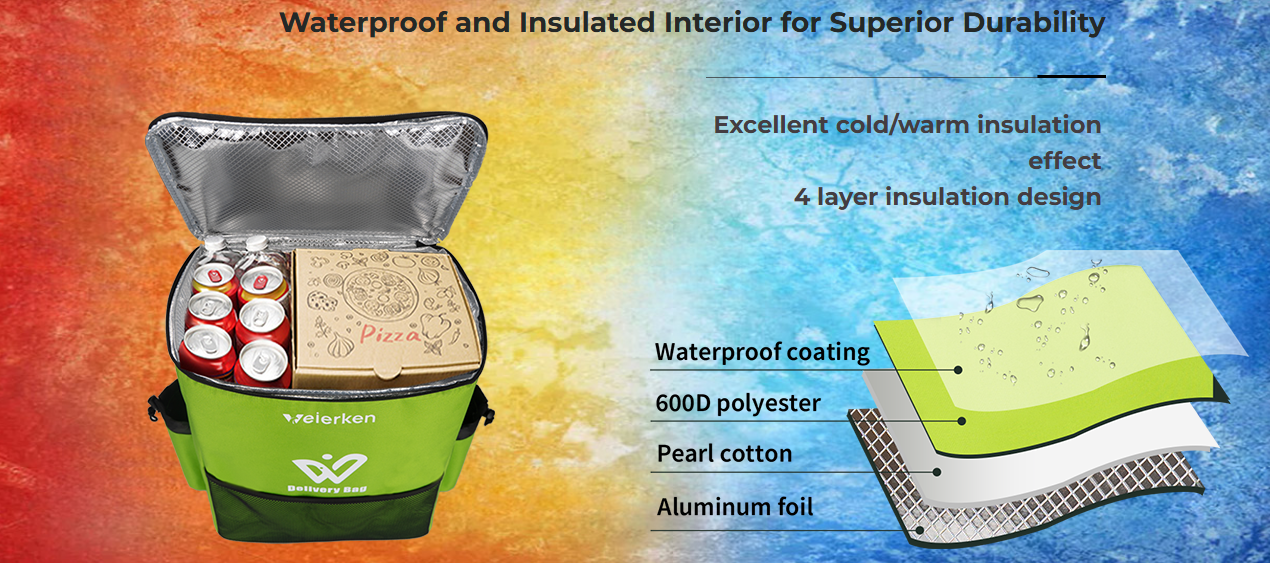
The core insulation material directly affects temperature retention. The factory should offer options like Expanded Polyethylene (EPE) foam, Ethylene-Vinyl Acetate (EVA) foam, or rigid extruded polystyrene (XPS) boards. Ask about the density of their EPE foam; a higher density (typically 20-25 kg/m³) offers much better resistance to collapsing over months of heavy use.
As a quality-driven meal delivery bag maker, weierken maintains strict inspection logs for every batch of raw insulation foam, measuring thickness and compressibility before it reaches the assembly line.
Food-Grade Liners and Secure Hardware
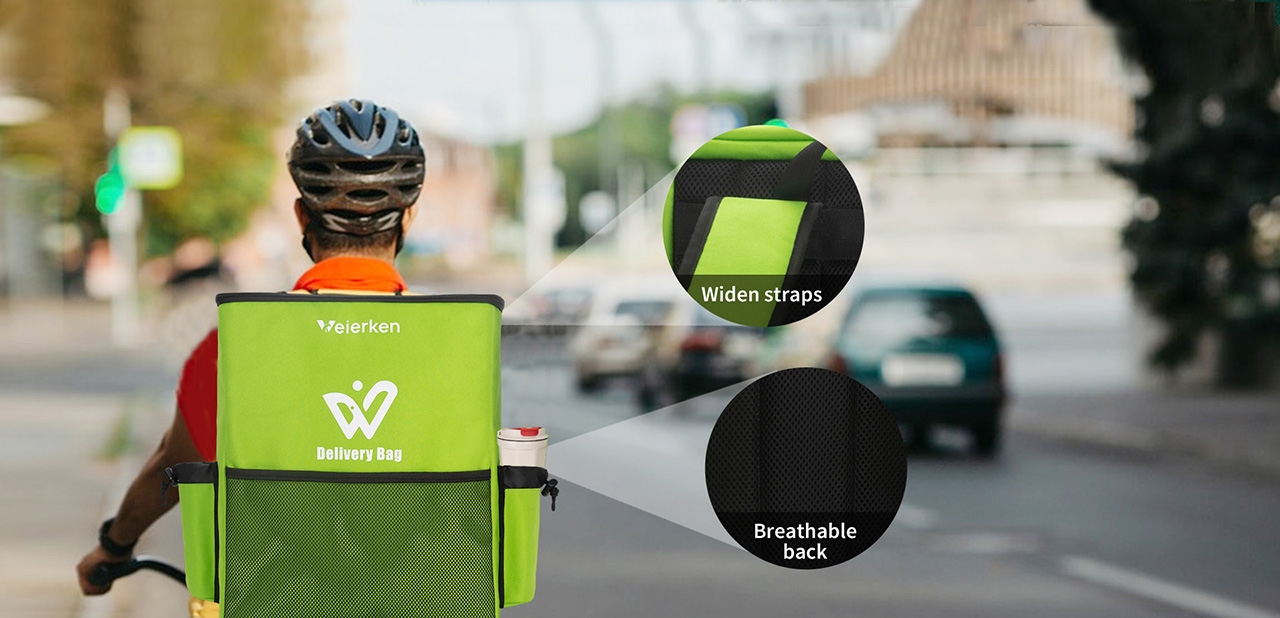
Interior linings must be safe for food contact. Ask for certification demonstrating that their PEVA, TPU, or aluminum foil linings are non-toxic and odor-free. Additionally, inspect their hardware inventory. A broken zipper renders a bag useless, so look for branded components like SBS or YKK zippers, along with heavy-duty POM plastic buckles.
3. Rigorous Quality Testing and Laboratory Protocols
A reputable factory does not rely on visual inspections alone. A fully equipped in-house testing laboratory is a key indicator of a professional supplier.
Thermal Performance Tracking
How does the manufacturer back up their temperature-retention claims? Ask if they use environmental test chambers. A reliable factory should be able to provide thermal retention curves showing internal temperature changes over 2, 4, and 6 hours under varying ambient temperatures.
Load-Bearing and Pull Testing
A fully loaded custom food delivery backpack can easily weigh over 15 kilograms. To prevent catastrophic tearing during a shift, look for these test protocols:
Static Load Test: Hanging a weighted bag for 24 to 48 hours to inspect for seam slippage or fabric distortion.
Dynamic Jerk Test: Machine-testing the handle and straps by repeatedly dropping the weighted bag from a short distance to simulate courier movement.
Tensile Strength Test: Testing the ultimate breaking strength of the webbing straps and plastic buckles.
Zipper Fatigue and Water-Resistancy Tests
Zippers on delivery bags are opened and closed dozens of times a day. Ask if the factory utilizes reciprocating zipper testing machines. A quality zipper should withstand at least 5,000 cycles without teeth misalignment. Furthermore, verify their spray test protocols to confirm the outer shell resists rain effectively.
4. Research, Development, and Customization Capabilities
A standard bag rarely fits every delivery model. Your logistics setup might rely on scooters, bicycles, or cars, each requiring unique mounting and carrying configurations.
Prototyping and Pattern Design
During your audit, evaluate the engineering team. Ask how long it takes to convert a 3D CAD design into a physical prototype. A competent engineering department should deliver a functional counter-sample within 5 to 7 working days, along with a detailed bill of materials (BOM).
Solving Practical Delivery Challenges
Ask the R&D team how they address common field issues. For example:
How do they design ventilation systems to prevent condensation from making pizza boxes soggy?
What mounting hardware do they recommend for securing bags to motorcycle luggage racks?
Can they integrate low-voltage heating elements or partition plates into the bag structure?
5. Social Compliance, Certifications, and Standards
Global delivery platforms and corporate brands must manage reputation risk. Sourcing from a factory with poor working conditions or non-compliant materials can create significant legal and public relations issues.
Quality Management System
The factory should hold a valid ISO 9001 certification. This standard ensures that the manufacturer maintains consistent processes, documents errors, and works toward continuous improvement throughout the production cycle.
Ethical Manufacturing Audits
For international procurement, verify that the supplier undergoes regular third-party ethical audits. Ask for recent, unexpired reports from recognized bodies, such as:
BSCI (Business Social Compliance Initiative)
SEDEX / SMETA (Sedex Members Ethical Trade Audit)
SA8000 (Social Accountability Certification)
Practical Checklist: Meal Delivery Bag Factory Audit
Use this convenient checklist during your next virtual or physical factory visit to keep your evaluation structured.
| Audit Category | Specific Verification Points | Pass / Fail / Notes |
|---|---|---|
| Production Floor | Automated fabric cutters are functional; dedicated pattern-sewing machines are used for heavy straps; welding machines are on-site. | |
| Material Inspection | Incoming material records match specification sheets; raw foam density is verified; fabric coatings are tested. | |
| In-House Lab | Presence of tensile pull-testers, zipper testers, and thermal monitoring equipment. | |
| R&D Team | Dedicated pattern-makers on staff; access to 3D CAD software; sample turnaround is under 10 days. | |
| Compliance | Valid ISO 9001, BSCI, or SEDEX certification reports are physically presented. |
Frequently Asked Questions
How can I verify if a factory's thermal claims are realistic?
Do not rely solely on data sheets. Request a live or recorded thermal test of the bag in their lab chamber, or request a sample to conduct your own field test using a simple USB temperature data logger placed inside the bag with standard hot or cold items.
What is the benefit of a BSCI or SEDEX audit for a delivery bag buyer?
These audits ensure the factory operates ethically, respecting labor laws, safe working conditions, and environmental standards. Many enterprise buyers require these audits to protect their supply chain from legal liabilities and consumer backlash.
Why does automated fabric cutting matter for OEM services?
Manual cutting creates minor errors in panel sizes. When those panels are sewn together, these variations put uneven stress on the seams, causing them to tear prematurely under load. Automated cutting ensures precise assembly and balanced stress distribution.
What are the signs of poor stitching during a visual inspection?
Look for loose threads, skipped stitches, and uneven seam allowances. On critical load-bearing joints, like where the shoulder straps attach, you should see tight box-stitching or zig-zag bartacking rather than a simple straight stitch line.
Can a meal delivery bag maker accommodate customized internal dividers?
Yes. A professional manufacturer can design adjustable internal shelf systems using hook-and-loop fasteners, rigid plastic corrugated boards, or thermal dividers. This allows couriers to safely separate hot items from cold drinks in the same delivery run.
Partner with a Certified Manufacturing Specialist
Selecting a manufacturing partner is a long-term operational decision. Rather than simply chasing the lowest unit cost, focus on finding a partner with robust production controls, reliable testing setups, and clear ethical standards. This balanced approach will protect your logistics fleet from early wear and tear, keeping your food hot and your customers happy.
As an established meal delivery bag maker, weierken welcomes comprehensive factory audits. We focus on reliable construction, durable materials, and consistent performance across all our product lines. Contact us today to discuss your next OEM project, request samples, or schedule a virtual tour of our production facility.