How to Choose the Right Outdoor Bag Supplier for Your Brand

How to Choose the Right Outdoor Bag Supplier for Your Brand

How to Choose the Right Outdoor Bag Supplier for Your Brand

How to Choose the Right Outdoor Bag Supplier for Your Brand

A Practical Sourcing Guide with Insights from Weierken
Choosing an Outdoor Bag Supplier is not just a sourcing decision. It directly affects how your product performs in real environments, how stable your supply chain is, and how fast your brand can scale. In outdoor categories, the gap between suppliers is often not visible at the sample stage—it usually shows up when production volume increases and real usage begins.
That’s why experienced buyers don’t only look at price or samples. They look at how a supplier behaves as a system.

What actually defines an outdoor bag supplier

In practice, outdoor bag companies can be very different in capability. Some are basic sewing factories, some are trading companies outsourcing production, and some are integrated OEM/ODM manufacturers that combine development, engineering, and production control.
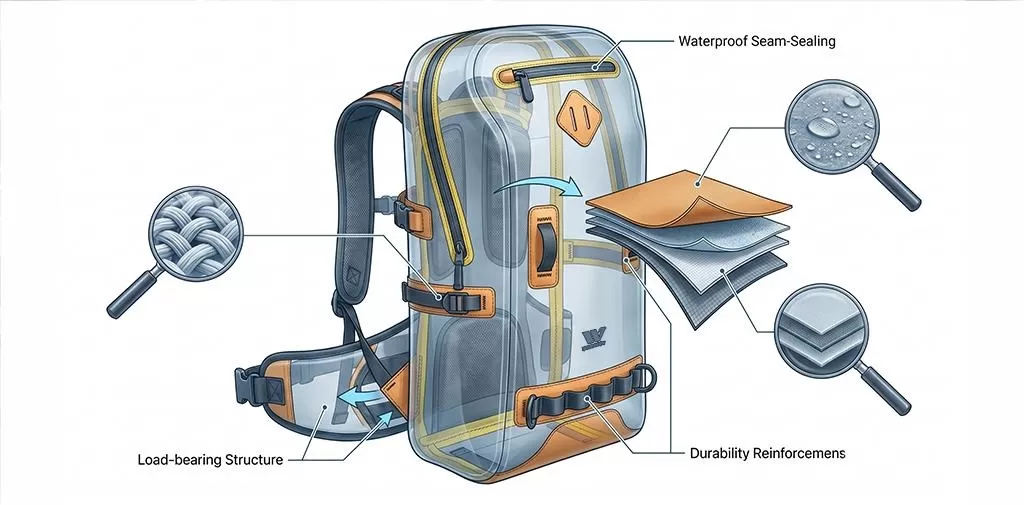
For outdoor products, this distinction matters more than in many other categories. Because outdoor bags are not just “assembled products”—they involve structure, load-bearing design, waterproof performance, and material durability under stress.
A supplier that cannot control these variables consistently will eventually create risk when your order volume increases.

Supply chain structure is often more important than unit price

Many brands focus on unit cost first, but in reality, total landed cost is affected by much more:
  • Defect rate and rework cost

  • Shipping delays and missed season windows

  • Tariffs and import structure

  • Communication efficiency during production

This is why supply chain design matters.
Weierken uses a multi-factory system (China + Cambodia) to balance different priorities:
  • China: product development, technical structure, complex construction

  • Cambodia: scalable production and tariff advantages

This setup helps reduce dependency on a single region while improving cost efficiency and delivery stability. In practical terms, it means fewer bottlenecks when demand increases or when market conditions shift.

Quality is not a promise, it is a system

Outdoor bag quality is rarely about one inspection point. It is about how many layers of control exist during production.
A stable system usually includes:
  • Incoming material inspection

  • In-process production checks

  • Final inspection before shipment

At Weierken, this system is structured to maintain a 99.5% pass rate, which directly reduces:
  • Return rates

  • After-sales cost

  • Brand reputation risk in the market

For outdoor brands, even a small defect rate can become expensive when products are used in real environments.

Development capability determines how fast you can move

OEM and ODM are often used as labels, but in reality the difference shows in execution speed and problem-solving ability.
OEM is about accuracy.
ODM is about whether the supplier can improve the product.
Weierken’s approach combines both:
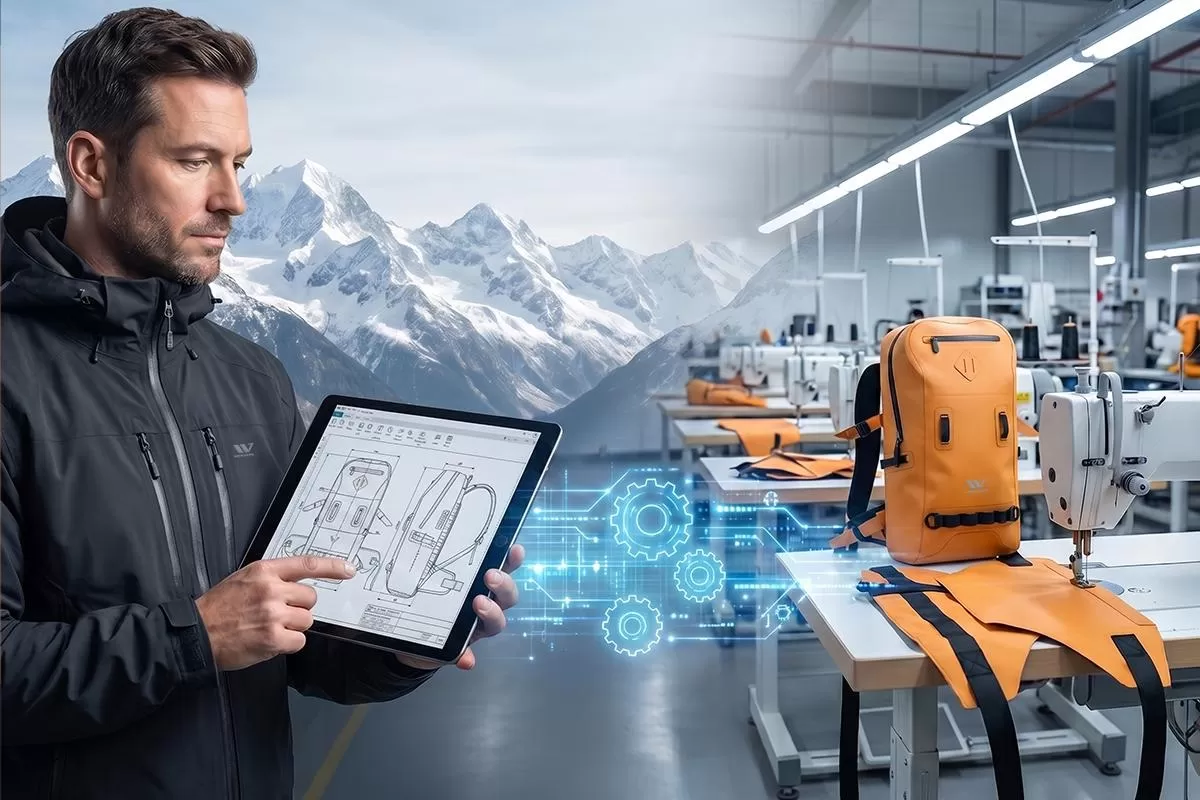
  • Internal R&D team driven by market trends

  • Continuous product iteration based on outdoor use scenarios

  • Engineering suggestions during sampling and development

This allows brands to move faster from concept to market-ready product, while reducing redesign cycles caused by structural or material issues.

Sampling is where most problems are revealed

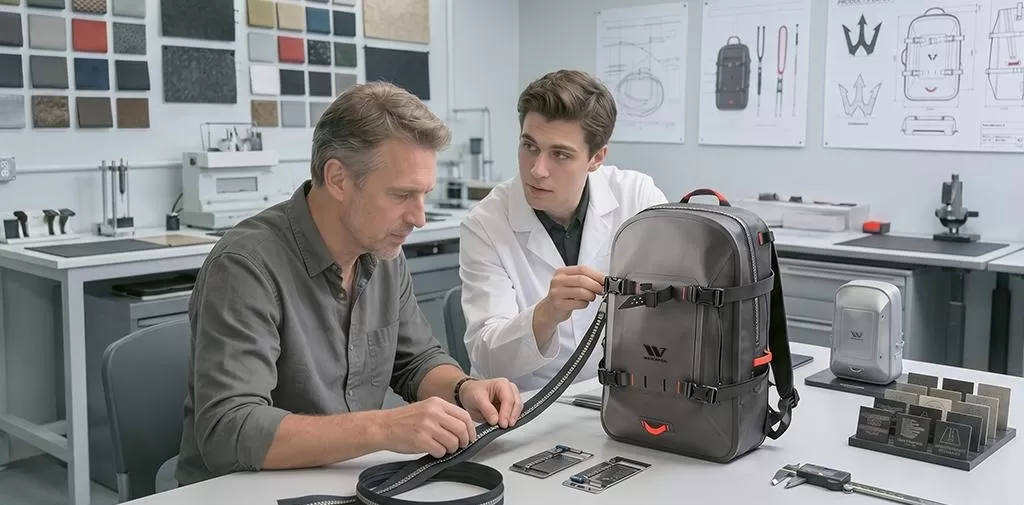
In outdoor bags, sampling is not just a formality—it is where engineering reality shows up.
What matters is:
  • How close the first sample is to expectation

  • How quickly revisions are handled

  • Whether feedback is clearly documented

Weierken’s in-house sample system supports faster iteration: 12–30 days

More importantly, changes are handled in a controlled process, which reduces repeated misalignment and shortens development cycles.
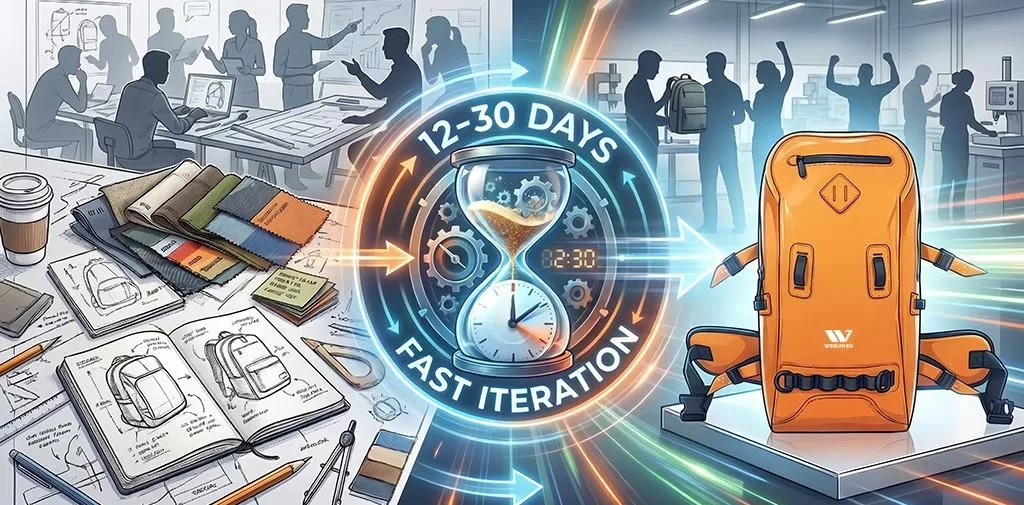


sample system supports faster iteration

Materials and structure decide real performance

Outdoor bags are highly dependent on material behavior:
  • Waterproof layers (coating vs lamination vs structural sealing)

  • Fabric density and tear resistance

  • Load-bearing reinforcement points

  • Hardware durability under repeated stress

A capable supplier should not only offer options, but also explain trade-offs:
  • Weight vs durability

  • Cost vs performance

  • Flexibility vs structural strength

Weierken’s material selection process is based on end-use scenarios, not just catalogs, which helps brands avoid over-engineering or under-specification.

Compliance is part of risk control, not just paperwork

Certifications such as BSCI, SEDEX, REACH, GRS, ISO9001 are often misunderstood as formal requirements only. In reality, they serve a deeper purpose in supply chain risk management.
They help ensure:
  • No labor-related compliance risks

  • Stable and auditable production systems

  • ESG and CSR alignment for brand customers

  • Reduced risk of supplier blacklisting during audits

For procurement teams, this is essentially about making sure the factory can be defended in front of downstream brand requirements.

Logistics and delivery complexity is often underestimated

In cross-border sourcing, production is only part of the equation. Shipping, customs, and duties often create hidden friction.
Weierken supports DDP (Door-to-Door delivery):
  • Covers shipping, customs clearance, and duties

  • Buyers receive goods as if sourced locally

This reduces:
  • Operational workload

  • Unexpected landed cost variations

  • Coordination across logistics providers

Communication and project control affect real efficiency

In international projects, miscommunication is one of the biggest hidden costs.
A mature supplier should provide:
  • Clear English communication

  • Structured documentation of decisions

  • Realistic timeline planning

  • Consistent confirmation of details

Weierken applies structured project management from development to shipment, which helps reduce delays caused by unclear alignment.

Can the supplier create long-term value for your brand?

Many brands do not fail at the first order—they fail when scaling.
A scalable supplier should be able to handle:
  • Increasing order volumes

  • More complex product structures

  • Faster turnaround expectations

  • Expanded product categories

Weierken’s multi-factory system and development capability are designed for this kind of growth trajectory, rather than one-time production.

Final perspective

Choosing an Outdoor Bag Supplier is not about finding the cheapest option or the fastest response. It is about finding a partner that can reduce uncertainty across production, development, logistics, and scaling.
In most cases, the real difference between suppliers is not visible in brochures or samples—it becomes clear only when systems are tested under pressure.
A strong partner like Weierken is not just producing bags. It is building a supply chain structure that helps brands stay stable, scale faster, and reduce hidden risks over time.
Because in the outdoor category, performance is not a feature—it is a system outcome.

FAQ

1. What is the most important factor when choosing an outdoor bag supplier?

The most important factor is whether the supplier can maintain consistent performance at scale—not just during sampling, but throughout mass production.
Outdoor bags are performance-driven products. What really matters is whether the supplier can consistently deliver on:
  • Material consistency (same fabric quality across batches)

  • Waterproof reliability (seams, zippers, construction)

  • Load-bearing strength (structure holds under real use)

  • Production consistency (every batch performs the same, not just the first sample)

A supplier that only performs well at the sample stage is not enough. The real test is whether quality, durability, and performance remain stable when order volume increases.
How to evaluate this in practice:
DimensionWhat to EvaluateRisk if Weak
CapacityCan they handle large or fluctuating orders without delays?Late shipments during peak seasons
Quality ControlDo they check quality at multiple stages (materials, production, final)?Higher defect rates in bulk orders
R&D CapabilityDo they understand how materials and structure affect performance?Product failure in real outdoor conditions
ServiceCan they adapt to seasonal demand, material changes, or urgent orders?Supply disruptions when the market shifts


outdoor bags

4.2 Why does multi-factory production matter for outdoor bags?

Multi-factory production matters for outdoor bags because it ensures stable capacity, reduces delivery risks, and improves cost efficiency—especially during peak seasons when demand surges.
Single-factory systems often face:
  • Capacity bottlenecks

  • Delayed shipments

  • Higher operational risk

Weierken operates a China + Cambodia dual production system:
LocationFunctionKey Advantage
ChinaR&D + complex engineeringHigh precision + product development
CambodiaMass productionTariff advantage + scalable capacity
Resulting benefits:
  • More stable lead times

  • Lower supply chain risk

  • Optimized cost structure for global markets

3. What certifications should outdoor bag suppliers provide?

Outdoor bag suppliers should provide certifications not for marketing purposes, but as essential risk control tools that ensure compliance, consistency, and long-term reliability in the supply chain.
These certifications help guarantee:
  • Ethical labor compliance

  • Audit readiness for global brands

  • Chemical safety of materials

  • Verified sustainability practices

Common certification system:
CertificationPurposeBusiness Value
BSCISocial complianceReduces labor-related risks
SEDEXEthical sourcingImproves audit transparency
REACHChemical safetyEnsures compliance with EU regulations
GRSRecycled materialsSupports sustainability positioning
ISO9001Quality management systemEnsures process stability
Core function:✔ Reduce brand audit risk ✔ Support ESG / CSR requirements ✔ Prevent supply chain blacklisting

4.4 What should I look for in sampling?

Sampling is the most direct reflection of real manufacturing capability.
Key indicators:
  • First sample accuracy

  • Revision speed

  • Clarity of communication

  • Documentation discipline

Weierken sampling performance:
Product TypeLead Time
Delivery bag3–7 days
Outdoor bag12–30 days
Interpretation:
  • Faster iteration = stronger internal coordination

  • Fewer revision cycles = higher engineering accuracy

4.5 How do I evaluate QC beyond promises?

“Strict QC” is not enough without structure.
A real QC system should include:
  1. Incoming material inspection

  2. In-process production checks

  3. Final inspection before shipment

Weierken system performance:
  • Pass rate: 99.5%

  • Focus: defect prevention, not detection

Business impact:
  • Lower return rate

  • Reduced after-sales cost

  • Improved brand reliability in market

4.6 What makes outdoor bag development different from normal bags?

Outdoor bags are engineering products disguised as consumer goods.
They require:
  • Structural load distribution

  • Waterproof system integration

  • Reinforcement design at stress points

  • Material performance balancing

Capability comparison:
Supplier TypeCapability LevelResult
Basic factoryExecution onlyHigh revision risk
OEM partnerAccurate productionStable replication
ODM partner (Weierken model)Engineering + optimizationFaster market success

4.7 What is DDP and why is it important?

DDP (Door-to-Door Delivery) simplifies cross-border sourcing.
It includes:
  • Shipping

  • Customs clearance

  • Import duties

Impact on buyers:
  • No logistics coordination burden

  • Predictable landed cost

  • Faster internal procurement process

4.8 How does communication affect production success?

Communication quality directly impacts production efficiency.
Weak communication leads to:
  • Misunderstood specifications

  • Rework cycles

  • Delayed shipments

Strong communication includes:
  • Structured confirmation

  • Written documentation

  • Clear timeline alignment

Weierken applies standardized project communication to reduce:
  • Information loss

  • Execution deviation

  • Timeline uncertainty

4.9 Can a supplier support your brand’s long-term growth and scalability?

This is one of the most important long-term questions.
A scalable supplier should support:
  • Higher production volumes

  • More complex designs

  • Faster seasonal cycles

  • Expanded product lines

Scalability comparison:
CapabilityLimited SupplierScalable Partner (Weierken)
Volume growthRestrictedMulti-factory expansion
Product complexityBasicEngineering-driven
Development speedSlow iterationMarket-driven R&D
Supply stabilitySingle point riskDistributed system

4.10 What is the biggest hidden risk in choosing the wrong supplier?

It is not price—it is system inconsistency at scale.
Common failure pattern:
  • Sample stage: good

  • First production: acceptable

  • Scale production: issues appear

Root causes:
  • Weak process control

  • Lack of engineering system

  • Single factory dependency

  • No structured QC system


Final takeaway

Final takeaway

Choosing an Outdoor Bag Supplier is ultimately about one question:
Can this supplier maintain stable performance under real production scale and real outdoor usage conditions?
Weierken’s approach is built around this principle, combining:
  • Multi-factory production (China + Cambodia)

  • Structured QC system (99.5% pass rate)

  • Market-driven R&D capability

  • DDP logistics support

  • Full project management system

Not as isolated advantages—but as a complete operational system designed for outdoor brands that need stability, scalability, and long-term reliability.
If you are developing or sourcing outdoor bags and need a stable manufacturing partner, Weierken can support you from sampling to mass production with a fully integrated supply chain system.
📩 Contact Weierken to discuss your next outdoor bag project