
Delivery insulated bag requirements: start with a needs assessment
-
Temperature mode: hot-hold, chilled, frozen, or mixed.
-
Time window: pack-out to handoff (including staging, driver dwell, doorstep exposure).
-
Worst-case ambient: hot summer car/curb, winter loading dock, rain.
-
Open/close behavior: single drop vs. multi-drop routes (every opening is a thermal hit).
Materials and insulation stack: what to specify (outer, foam, liner, seams)
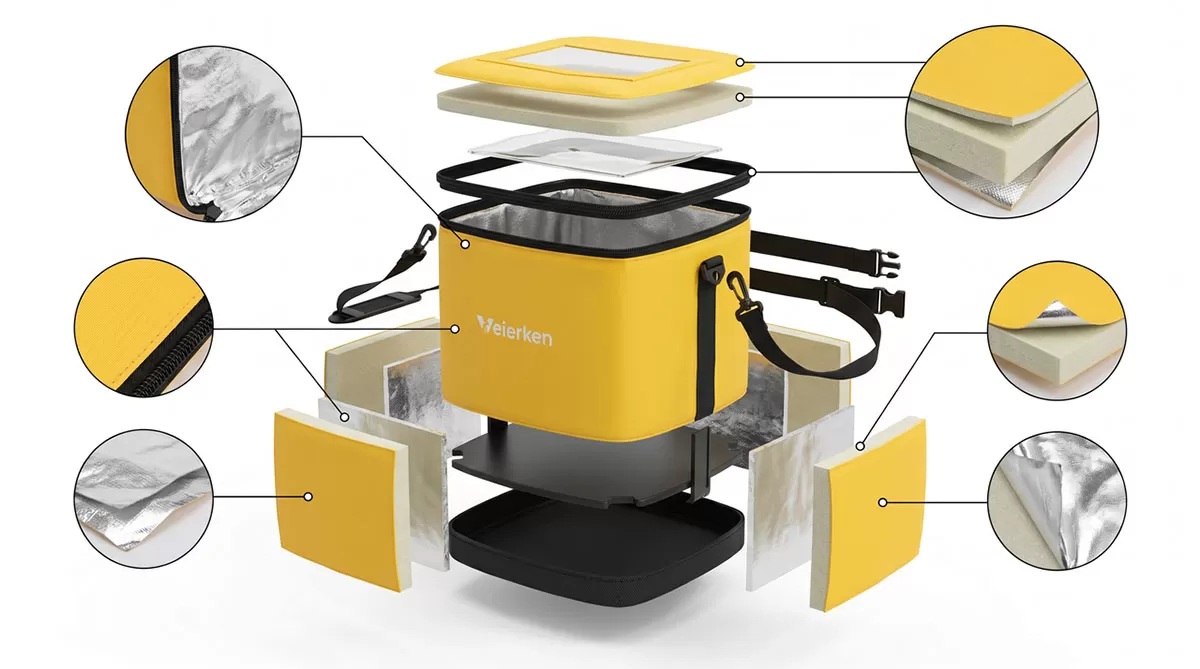
Outer shell: abrasion, weather, and wipe-down reality
-
Abrasion and tear resistance (multi-drop routes eat fabric)
-
Water resistance (rain, wet docks, condensation)
-
Wipe-down compatibility (you’ll sanitize these more often than you think)
Insulation: thickness is a lever, not a guarantee
-
Insulation type (e.g., closed-cell foam vs. other constructions)
-
Compression resistance (will the foam crush over time?)
-
Edge protection (corners and fold lines are early failure points)
Inner liner: what decides whether the bag stays usable
-
A wipeable liner that resists staining and odor
-
Sealed transitions at corners and seams
-
A barrier that prevents liquids from entering insulation
Seams and stitching: the quiet thermal leak
-
The best insulation in the world won’t save a bag that leaks air at the seams.
-
The seams are where durability failures start.
-
Are seams bound, taped, welded, or stitched?
-
What is the reinforcement at high-stress points (handles, corners, zipper ends)?
-
How do they prevent the liner from separating after repeated cleaning?
Insulated Delivery Bag Sourcing Checklist
| Bag Component | What to Specify (Technical Requirements) | Operational Impact (Why It Matters) | Common Red Flags (What to Avoid) |
| Outer Shell | • High-denier Nylon/Polyester (e.g., 600D to 1680D)• Water-repellent coating (PU/PVC back coating)• Target tensile & tear strength metrics | • Survives scraping against curbs, metal racks, and truck floors• Prevents rain/condensation from soaking into the insulation | • Low-denier fabrics that scuff or tear within 30 days• Coatings that crack in freezing winter temperatures |
| Insulation Core | • High-density, Closed-Cell Foam (EPE or EVA)• Specific thickness (e.g., 15mm–25mm)• Compression-resistance rating | • Retains structural shape under vertical load• Closed-cell structure ensures zero water absorption if a spill occurs | • Open-cell foam or poly-fill (acts like a sponge, absorbs liquids/smells)• Foam that permanently flattens when bags are stacked |
| Inner Liner | • Food-grade, heavy-duty TPU or PEVA• Anti-microbial/stain-resistant treatment• Minimum puncture-resistance threshold | • Allows rapid sanitization with commercial wipes or sprays• Prevents sharp food trays/ice pack corners from piercing the lining | • Thin PVC liners that split at the folds• Materials that retain pungent food odours or cause chemical leaching |
| Seams & Construction | • RF (Radio Frequency) or Sonic Welded interior seams• Bar-tack reinforcement at load points (handles/straps)• Continuous binding on exterior edges | • Eliminates stitch holes where liquids leak into the foam core• Prevents "thermal bridging" (heat leaking through needle punctures) | • Stitched-only interior liners (will inevitably leak or harbor bacteria)• Handles attached without backing plates or reinforced cross-stitching |
| Closures & Hardware | • Heavy-duty, water-resistant zippers• Internal insulated zipper baffles/flaps• Ergonomic, oversized zipper pulls | • Reduces convective air exchange at the bag's weakest thermal point• Speeds up pack-out and delivery handoffs for operators | • Standard dress zippers that snag or split under tension• Exposed zippers without a protective overlap, allowing rain intrusion |
| Ergonomics & Ops | • Reinforced hardboard or molded plastic bottom panel• Integrated internal mesh pockets for ice/gel packs• External transparent document/NFC pocket | • Prevents bag sagging, keeping meals level and preventing spills• Ensures optimal cold distribution without crushing the meal kits | • Bags that warp or buckle when loaded to max weight capacity• Lack of designated space for route sheets or tracking tags |
Closures and openings: where temperature control is won or lost
-
Zipper quality and protection (snag resistance, water resistance, replacement strategy)
-
Leak points around zipper ends and corners
-
Ease of closing correctly (operators under time pressure will leave “almost closed” bags)
-
Fast access without full exposure (e.g., partial opening designs)
-
Internal organization so staff aren’t rummaging with the bag open
Temperature control validation: how to run an insulated delivery bag temperature test
4.1 Define acceptance criteria tied to safety and quality
4.2 Run a route-sim test (not just a bench test)
-
Choose 2–3 representative payloads (your real meal formats and pack-out).
-
Standardize starting temperatures (document them).
-
Choose worst-case ambient scenarios (hot day, long dwell, delayed customer pickup).
-
Place temperature data loggers in consistent locations (core of the payload, not only near the surface).
-
Run multiple reps, not one heroic test.
-
time-to-threshold (how long until you cross your limit)
-
max deviation across runs
-
failure notes (what caused the miss: opening behavior, seal gap, crushed insulation, etc.)
4.3 Treat “standards” as methods, not a stamp
Durability and cleanability: the checklist ops will thank you for
What to inspect during sampling
-
Zippers: snagging, teeth separation, stitch pull-out at ends
-
Handles/straps: reinforcement points, bar-tacking, comfort under load
-
Bottom panel: sagging under weight; water resistance; easy wipe-down
-
Corners and folds: early abrasion and liner delamination
-
Interior liner: puncture resistance; seam sealing; odor retention after cleaning
Standardize a simple in-ops inspection SOP
-
inspection frequency (e.g., weekly quick check + monthly deep check)
-
“pull from service” criteria (liner tear, wet insulation feel, zipper failure, odor)
-
cleaning method and allowed chemicals (supplier should confirm material compatibility)
Cost / TCO: estimating insulated delivery bag cost per successful delivery
-
purchase cost amortized over usable trips
-
shrink/loss allowance (bags not returned / misplaced)
-
cleaning supplies + sanitation labor
-
return handling/admin time
-
failure reserve (refunds, reships, customer support time when temperature misses happen)
-
Purchase amortization per trip = bag_price / expected_usable_trips
-
Loss allowance per trip = bag_price / expected_usable_trips * loss_rate
-
Labor per trip = minutes_per_turn / 60 * labor_rate
-
Expected failure cost per trip = failure probability * cost_per_failure
-
average trips before failure (by failure mode)
-
bag loss rate by customer segment / region
-
cleaning minutes per bag (including inspection + staging)
-
temperature exception rate and average recovery cost
Supplier evaluation: what to ask beyond the sample
-
QC plan: incoming material checks, in-process inspections, final inspection criteria
-
Lot consistency: how they keep insulation thickness and liner materials consistent
-
Documentation: what certifications and audit reports they can share when relevant (examples in manufacturing include BSCI/SEDEX/ISO—verify applicability to your program)
-
Sampling cadence: how fast from spec → prototype → pilot → first mass run
-
MOQ and pilot strategy: can you do a small run to validate before committing?
Next steps: a practical pilot plan (and a neutral brand example)
-
Define pass/fail thresholds (by product type and route)
-
Run logger-based tests on worst-case routes
-
Track failures by cause (seal, opening time, liner damage, dwell time)
-
Measure cleaning time and bag turnaround
-
Build your TCO inputs from observed data
If you’re working with an OEM/ODM supplier, ask about custom features that reduce operational friction.
-
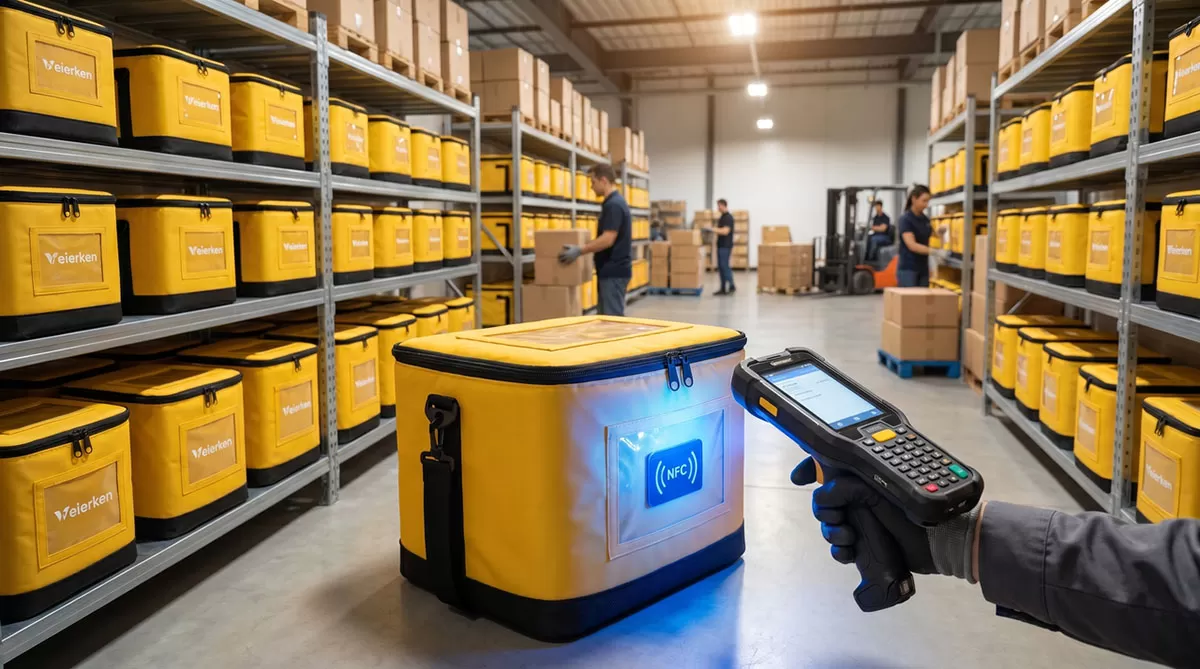
Client challenge: A central-kitchen operator needed more precise insulated bag check-in/check-out tracking to reduce losses and speed up staging.
-
Solution implemented: Weierken added small internal pockets sized for NFC tags inside each insulated bag.
-
Operational impact: More consistent scanning and clearer in/out management across routes and warehouse handoffs.