Waterproof cooler bag technology: the top 5 innovations shaping 2026
LIN XIAO TONG|International Marketing Manager
Blog
If you manufacture, source, or spec waterproof and insulated bags, 2026 feels like a fork in the road.
On one side: customer expectations keep climbing. Waterproof means “no leaks,” not “probably fine in the rain.” Cooler bag performance is judged by hold time, not marketing copy. And a bag that performs in a sample run has to perform again in bulk.
On the other side: materials and compliance rules are changing fast, especially around PFAS. That’s forcing design teams to rethink waterproofing chemistries, seam construction, and test plans.
This guide covers the five innovations that actually change your spec, your bill of materials, or your QC workflow. Not five buzzwords.
How we chose these five innovations
To keep this useful for procurement and product teams, each “innovation” here meets at least one of these criteria:
It’s being driven by a real external constraint (regulation, restricted chemistries, recycled-content requirements)
It changes how water or air moves through the bag (construction, barriers, closures)
It improves performance per unit thickness or weight (insulation stacks)
It improves repeatability at scale (manufacturing controls, testability)
Also: this is an awareness-stage piece. I’m going to talk about what to evaluate and how to validate, not pitch a specific supplier.
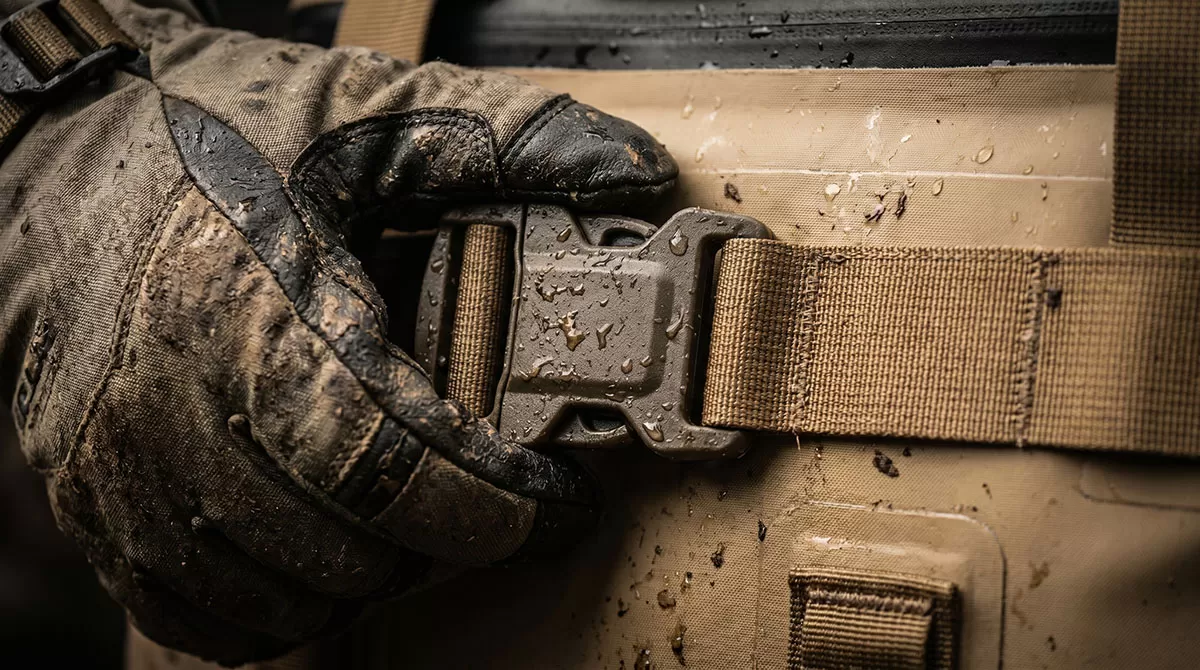
Innovation 1: Functional Hardware Innovation – From Utility to User Experience
For years, hardware components such as buckles, attachment points, and carrying systems were treated as secondary accessories.
In 2026, leading outdoor brands are using hardware innovation as a key product differentiator, improving both functionality and user experience.
Key Innovations
Quick-Release Attachment Systems
Modern outdoor users expect faster transitions between activities.
Quick-release systems allow users to:
Attach or remove accessories in seconds
Switch carrying configurations without tools
Access frequently used gear more efficiently
This type of modular design is increasingly appearing in premium cooler bags, fishing bags, and overlanding equipment.
Modular Carrying Solutions
Rather than a fixed carrying structure, brands are introducing:
Detachable shoulder straps
Interchangeable carrying handles
MOLLE-compatible attachment systems
Expandable accessory modules
These features allow one product to serve multiple outdoor scenarios.
Ergonomic Hardware Design
New generations of hardware focus on:
Reduced hand fatigue
Better grip in wet environments
Improved load distribution
Easier operation while wearing gloves
For outdoor consumers, convenience is becoming just as important as durability.
What Buyers Should Evaluate
When reviewing hardware innovations, ask:
Can the mechanism survive repeated opening and closing cycles?
Does the hardware maintain performance under UV exposure, mud, saltwater, and low temperatures?
Can replacement parts be sourced consistently for future production runs?
Does the design improve user experience or simply add complexity?
The most successful hardware innovations are those that combine durability, simplicity, and measurable improvements in usability.
Innovation 2: Construction-first waterproofing: welded seams and better closures
If you want true waterproof performance, you’re fighting the same enemy every time: holes.
Stitching creates holes. Needle holes are leak paths. Seam tape can fail at edges, curves, and high-flex points. And a great fabric can still leak at the zipper.
That’s why the most important “innovation” in waterproof bags isn’t a new fabric. It’s manufacturing methods that reduce leak paths.
RF-welded seams are moving from niche to expectation in high-seal bags
You’ll hear a few joining terms used loosely. Here’s the practical translation:
RF welding: common for TPU-based constructions; creates a bonded seam without needle holes.
Heat welding / hot-wedge welding: uses heat and pressure to fuse thermoplastic layers.
The value is the same: fewer leak paths, and more repeatable sealing when the process is controlled.
For thermoplastic-based materials (especially TPU-laminated fabric), RF-welded seams can bond layers without stitching. The output is a seam that’s designed to be sealed, not patched after the fact.
OutdoorGearLab’s product testing is a useful signal here. In its field-testing roundup, OutdoorGearLab’s dry bag testing notes discuss designs that use welded seams and waterproof zippers for high water resistance.
You don’t have to build a dry bag to learn from that construction logic. Cooler bags face the same water paths, plus internal meltwater.
Even when a zipper is marketed as waterproof, performance depends on:
slider pressure and alignment
end-stop sealing
contamination (sand, grease)
how the zipper is integrated into the bag body
Some brands use highly engineered zipper systems. For example, YETI describes its HydroLok zipper as built for submersion scenarios in YETI’s HydroLok zipper description.
Treat that link as a reference for how premium brands position waterproof zippers, not as proof that every waterproof zipper performs equally.
What to spec in 2026
For waterproof bags and waterproof cooler bags, the most practical spec changes look like this:
Pick a closure strategy first (zipper vs roll-top vs gasket + latch) based on access needs and risk tolerance.
Define leak paths in the drawing: corners, zipper ends, strap anchors, drain ports.
If you’re sourcing a waterproof cooler bag for bulk production, this is where the “innovation” becomes actionable: specify the seam method, and specify the closure.
Require a seam construction map: welded, taped, sewn, or hybrid.
Innovation 3: Premium insulation stacks: VIPs, aerogels, and temperature stability materials
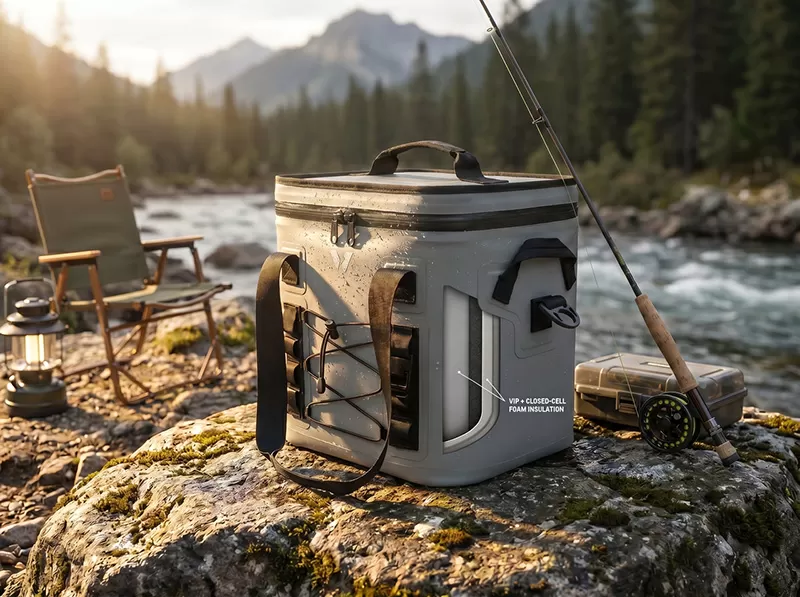
Most cooler bags still win on fundamentals: closed-cell foam insulation plus a leak-resistant liner. That architecture is popular because it’s manufacturable, durable, and cost-effective.
But brands are pushing for two things at the same time:
Longer hold time
Thinner walls and better packability
Those two goals fight each other unless you change the insulation stack.
The baseline isn’t changing: foam plus barrier liner
Closed-cell foam is still the workhorse because it slows conductive heat flow and keeps some performance even when the outer shell gets wet.
What’s changing is how premium bags layer additional thermal barriers to improve performance per millimeter.
Vacuum insulation panels (VIPs): thin, high performance, but fragile
VIPs deliver very high insulation because they remove air (and therefore convection) from the panel core. The upside is obvious: thinner walls can behave like much thicker foam.
The downside is also obvious if you’ve ever had a customer toss a cooler bag into a truck bed.
VIPs can be punctured or damaged in ways that are hard to detect visually.
Edge zones can create thermal bridging.
Integrating VIPs reliably can raise manufacturing complexity.
This is why VIPs tend to show up in premium applications first.
Aerogel blankets: strong insulation, hard scaling story
Aerogel-based insulation is another way to improve performance with less bulk. It can be flexible in blanket form, which is attractive for bags.
Cost and scalable manufacturing are still the main barriers.
Phase change materials (PCMs): not “colder,” but more stable
PCM inserts and panels are used when temperature stability matters more than absolute coldness. They can absorb or release heat at a target temperature range.
That makes them interested in:
grocery delivery
meal kits
dairy
some pharma or wellness products
But PCMs add weight and cost, and they don’t fix poor bag insulation.
What to ask when a supplier claims “next-gen insulation”
Ask questions that force clarity:
Is the insulation improvement coming from thickness, material, or construction?
How does performance change after flexing, drop tests, and repeated use?
What is the temperature retention test method?
If the supplier can’t share the test method, you can’t compare the claim.
Innovation 4: Sustainable technical textiles: recycled nylon and rPET that can still take abuse
Recycled content used to be treated as a branding decision. In 2026, it’s more likely to be written into sourcing requirements.
The trap is assuming that “recycled” is one material category.
Recycled performance depends on:
polymer type (nylon vs polyester)
yarn quality and consistency
denier and weave
coatings/laminates
how reinforcement zones are designed
Recycled nylon (example: ECONYL) and what it signals
ECONYL is a well-known regenerated nylon 6 input made from nylon waste streams. Aquafil positions ECONYL regenerated nylon (Aquafil) as a regenerated material made from 100% nylon waste.
You don’t need to spec ECONYL specifically. But the broader point matters: recycled nylon supply is mature enough that it’s now a credible input for hard-wearing bag shells.
TPU laminates: when you want a barrier, not just repellency
For waterproof and waterproof cooler bags, a TPU laminate can do two jobs:
add a stronger water barrier than a simple DWR
improve abrasion and scuff resistance in some builds
It also changes manufacturability. It can enable welding in places where sewing would create leak paths.
What to request in a 2026 fabric package
Ask for a fabric spec pack that includes:
base fabric details (fiber type, denier, weave)
coating or laminate details (PU vs TPU; thickness)
abrasion and flex performance evidence
recycled-content documentation (especially if you need certifications like GRS)
If your brand has a sustainability mandate, this is also where compliance documentation starts to matter as much as the fabric itself.
Innovation 5: Smart Cooler Design — Temperature Control, Visibility, and Digital Identity
Traditional cooler bags are designed around one core function: keeping contents cold. But as user expectations evolve, the next step is no longer just “better insulation”—it’s intelligent thermal management and visibility built into the product itself.
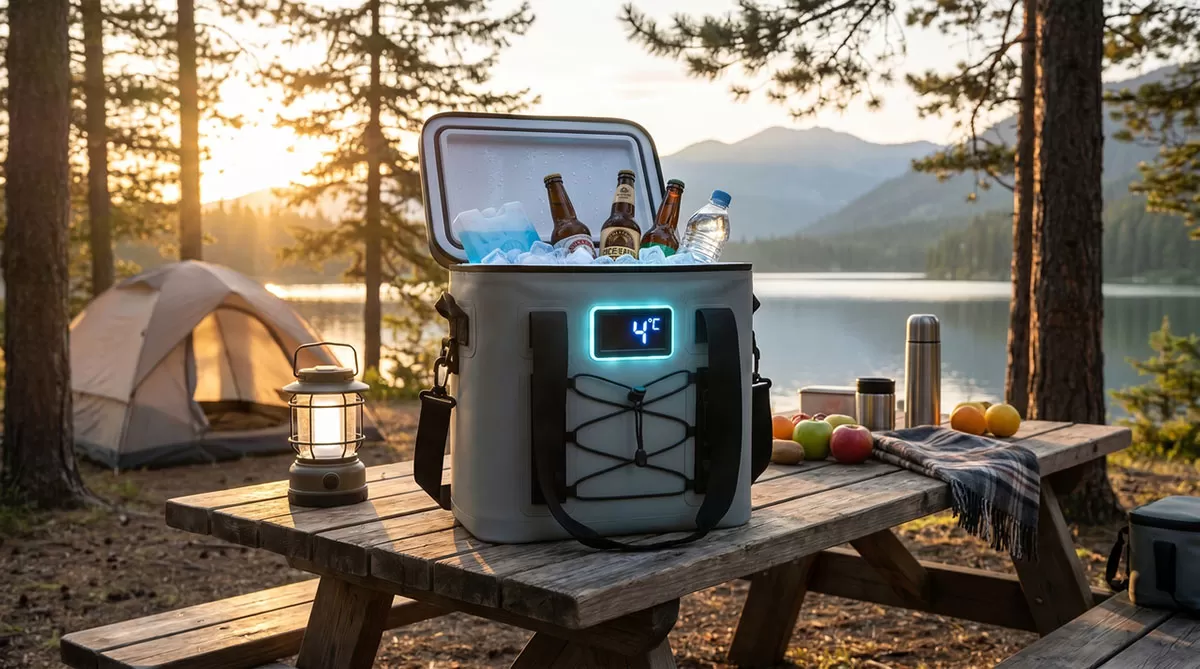
In 2026, the emerging direction is the Smart Cooler: a new generation of insulated bags that can sense, display, and record temperature in real time.
From Passive Insulation to Active Intelligence
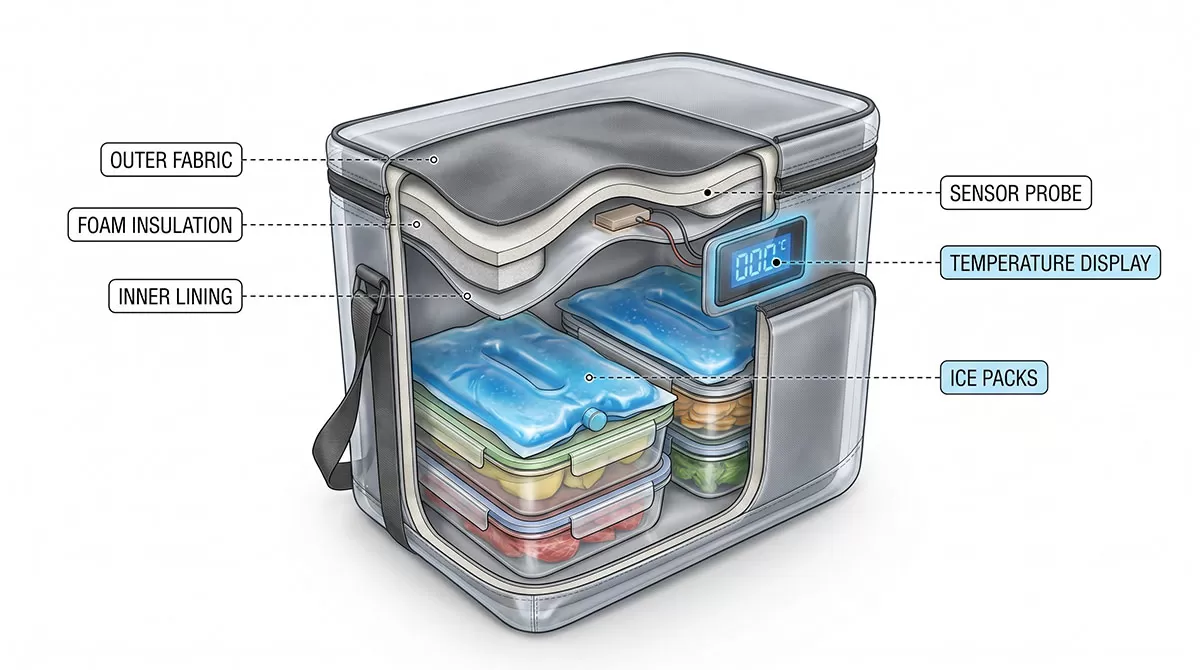
Instead of relying only on foam thickness or zipper sealing, smart coolers integrate lightweight electronic systems that enhance control and transparency:
● Built-in temperature control modulesSome advanced concepts explore micro cooling or assisted temperature stabilization systems, helping maintain a more consistent internal environment rather than relying purely on passive insulation.
● Real-time temperature displayIntegrated LED indicators or compact digital screens allow users to instantly see internal conditions, removing guesswork and improving usability.
● NFC-based digital identityEach unit can be embedded with an NFC tag or digital ID, enabling quick access to stored temperature data or product information via smartphone.
Why This Matters for Product Development
Adding intelligence to a cooler bag is not just about electronics—it changes how the entire product is engineered.
● Sensor integration strategySensors must be positioned to reflect accurate internal conditions, avoiding interference from ice packs, moisture, or external heat zones.
● Protecting electronic modulesSmart components require waterproofing, shock resistance, and long-term durability without compromising insulation performance.
● System-level product architectureThe bag is no longer a single-material product—it becomes a hybrid system combining textiles, insulation layers, and embedded electronics.
● User interaction designClear logic is needed for how users activate, read, and interpret temperature data, ensuring the smart features feel intuitive rather than complex.
The Real Value of Smart Coolers
The purpose of smart integration is not to turn cooler bags into complex devices, but to enhance trust and usability through clear, visible, and verifiable temperature experience.
When done correctly, a smart cooler shifts from being a passive storage product to an interactive, data-aware system that communicates its performance in real time.
A buyer’s evaluation checklist for waterproof cooler bag technology
This is the part most trend posts skip.
If you’re sourcing bags at scale, innovation is only valuable if you can specify it and validate it.
Separate “repellency” from “waterproof” in your spec
Repellency: beads water, looks dry, helps in light rain.
Waterproof: resists ingress under pressure, seams and closures included.
Write both into the spec so suppliers can’t swap them.
Require a closure and seam map
Ask for a simple diagram that shows:
what’s welded
what’s sewn
what’s taped
where reinforcement patches sit
This is where hidden quality risk shows up.
Use a test plan that matches real use
Fabric test alone isn’t enough.
Material: hydrostatic head (HH) concepts help compare shell fabrics.
Finished product: seam leak checks and water ingress exposure.
Cooler performance: a standardized temperature retention method.
Ask for compliance proof, not just promises
If you sell in regions tightening PFAS rules, you need traceable assurance.
Use regulatory context like bluesign’s 2026 PFAS-in-clothing overview as a forcing function to align internal teams: design, QA, procurement, and compliance.
CASE STUDY: Engineering a Premium Soft Cooler for Outdoor Adventures
The Challenge:
A North American outdoor brand approached Weierken to develop a premium soft cooler bag designed for camping, fishing, boating, and overlanding enthusiasts.
The brand faced three key challenges:
• Existing cooler bags were bulky and difficult to carry on long outdoor trips.
• Customers reported water leakage around seams and zipper areas after extended use.
• The product needed to maintain ice retention for extended outdoor activities while remaining lightweight and portable.
The client was looking for a solution that could compete with leading premium outdoor cooler brands while maintaining scalable manufacturing costs.
Our Engineering Solution:
After reviewing the product requirements, our R&D team redesigned the cooler bag from both a thermal performance and waterproof construction perspective.
Key improvements included:
✔ High-Frequency RF Welded Seams
Traditional stitched seams were replaced with RF-welded construction to eliminate needle holes and reduce potential leak paths.
✔ TPU Laminated Waterproof Exterior
A durable TPU-laminated shell was selected to provide waterproof protection, abrasion resistance, and outdoor durability.
✔ Optimized Insulation Structure
The insulation system combined high-density closed-cell foam with strategically reinforced thermal zones to improve ice retention while minimizing overall bulk.
✔ Premium Waterproof Zipper System
A high-performance waterproof zipper was integrated to improve sealing performance in wet outdoor environments such as fishing trips and boating excursions.
✔ Ergonomic Outdoor Design
The shoulder strap system and carry handles were redesigned to improve comfort during hiking, camping, and day-long outdoor activities.
The Result:
Compared with the client's previous-generation cooler bag, the new design achieved:
• Up to 30% longer ice retention under controlled testing conditions
• Improved waterproof performance through welded seam construction
• Reduced product weight without sacrificing durability
• Enhanced user comfort and portability
• Increased customer satisfaction and stronger market positioning in the premium outdoor category
The redesigned cooler bag successfully launched as part of the client's outdoor gear collection and became one of its best-performing seasonal products.
Key Takeaway
In the outdoor market, cooler bag performance is no longer defined by insulation alone.
Successful products combine waterproof construction, thermal efficiency, durability, and user-focused design. By integrating advanced materials, RF welding technology, and outdoor-specific engineering, brands can create cooler bags that perform reliably in real-world adventures while remaining scalable for mass production.
Summary
2026 brings regulatory pressure, higher customer expectations, and new materials. Buyers need a clear specification and validation plan.
Weierken combines material expertise, manufacturing controls, and smart solutions to deliver consistent, PFAS-free, high-performance cooler bags at scale.
About Weierken
At Weierken, we help brands turn product concepts into scalable manufacturing solutions through:
✔ R&D-driven product development
✔ RF welding and waterproof construction expertise
✔ Quality control from sampling to mass production
YOUTUBE Link:
FAQ
Q1: What is the critical distinction between "water-repellent" and "waterproof" in 2026 product specifications?
A:Water-repellent (Repellency): Refers to a fabric treated with a chemical coating (like DWR) that causes water to bead up and roll off. It performs fine in light rain but cannot withstand hydrostatic pressure. It will inevitably leak at sewn seams and standard zippers under sustained wet conditions.
Waterproof: Means the finished product resists water ingress under pressure (often measured by Hydrostatic Head). This requires both a highly impermeable base material (such as a TPU laminate) and specialized construction—such as stitchless RF-welded seams and airtight/waterproof zippers or roll-top closures—to completely eliminate water leak paths.
Q2: Why are premium brands shifting from "sewn-and-taped" seams to RF Welding (Radio Frequency Welding) for bulk production?
A: Stitching inherently creates holes. While seam tape seals these needle punctures initially, tape is prone to peeling, cracking, and degradation over time, particularly at sharp corners, curves, and high-flex stress points. RF Welding uses electromagnetic energy to fuse thermoplastic layers (like TPU) at the molecular level. This creates a monolithic bond with zero needle holes, drastically reducing the risk of internal meltwater leaking out or external moisture leaking in. It also provides a much higher level of repeatability and quality control at scale.
Q3: What are the main integration and quality risks when specifying waterproof zippers?
A: Zippers are where waterproof specs are most vulnerable. A zipper's real-world performance depends less on marketing claims and more on precise manufacturing integration. Buyers must evaluate:
Slider pressure and alignment consistency during repeated cycles.
The technology used for end-stop sealing (where most leaks occur).
Vulnerability to environmental contamination (sand, saltwater, grease).
How the zipper tape is bonded to the main bag body (welded vs. sewn). When sourcing, always request field-testing data or water-submersion test reports for the finished closure assembly.
Q4: If a brand wants to increase cooler bag hold times without adding bulk or thickness, what advanced insulation options should be evaluated?
A: While closed-cell foam remains the reliable, cost-effective baseline, three advanced technologies are emerging for premium applications, each with distinct trade-offs:
Vacuum Insulation Panels (VIPs): Offer exceptionally high thermal resistance per millimeter, allowing for much thinner walls. However, they are fragile; if a panel is punctured during rugged outdoor use, its thermal performance drops significantly.
Aerogel Blankets: Provide high thermal efficiency in a flexible format, making them highly attractive for premium bags, though material cost and scalable assembly remain challenges.
Phase Change Materials (PCMs): Ideal for precise temperature stability (e.g., medical cold chains or specialized grocery delivery), but they add weight and cost and do not replace the need for high-quality passive insulation.
Note: For most rugged outdoor cooler bags, the most practical premium stack is an optimized combination of high-density closed-cell foam, strategic thermal zoning, and a high-performance TPU liner.
Q5: What is a "Smart Cooler," and how does it impact the product engineering process?
A: A Smart Cooler shifts the product from passive insulation to intelligent thermal management by integrating lightweight electronics. Key features include:
Real-Time Temperature Monitoring: Built-in digital displays or LED indicators that show internal conditions without requiring the user to open the bag.
NFC/Digital Identity: Embedded NFC tags that allow users or logistics teams to scan the bag with a smartphone to access temperature logs, authenticity data, or product info.
The Engineering Impact: This transforms a soft-goods product into a hybrid system. Engineering teams must strategically place sensors to avoid ice/moisture interference and protect electronic modules from shocks and water ingress without creating thermal bridges that compromise insulation.
Q6: What specific technical documentation should a procurement team demand from a factory during the RFQ/sampling stage?
A: To eliminate quality risks prior to mass production, you should require:
A Seam Construction Map: A clear diagram defining exactly which zones are welded, sewn, taped, or hybrid, alongside reinforcement patch layouts for heavy load-bearing anchors.
A Fabric Tech Pack: Full specifications of the base fabric (fiber type, denier, weave), coating/laminate thickness (PU vs. TPU), and standardized abrasion/flex test data.
Standardized Test Protocols: The exact methodologies used to verify hydrostatic head (HH) for waterproofing and ice retention (Hold Time) for insulation.
Q7: How does Weierken support brands navigating these technical transitions for 2026?
A: As an R&D-driven manufacturer, Weierken bridges the gap between complex engineering concepts and scalable mass production through:
Waterproof & RF Welding Expertise: Specialized tooling and process controls that eliminate leak paths in complex soft-cooler and dry-bag architectures.
Regulatory Compliance: A fully vetted supply chain capable of delivering high-performance, PFAS-free materials and certified recycled textiles.
Dual-Regional Manufacturing: Production facilities in both China and Cambodia, offering brands supply chain flexibility, capacity scaling, and tariff mitigation strategies.
End-to-End Quality Assurance: Rigorous testing from initial prototyping and material stress-testing through to final bulk production quality control.
Next steps (if you’re turning these innovations into a 2026 sourcing spec)
If you want to turn this into a supplier-ready requirements package, start by browsing current build options and then narrowing your spec:
Explore Weierken cooler bags to see common structures, materials, and formats.
If you’re evaluating manufacturing repeatability, review Weierken manufacturing and Weierken customization to align on process, documentation, and sample-to-bulk controls.
If you already know your bag category and target use case, you can also route directly to Weierken OEM or Weierken ODM to frame how much design support you want.