
Market Context: Why Bulk Cooler Demand Is Rising
Quick Comparison: Technical and Strategic Metrics
| Strategic Metric | Soft Cooler Bags (High-Performance) | Hard Coolers (Rotomolded) |
| Core Manufacturing Process | RF Welding (Radio Frequency) / Sewing | Rotomolding (Rotational Molding) |
| Primary Materials | TPU Coated Fabric, 840D Nylon, rPET | LLDPE (Linear Low-Density Polyethylene) |
| Insulation Technology | NBR Foam / EPE Foam (Closed-cell) | PU Foam (Polyurethane injection) |
| Ice Retention Window | 24 to 72 Hours | 3 to 10+ Days |
| Upfront Tooling Cost | Moderate (Precision dies for RF welding) | Exceptionally High (Heavy steel/aluminum molds) |
| Shipping & Storage Efficiency | High (Collapsible, lower volumetric weight) | Low (Fixed dimensions, high dead space) |
| 2026 Consumer Trends | Kayaking, SUP, Overlanding, Urban Day-trips | Off-grid Camping, Fishing, Hunting, RVing |
Deep Dive for Product Managers: Choosing Your Next SKU
Option A: High-Performance Soft Cooler Bags
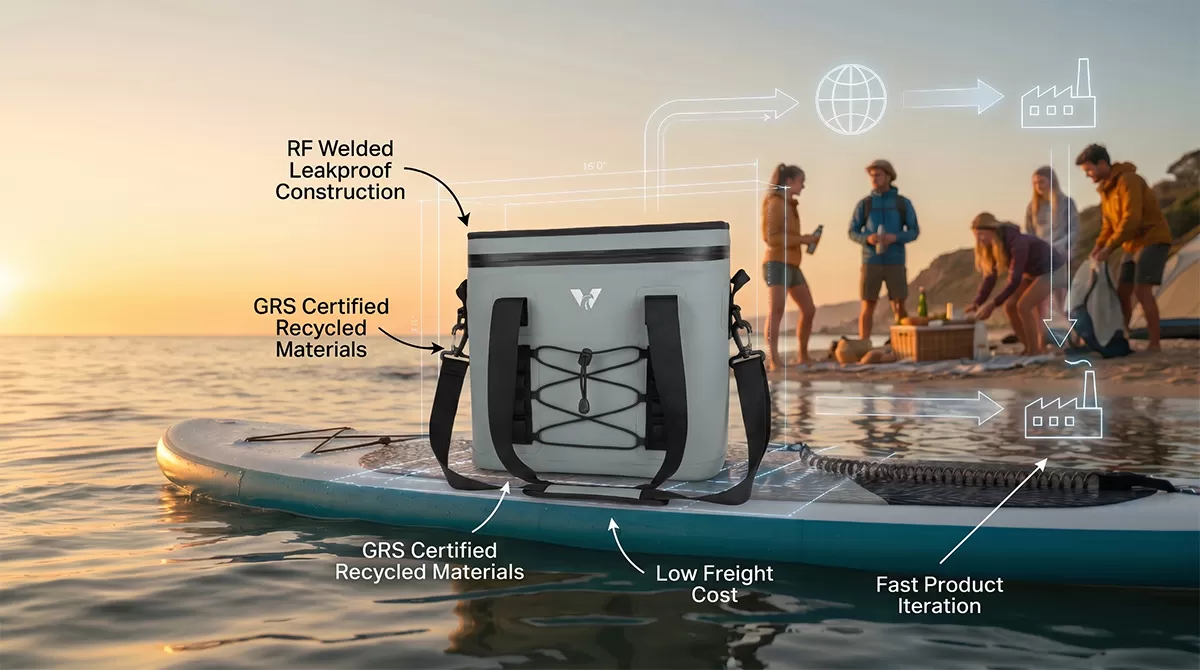
Advanced Waterproof Barriers: Modern premium soft coolers rely on RF welding (Radio Frequency welding) instead of traditional sewing. This melts the TPU (Thermoplastic Polyurethane) fabrics together, creating 100% leakproof, airtight seams. Combined with airtight zippers, these bags can literally float on water, making them perfect for paddleboarders and surfers.
The 2026 Eco-Advantage (GRS & rPET): Consumers demand sustainability. Today’s top-tier B2B trading factories can supply GRS (Global Recycled Standard) certified recycled polyester (rPET) for exterior shells without sacrificing hydrostatic head (waterproofness) or abrasion resistance.
Logistical Efficiency: From a supply chain perspective, soft coolers can be flattened or nested during maritime shipping. This drastically reduces your ocean freight costs per unit and optimizes your warehouse footprint.
Option B: Rotomolded Hard Coolers
Unmatched Ice Retention: Utilizing thick walls injected with high-density polyurethane (PU) foam, rotomolded hard coolers can retain ice for over a week under extreme conditions.
Virtually Indestructible: The rotational molding process ensures uniform wall thickness and stress-free corners. These coolers can withstand bear encounters, heavy drops, and double as rugged camp benches.
The Capital Barrier: PMs must note that the tooling cost for a single rotomolded cooler size can exceed tens of thousands of dollars. The development cycle is significantly longer, and the high volumetric weight means shipping costs consume a larger percentage of your product's margin.
Product Architecture Determines Business Complexity
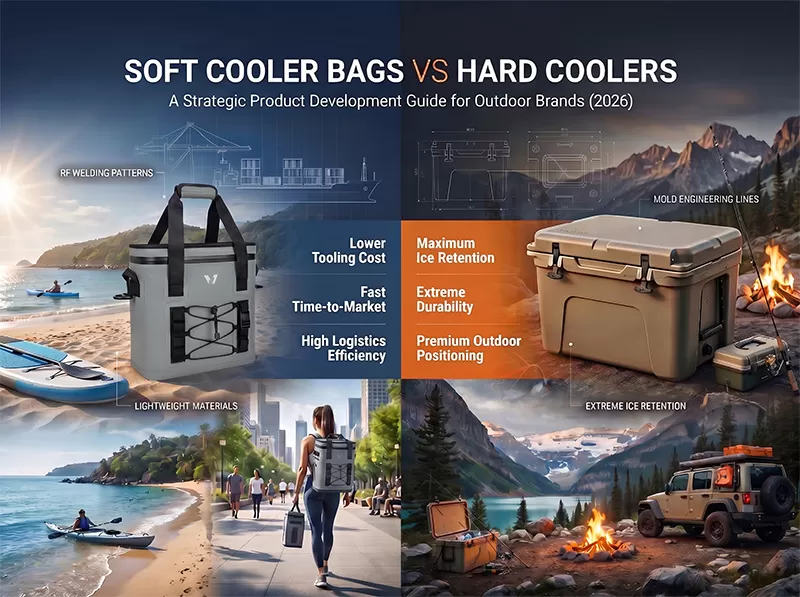
At first glance, both categories appear to solve the same problem: thermal insulation and portable cooling. But from an engineering and manufacturing perspective, they operate almost like entirely different industries.
Soft Cooler Bags: Textile-Based Product Engineering
Outdoor bags
Travel gear
Waterproof luggage
Tactical packs
Exterior fabrics such as TPU, Oxford polyester, or recycled PET
Thermal insulation foams
Leakproof PEVA or TPU liners
Reinforced stitching or heat-welded seams
Change exterior fabrics
Introduce new colorways
Adjust insulation thickness
Add modular pockets
Modify carrying systems
Introduce seasonal variants
New silhouettes
Limited-edition collaborations
Regional color preferences
Different fabric textures
Eco-material collections
This flexibility is particularly valuable in today’s trend-sensitive outdoor market, where consumer preferences evolve rapidly through social media exposure and short product cycles.
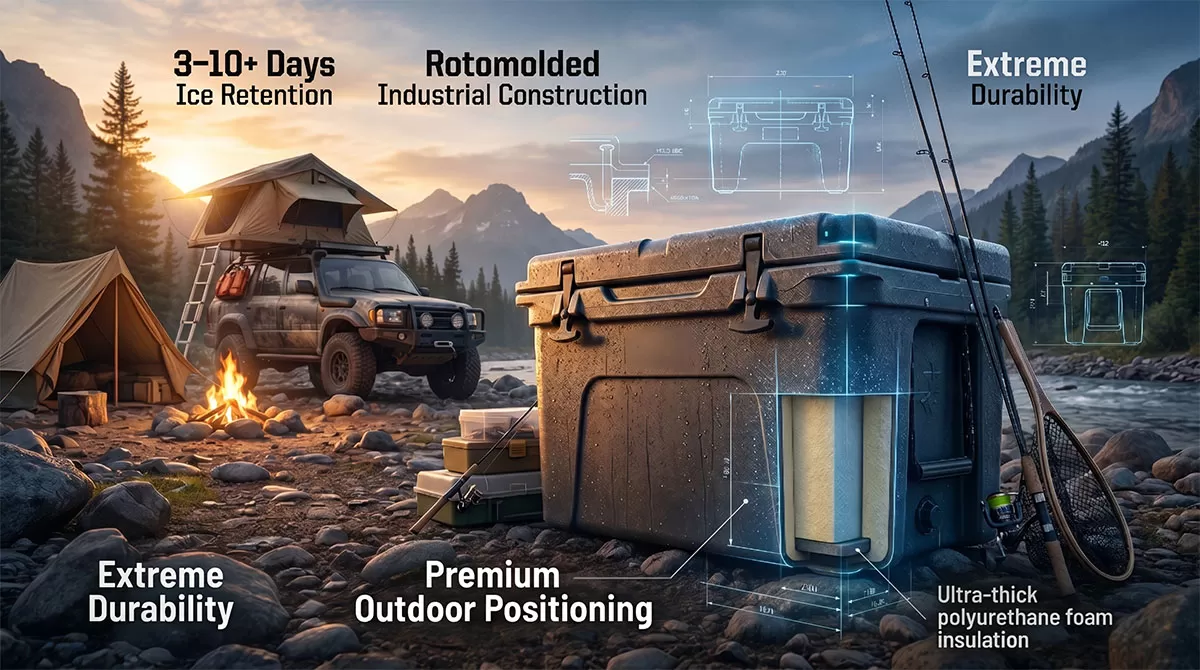
Hard Coolers: Industrial Manufacturing Systems
Large molds
Precision temperature control
Pressure-managed insulation foaming
Structural stress engineering
Complex hinge and sealing systems
New mold development
Re-engineered structural testing
Revised tooling calibration
Additional production validation
Long-term demand forecasting
Retail placement stability
Inventory turnover expectations
Distribution channel consistency
Quick Decision Matrix for Procurement Managers
| If your priority is… | Recommended choice |
| Lowest total landed cost per unit | Soft cooler |
| Compact storage and low freight | Soft cooler |
| Bulk distribution for marketing campaigns | Soft cooler |
| Custom logo visibility at scale | Soft cooler/Hard cooler |
| Ice retention beyond 2 days | Hard cooler |
| Extreme outdoor/industrial durability | Hard cooler |
| Bear‑resistant or marine‑grade certification | Hard cooler |
Supply Chain Feasibility & Financial Assessment
Minimum Order Quantities (MOQ) vs. Tooling Costs
Factory Compliance and Audits
Customization & Co-Branding Elasticity
R&D Costs & Manufacturing Complexity Breakdown
High-Performance Soft Coolers (Material Stacking & RF Precision)
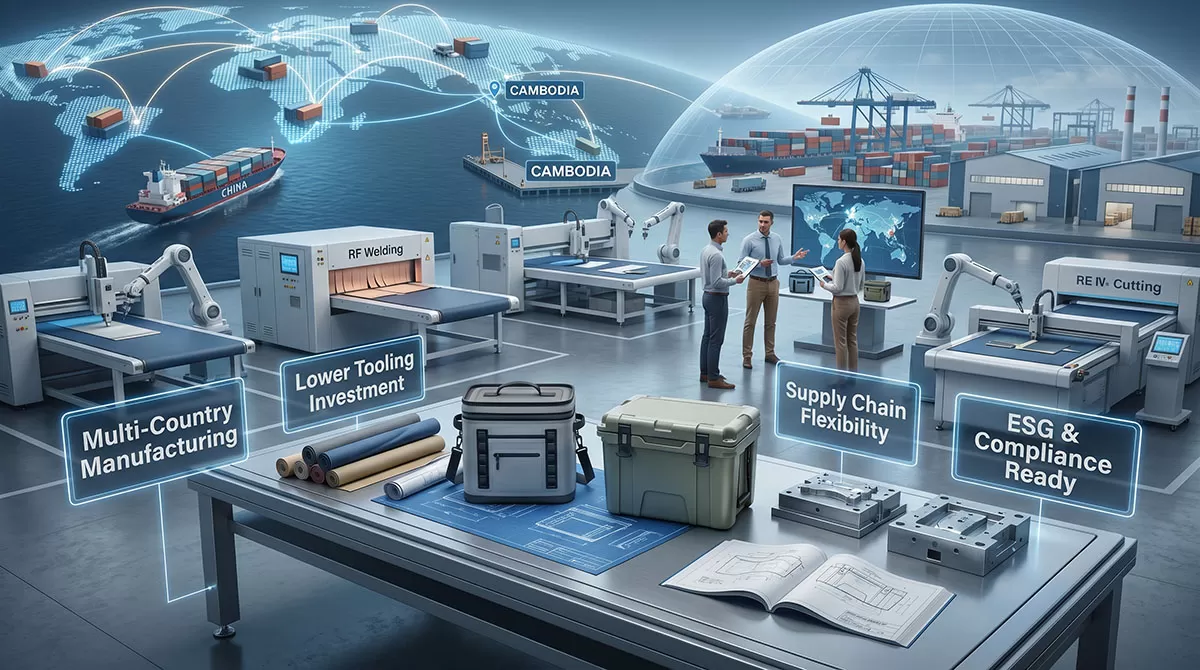
Tooling Capital (CapEx): Relatively accessible. Custom tooling for high-frequency Radio Frequency (RF) welding dies and automated laser-cutting templates typically ranges from $3,000 to $6,000 per bag geometry.
Production Costs (OpEx): High. Premium components like 100% airtight, waterproof zippers often account for over 20% of the total Bill of Materials (BOM). Furthermore, RF welding demands meticulous manual alignment by skilled technicians before heat-sealing, driving up labor hours per unit compared to fully automated lines.
R&D Engineering Focus: Controlling "Thermal Bridging." R&D teams must mathematically calculate the nesting density of closed-cell NBR/EPE foam at the corner junctions. If the foam gaps are too wide near the welded seams, cold air quickly escapes, ruining the ice retention rating.
Rotomolded Hard Coolers (Heavy Tooling & Volumetric Uniformity)
Tooling Capital (CapEx): Exceptionally high. A single mid-sized (e.g., 45-Quart) CNC-machined aluminum or cast aluminum mold costs between $25,000 and $75,000+. This includes machining the tight tolerances required for integrated drain valves, interlocking hinges, and silicone rubber gasket tracks.
Production Costs (OpEx): Highly predictable. Linear Low-Density Polyethylene (LLDPE) powder is loaded into multi-axis rotational machines, melting evenly across the mold walls via automated heating/cooling cycles. Manual labor is strictly restricted to secondary trimming and the high-pressure injection of two-part liquid Polyurethane (PU) foam.
R&D Engineering Focus: Uniform Wall Thickness. If a mold’s internal radii (corners) are incorrectly engineered, the polymer resin will pool unevenly, causing thin spots in the outer shell that create thermal blind spots and structural weak points.
Case Study:
Weekend road trips
Beach activities
Urban picnics
Short camping excursions
Festival and outdoor event usage
Global Market Trends Impacting Product Roadmaps
Trend 1: "Micro-Vacations" Spark a Surge in Compact Capacities
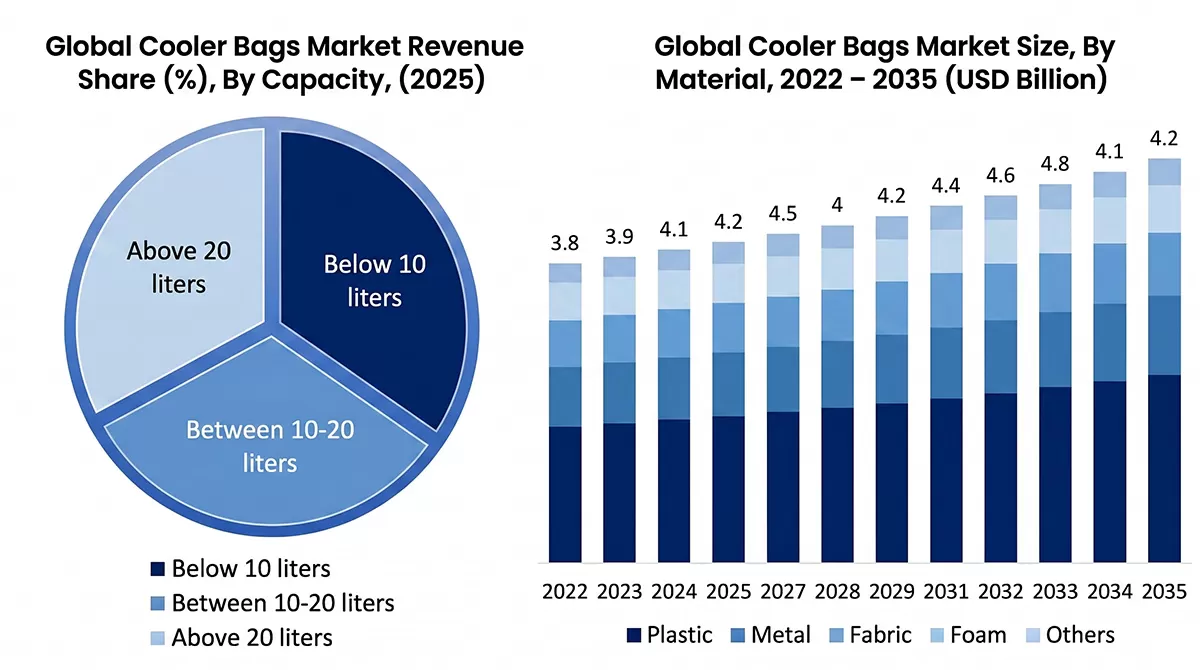
The Data: The global retail cooler market is experiencing a profound shift toward mobility. While multi-day family camping maintains baseline volumes, personal-use coolers with capacities below 25 quarts are expanding rapidly, fueled by an 11.2% CAGR.
The Product Insight: Consumers are favoring shorter, high-frequency outdoor experiences—such as single-day paddleboarding (SUP), beach trips, or afternoon picnics. This lifestyle shift directly favors Soft Cooler Bags. Their lightweight profiles, ergonomic backpack straps, and "Gorpcore" tech-wear aesthetics make them high-turnover lifestyle accessories compared to bulky traditional ice chests.
Trend 2: Sustainability Transitioning from "Nice-to-Have" to a Regulatory Gatekeeper
The Data: Sustainable outdoor gear has officially moved mainstream, capturing over 25% of the total market share. Industry studies show 62% of core outdoor consumers prioritize brands that utilize verified recycled materials, with many willing to pay up to a 15% green premium.
The Product Insight: For soft coolers, utilizing GRS (Global Recycled Standard) certified rPET for exterior shells paired with eco-friendly TPU coatings (moving away from toxic PVC) is no longer just a marketing narrative. It is a mandatory compliance requirement to clear customs and secure shelf space at premium global retailers like REI or MEC.
Trend 3: Supply Chain De-Risking via Multi-Country Manufacturing
The Data: Volatile global tariff environments and geopolitical trade tensions have made international procurement managers highly risk-averse.
The Product Insight: Soft coolers offer supreme manufacturing agility. Because the production machinery is modular compared to massive rotomolding ovens, leading OEM/ODM suppliers can easily distribute production across a multi-country footprint (e.g., China, Vietnam, and Cambodia). This allows brands to shift production dynamically to mitigate tariff penalties and safeguard profit margins.
Conclusion
Supply chain efficiency
Speed-to-market
Consumer lifestyle alignment
ESG adaptability
Inventory flexibility
Operational scalability
FAQ
Q1: What is the main structural difference in ice retention between soft and hard coolers?
Q2: Why is RF Welding preferred over traditional stitching for high-end soft coolers?
Q3: How do tooling costs (CapEx) and development cycles compare when launching a new cooler line?
| Financial & Development Metric | Soft Cooler Bags (High-Performance) | Hard Coolers (Rotomolded) |
| Initial Tooling Cost (CapEx) | Low to Moderate ($3,000 - $6,000 for precision RF welding dies) | Exceptionally High ($25,000 - $75,000+ for CNC aluminum molds) |
| Development Lead Time | Short (3 to 5 months from blueprint to mass production) | Long (6 to 10+ months due to complex mold testing and tuning) |
| Minimum Order Quantity (MOQ) | Higher per-run fabric requirements (typically 500-1000 pcs) | Lower per-run limits once molds are paid (typically 200-500 pcs) |
| Product Iteration Agility | High. Modifying pockets, straps, or aesthetics requires minimal tooling adjustment. | Low. Any dimensional change requires a costly complete rewrite of the metal mold. |
Q4: Can high-performance soft cooler bags meet strict ESG and GRS certifications?
Q5: How do logistics and tariff risks impact the total cost of ownership (TCO) for global procurement?
| Logistical Risk Factor | Soft Cooler Bags (High-Performance) | Hard Coolers (Rotomolded) |
| Container Loading Efficiency | Maximum. Can be flattened, nested, or vacuum-packed. Zero wasted container volume. | Poor. Rigid, hollow shapes mean you pay premium ocean freight to transport "trapped air." |
| Storage & Warehousing Footprint | Low. Disassembled or flat-packed inventory maximizes pallet density. | High. Fixed 3D dimensions demand massive warehouse shelf space before sale. |
| Tariff Mitigation (Supply Chain) | Highly Flexible. Can be seamlessly shifted to fully audited factories in Vietnam or Cambodia to bypass country-specific tariffs. | Restricted. Rotomolding heavy machinery setup is capital-intensive and harder to relocate quickly. |
| Impact on Landed Cost Margin | Freight adds a small percentage to the per-unit cost. | Freight and logistics can swallow up to 25-35% of the total landed cost. |
Partner With Weierken — Your OEM/ODM Cooler Bag Manufacturing Partner
Production scalability
Tariff efficiency
Freight cost control
Faster lead times
Flexible MOQ strategies
RF welding and heat-sealed waterproof construction
Leakproof TPU soft coolers
High-density thermal insulation systems
Custom embroidery and full-surface printing
Private label packaging solutions
Outdoor-grade waterproof materials
Lightweight backpack coolers
Beach and camping cooler bags
Roll-top waterproof coolers
Promotional insulated products
Premium outdoor soft coolers